
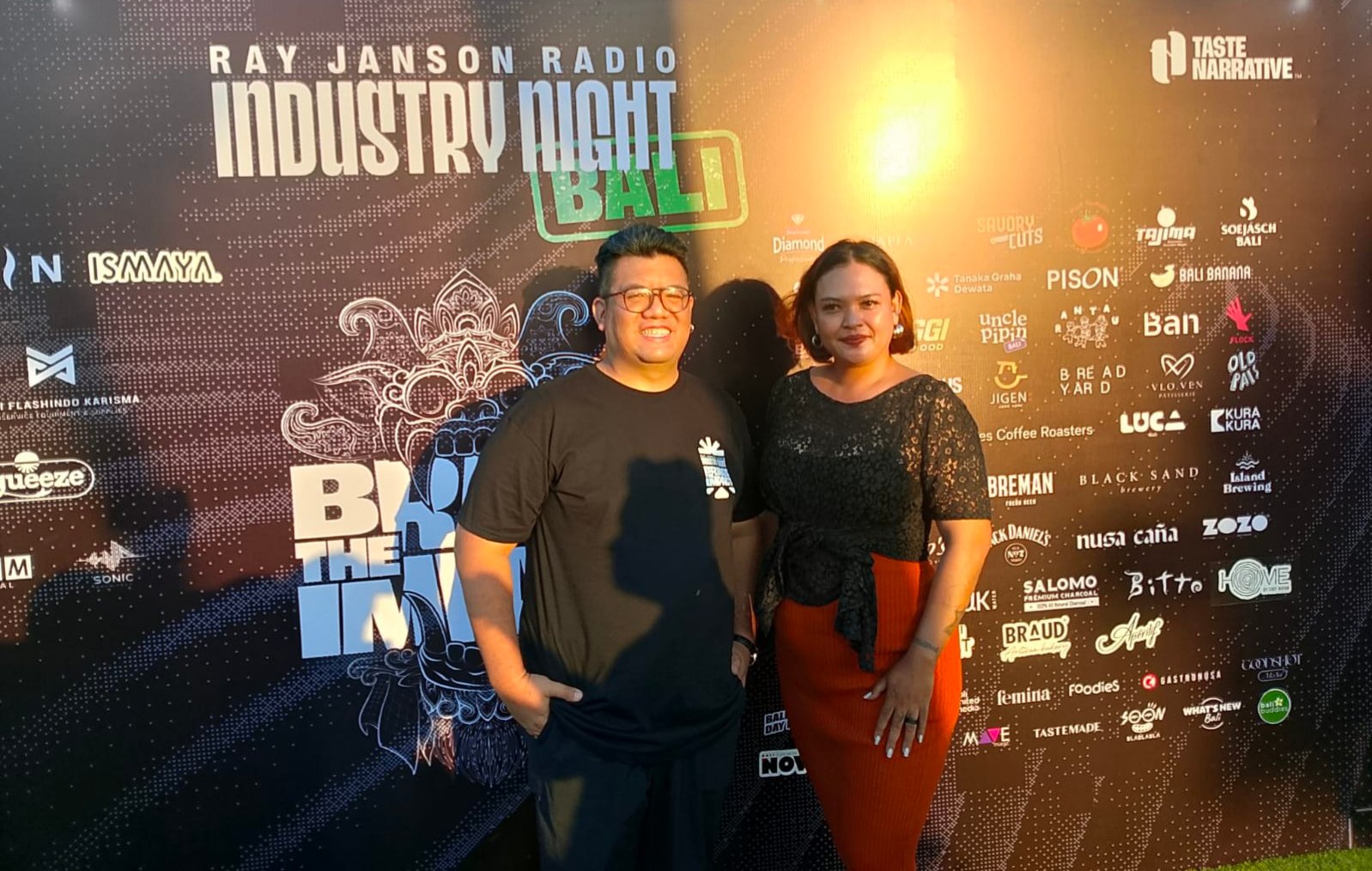
BALINEWSID.COM, KUTA — Kuta is showing signs of a new awakening—not simply through the return of tourists, but through a powerful gathering of local and national food and beverage (F&B) industry players who are turning the iconic destination into a meeting point for ideas, business, creativity, culture, and collaboration.
As many as 85 F&B companies took part in the KutaKita Festival, which this year joined forces with Ray Janson Radio Industry Night. Thousands of industry professionals and visitors filled the areas surrounding Discovery Kartika Plaza Hotel and Discovery Kartika Plaza Mall on Monday evening, August 10, 2026.
The event brought together a broad spectrum of the F&B ecosystem, including restaurant and bar owners, chefs, bartenders, baristas, suppliers, distributors, and micro, small, and medium-sized enterprises (MSMEs).
For Ray Janson, chef and founder of Ray Janson Radio Industry Night, the gathering was about far more than celebrating the industry.
It was designed as a platform for building connections, opening doors to new partnerships, exchanging knowledge and experience, and connecting entrepreneurs with potential investors.
“This is Ray Janson Radio Industry Night. We are bringing together people from across the F&B industry—chefs, baristas, bartenders, suppliers, distributors, and business owners. It is held once a year and has now been running for four years,” Ray Janson said.
The response exceeded expectations. The initial target was approximately 1,000 participants, but reservations reached around 2,000 people.
The surge in interest reflects a growing need within the F&B sector for face-to-face interaction, stronger professional networks, and new opportunities for collaboration.
Ray Janson said the Industry Night originally began as a gathering of only a few dozen people. As interest grew, it evolved into an annual industry event attracting professionals from across Bali and other parts of Indonesia.
“This event has become increasingly important as a platform for collaboration, learning from one another, building F&B industry networks, finding new investors, and creating other business opportunities,” he said.
Bringing the F&B Industry Back to Local Roots
Bali was chosen as the venue for the gathering for a reason. Beyond its global tourism reputation, the island possesses enormous cultural, culinary, and creative strengths, as well as a rich base of local economic potential.
For that reason, Ray Janson Industry Night incorporated elements of Balinese culture, including Mebat, a traditional communal cooking activity deeply rooted in Balinese social life.
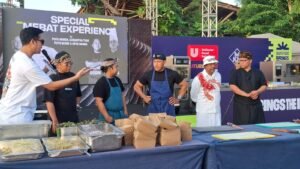
The Mebat session involved several Balinese culinary figures, including Jero Mangku and Chef Yudi of Dapur Bali Mule in Tejakula. Chef Yudi reportedly traveled for approximately five hours to take part in the event.
Visitors were also presented with cooking demonstrations featuring locally sourced ingredients and traditional Balinese dishes.
The initiative carried a broader message about one of the challenges facing the F&B sector: dependence on imported ingredients and rising food costs.
The message was straightforward but significant: Indonesia’s F&B industry does not always have to rely on imported ingredients when the country possesses such an extraordinary abundance of local produce, traditional ingredients, and culinary heritage.
By placing local ingredients and culinary traditions at the center of an international-facing industry gathering, the event demonstrated that cultural heritage and modern business networking can reinforce one another.
KutaKita’s Mission: Bringing Kuta Back to Life
Meanwhile, Damiyana Petracia, Vice Chairperson of KutaKita at Discovery Kartika Plaza Hotel, said the festival was built around openness and collaboration.
The KutaKita Festival, hosted across Discovery Kartika Plaza Hotel and Discovery Kartika Plaza Mall, is scheduled to continue through January 15, 2027.
“We are open to collaborating with everyone. F&B is an industry, and Ray Janson Radio Industry Night is one of the biggest gatherings. We provide opportunities to support one another—from venues and sponsors to venue partnerships, talent, and networking. Everything comes together here,” Damiyana said.
According to Damiyana, KutaKita has a much larger ambition than simply hosting a festival.
Its central mission is to help restore Kuta as a vibrant, creative, dynamic destination—a place where communities, businesses, artists, entrepreneurs, and industries can meet and create new opportunities.
“The main goal of the KutaKita Festival is to make Kuta like it used to be—busy again, rising again, and alive again,” she said.
Discovery Kartika Plaza Hotel has also opened its helipad area, which can accommodate approximately 1,500 people for a single event. The space is being made available for activities that can generate wider economic and social benefits for the Kuta area.
The opportunities extend beyond F&B. KutaKita is also opening its doors to corporate social responsibility programs, tourism initiatives, arts and cultural activities, community gatherings, and other creative events.
85 Companies, Thousands of People, One Message: Kuta Must Rise Again
The participation of 85 F&B companies and thousands of attendees at Ray Janson Radio Industry Night offers a powerful indication that Kuta still possesses the ability to serve as a meeting point for businesses, communities, and creative industries.
But the significance of the event goes beyond attendance figures.
It demonstrates how a tourism destination can begin to regenerate itself when industries, communities, cultural traditions, and creative energy are brought together in one space.
F&B professionals from Bali and other parts of Indonesia reconnected. MSMEs gained opportunities to expand their markets. Chefs and bartenders exchanged knowledge and experience. Suppliers and distributors developed new business networks. Business owners explored potential partnerships. And potential investors found opportunities through connections that might otherwise never have been made.
For Damiyana, creating those connections is precisely one of KutaKita’s objectives.
“Having the F&B industry networking event here makes us truly happy. Many people from across Bali and nationally are coming together again. We genuinely support MSMEs in continuing to rise and expand their market networks. Through the KutaKita Festival, we are opening opportunities for MSMEs and F&B businesses to collaborate and build stronger networks,” she said.
KutaKita is therefore becoming more than a festival.
It is evolving into a social and economic experiment—an effort to demonstrate how a destination can regain its vitality when physical spaces, businesses, communities, culture, and creativity are brought together.
In an increasingly competitive tourism industry, Kuta’s revival may not depend solely on how many tourists arrive.
It may depend just as much on how many people are willing to come together, create opportunities, collaborate, and generate meaningful impact.
And from Kuta, a message is emerging once again:
When an industry moves together, a destination can come alive again.

Discussion (0)
No comments yet.