
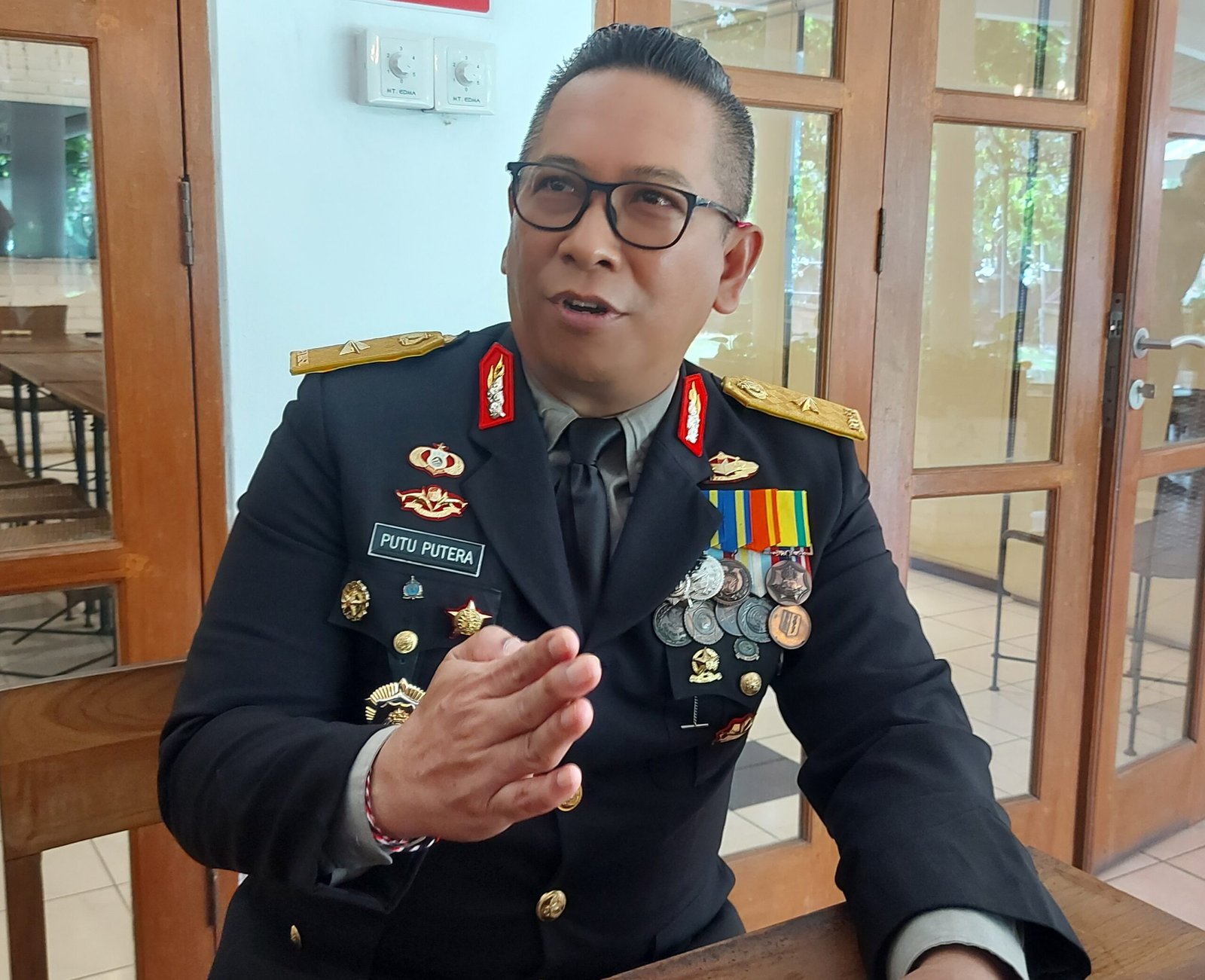
BALINEWSID.COM, DENPASAR — The National Narcotics Agency (BNN) of Bali Province has raised concerns over the growing involvement of children and teenagers in drug trafficking networks following the arrest of a 15-year-old boy allegedly carrying 98.80 grams of crystal methamphetamine in Denpasar.
BNN Bali Chief Brigjen. Pol. Dr. Putu Putera Sadana stressed that children involved in narcotics cases cannot be treated in the same manner as adults. Their cases must prioritize child protection, assessment and law enforcement in accordance with applicable regulations.
“Adults and children cannot simply be treated the same,” Putu said in Denpasar on Monday (Aug. 17, 2026).
His statement came in response to the case involving AAN, a 15-year-old from West Denpasar who was arrested by the Bali Police Narcotics Investigation Directorate. Police reportedly seized 98.80 grams of methamphetamine from the trunk of the motorcycle used by the teenager.
During the initial investigation, AAN allegedly told investigators that he had been instructed by a person identified by the initial B to collect the drugs through a so-called “drop-off” system. Police also found WhatsApp contacts allegedly linked to the person who instructed him.
The Bali Police are continuing to investigate the case to identify other individuals who may have recruited or exploited the teenager as part of a drug trafficking network.
Putu said cases involving children suspected of serving as drug couriers require cooperation among multiple institutions. Law enforcement agencies must work together with the police’s Women and Children Protection Unit and relevant government ministries.
“If there is an indication that a child has been used as a courier, this requires cooperation with the relevant ministries. The police also have a Women and Children Protection Unit,” he said.
According to Putu, the involvement of children in drug distribution demonstrates that combating narcotics cannot rely solely on arrests and law enforcement. Prevention must begin with the child’s closest environment, particularly the family.
“Parents must be more concerned and pay attention to their children at home and in their surroundings, including at school, especially for those who are still minors,” he said.
BNN Bali is urging parents to strengthen supervision of their children’s activities, friendships and social environments. The public is also encouraged not to ignore signs that children may be using drugs or becoming involved in narcotics abuse or trafficking.
Putu said BNN has an assessment team that can determine the appropriate course of action for children suspected of being involved in narcotics cases.
Regarding the 15-year-old arrested by the Bali Police, Putu said he had not yet received confirmation as to whether the teenager had been referred to BNN Bali for an assessment.
“I do not know yet whether it has been conducted. When he is referred to us for assessment, we will carry it out,” he said.
Putu also warned that narcotics threats targeting young people are becoming increasingly complex. Drug trafficking methods and forms of narcotics continue to evolve, including substances in liquid form that can potentially be concealed in devices such as electronic cigarettes.
The development presents a new challenge for prevention efforts, particularly because children and teenagers remain vulnerable to exploitation by drug trafficking networks.
BNN Bali therefore supports drug-prevention education from an early age, with educational materials and methods adapted to students’ stages of development, from kindergarten and elementary school to junior and senior high school and university.
“Starting from elementary and junior high school, education must be provided according to age. Kindergarten, elementary school and junior high school students require different approaches. The same applies to university students,” Putu said.
BNN Bali is also implementing a cross-generational approach targeting different age groups, including Baby Boomers, Millennials, Generation Z and Generation Alpha.
“All generations must receive educational, informative and objective information,” Putu stressed.
Putu said BNN Bali would continue to pursue two main strategies to break the chain of narcotics distribution: prevention through education and public awareness, and eradication through law enforcement.
However, when children become entangled in narcotics networks, he emphasized that their protection must not be overlooked.
The case of the 15-year-old allegedly carrying nearly 100 grams of methamphetamine is a stark reminder that drug networks do not only target adult users but can also exploit children as part of their distribution chains.
BNN Bali stressed that breaking this chain requires joint action by families, schools, communities, law enforcement agencies and child-protection institutions.
Children must be protected from narcotics networks, while adult actors suspected of exploiting minors must be identified and brought to justice.





Discussion (0)
No comments yet.