
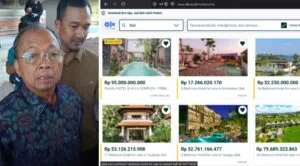
BALINEWSID.COM, DENPASAR — A total of 244 hotels and villas in Bali have been observed being offered for sale through property marketplace platforms. Amid the growing number of accommodation properties entering the sales market, Bali Governor Wayan Koster said the government’s efforts to regulate unlicensed accommodation businesses were beginning to encourage villa owners to obtain the required permits.
Koster said that 5,000 villa businesses had applied for permits during 2025–2026. He made the statement during a plenary meeting of the Bali Provincial Legislative Council (DPRD Bali) on Monday, September 21, 2026.
“Throughout 2025–2026, 5,000 villa businesses applied for permits,” Koster said.
According to Koster, one of the factors driving the increase in permit applications was the government’s policy of stopping the marketing of unlicensed tourism accommodation through online travel agents (OTAs).
He said OTAs were no longer listing accommodation properties that failed to meet licensing requirements. As a result, tourists booking accommodation through these platforms were being directed toward properties with the necessary legal permits.
“Because OTAs are no longer marketing unlicensed properties, tourists booking through these travel agents are no longer using unlicensed accommodation or staying at unlicensed properties,” Koster said.
Koster also said the policy had contributed to occupancy rates at licensed hotels. He claimed that hotel occupancy rates had reached around 80 to 90 percent per day.
According to Koster, the increase in occupancy had also contributed to higher revenues for hotels and restaurants, as well as increased government revenue.
Koster’s statements regarding improved compliance and hotel occupancy came amid property-market monitoring data showing that hundreds of hotels and villas in Bali were being offered for sale.
Based on monitoring of OLX listings using the keyword “hotels in Bali,” there were 524 property advertisements. Of these, 244 listings were identified as hotels and villas being offered for sale.
The properties were spread across several tourism areas, including Kuta, Seminyak, Canggu, Ubud, Nusa Dua, Pecatu, Sanur, and South Denpasar.
The asking prices varied widely, ranging from hundreds of millions of rupiah to hundreds of billions of rupiah.
One of the properties listed for sale is located in the Nusa Dua area of Badung. The five-star hotel was offered for Rp500 billion.
According to an advertisement posted on August 28, the property on Jalan Raya Nusa Dua Selatan, Sawangan, was marketed as a five-star hotel with 176 rooms, comprising 24 suites and 152 standard rooms.
The hotel is also equipped with a ballroom, six meeting rooms, a café, a restaurant, a business center, two boardrooms, a spa and wellness facility, a lounge bar, a sports bar, a wedding chapel, and a swimming pool.
The listing states that the property occupies 22,291 square meters of land and has 11,900 square meters of building space. It also includes approximately 9,815 square meters of vacant land designated for parking.
Another property being offered for sale is located in Pecatu, Uluwatu. The resort is being offered for approximately Rp535 billion, with a capacity of around 200 rooms, and is reportedly operating under the Swiss-Bel Resort brand.
In Ubud, a three-star hotel with 19 rooms is being offered for approximately Rp38 billion. The hotel is reportedly still operating and is located about 1.5 kilometers from central Ubud.
The growing number of hotels and villas entering the sales market has drawn attention from I Putu Winastra, chairman of the Bali chapter of the Association of the Indonesian Tours and Travel Agencies (ASITA).
Winastra called on the government to reassess the direction of accommodation development in Bali. He proposed a temporary halt to the construction of new accommodation facilities to allow the existing industry to be reorganized and regulated.
“This does not mean that we are against investors,” Winastra told Balinews.id on Sunday, September 20, 2026.
According to Winastra, the challenges facing Bali’s accommodation industry are not solely related to investment, but also to the continued growth in the number of accommodation properties without adequate market planning and oversight of unlicensed villas.
The presence of unlicensed accommodation, he said, could increase competitive pressure on hotels and villas that comply with licensing requirements.
Businesses that meet their tax, employment, licensing, safety, and other regulatory obligations operate with a different cost structure from businesses operating outside the established regulatory framework.
Winastra also said the situation could affect small businesses and local micro, small, and medium enterprises (MSMEs).
“If this is allowed to continue, small accommodation businesses and locally owned MSMEs will be squeezed and eventually find it difficult to compete,” he said.
For this reason, ASITA Bali is calling for a shift in the focus of tourism development. The government, Winastra argued, should not focus solely on increasing the number of available rooms, but also on attracting higher-quality tourists, increasing tourist spending, and extending visitors’ length of stay.
“There is no urgency to add more accommodation facilities,” Winastra said.
Nevertheless, the large number of hotels and villas being offered for sale cannot, by itself, be taken as evidence that Bali’s entire accommodation industry is experiencing financial difficulties.
Property sales can be driven by a variety of factors, including owners’ liquidity needs, business restructuring, changes in investment strategy, debt-related issues, changes in ownership, corporate consolidation, or investors’ decisions to divest their assets.
Similarly, the figure of 244 hotels and villas is based on monitoring advertisements on property marketplace platforms and does not constitute official data on the number of hotels and villas in Bali experiencing financial problems.
Meanwhile, the Bali provincial government is continuing to promote the regulation of accommodation businesses through licensing and the management of distribution channels. During a meeting with several OTAs at Jayasabha on Friday, May 8, 2026, Koster asked the platforms to list and market only legal tourism businesses.
In addition to licensing issues, OTAs have also been asked to assist the government in collecting the Bali Tourism Levy, a charge imposed on foreign tourists.
These developments illustrate two issues unfolding simultaneously within Bali’s accommodation industry: the government is pushing for the legalization and regulation of unlicensed accommodation, while hundreds of hotels and villas are being offered for sale on the property market.
For ASITA Bali, the situation provides grounds for reassessing the need for new accommodation development. Meanwhile, the Bali provincial government maintains that its efforts to regulate unlicensed accommodation are encouraging business owners to obtain the necessary permits and directing tourist demand toward accommodation providers that comply with applicable regulations.





Discussion (0)
No comments yet.