
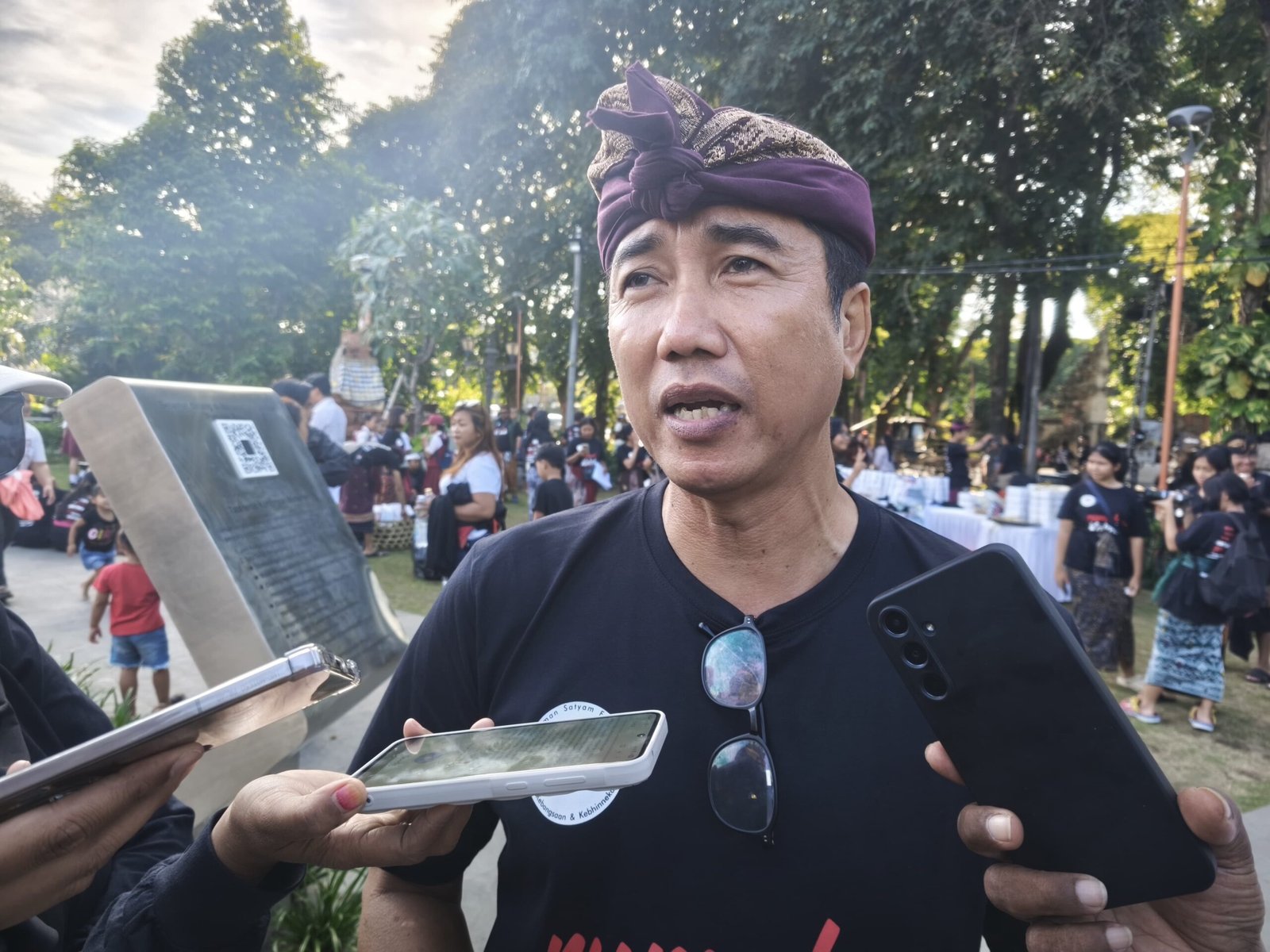
BALINEWSID.COM, DENPASAR – Concerns over the younger generation’s declining understanding of Pancasila values were highlighted during the Pancasila Carnival 2026 held in Denpasar on Monday (June 1), coinciding with Indonesia’s Pancasila Day and the opening of Bung Karno Month.
Chairman of Rumah Kebangsaan dan Kebhinnekaan (House of Nationalism and Diversity) Pasraman Satyam Eva Jayate, Ketut Udi Prayudi, said the rapid growth of digital technology and the overwhelming flow of information have contributed to a weakening appreciation of the nation’s foundational values among young people.
According to Prayudi, Pancasila should not merely be memorized during ceremonies but must be practiced in everyday life through tolerance, unity, mutual respect, and nationalism.
“The noble values of Pancasila must be preserved, defended, and, most importantly, implemented in our daily lives,” he said during the event.
He pointed to viral social media content showing some young Indonesians struggling to recite the five principles of Pancasila as a warning sign that civic and national education needs to be strengthened.
“If young people cannot even memorize Pancasila, it becomes even more difficult for them to apply its values in society,” he said.
The Pancasila Carnival 2026 showcased Indonesia’s cultural diversity through performances and participation from various ethnic and cultural communities. In addition to Balinese arts, participants presented traditional performances such as Reog Ponorogo, Barongsai (lion dance), Okokan, and cultural displays featuring traditional costumes from across the archipelago.
Prayudi said the diversity represented in the carnival symbolized the spirit of “Bhinneka Tunggal Ika” (Unity in Diversity), Indonesia’s national motto.
“We want to foster brotherhood, togetherness, and harmony among communities through this event,” he said.
Now in its third year, the carnival involved more than 1,000 participants from a wide range of groups, including community organizations, student executive bodies, local communities, and government agencies from both the Bali Provincial Government and the Denpasar City Government.
The event was organized through collaboration among multiple stakeholders, including financial and logistical support from participating institutions and organizations.
“This event is carried out collectively. We do not have our own funding source, so everything is made possible through collaboration,” Prayudi explained.
The parade route passed through several historic areas of Denpasar, including the city’s zero-kilometer point and the vicinity of Puputan Badung Square, a site closely associated with Bali’s history of resistance and struggle.
“We want to revive the spirit of heroism and the historical significance of Denpasar’s zero point and Puputan Badung Square,” he said.
Unlike previous editions, which featured participants traveling around the city in vehicles, this year’s carnival adopted a walking parade format. Organizers believe the new concept better reflects the essence of a cultural carnival while strengthening the atmosphere of national celebration.
“Last year, participants used vehicles, and the carnival spirit was not fully felt. This year, everyone walks together in a cultural parade, creating a true national arts and cultural festival,” Prayudi said.
The House of Nationalism and Diversity hopes the Pancasila Carnival will become a regular annual event that expands beyond Denpasar and Bali to other regions across Indonesia.
In addition to the carnival, a series of activities has been planned throughout Bung Karno Month, including national seminars, discussion forums, a pilgrimage to Bung Karno’s Grave, as well as social and environmental programs.
“We hope these activities will strengthen bonds among young people and eliminate barriers based on ethnicity, schools, or other backgrounds. Everyone can unite under the spirit of Indonesia,” Prayudi concluded.



Discussion (0)
No comments yet.