
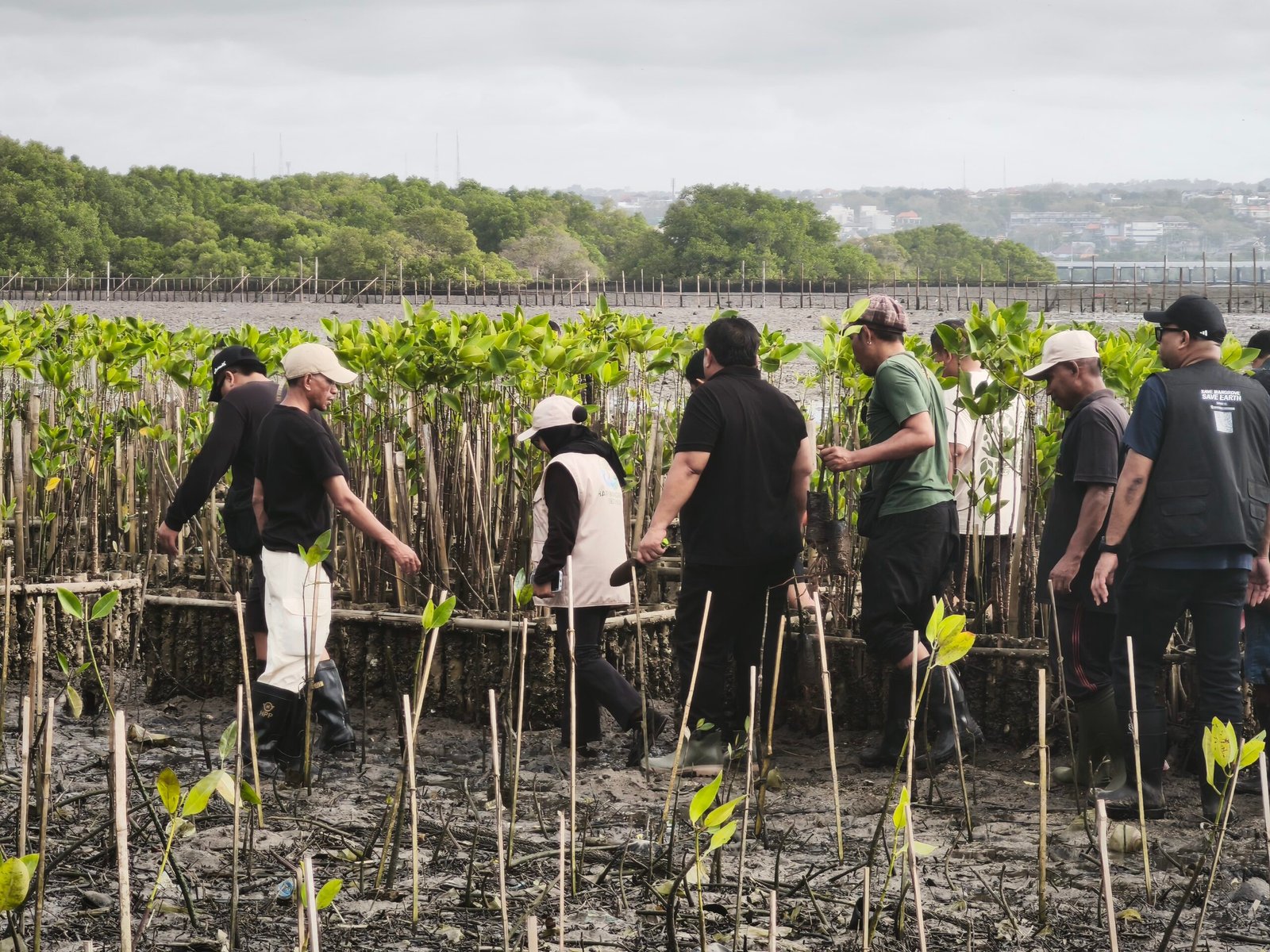
BALINEWSID.COM, BADUNG – The condition of Bali’s mangrove ecosystems has come under renewed scrutiny, with environmental activist Lanang Sudira warning that the area traditionally reported to cover around 1,300 hectares may have been reduced due to land conversion in several locations.
Lanang said changes in the mangrove landscape could be seen through development and land-use activities around mangrove areas. He identified several locations, including Jimbaran, as areas requiring closer attention.
Lanang said he had accompanied the Bali Regional House of Representatives’ Special Committee on Spatial Planning, Assets and Licensing (Pansus TRAP) during inspections of several mangrove sites of concern.
“If the area is measured again, it is not as large as 1,300 hectares. It has decreased because of land conversion,” Lanang said.
He also raised concerns over alleged mangrove clearing in an area managed by PT Bali Turtle Island Development (BTID). As a mangrove activist, Lanang said he had reported the condition to the Bali legislative committee and called on the relevant authorities to follow up on the matter.
“I have reported the condition directly to the chairman of the Pansus TRAP. Now it is the responsibility of the authorized institution to summon BTID and ask for an explanation,” he said.
Lanang also stressed the importance of protecting mangrove species that require decades to grow. He cited Sonneratia alba, which he said is particularly difficult to regenerate.
“It has already taken 75 years. Moreover, Sonneratia alba is very difficult to propagate,” he said.
Meanwhile, Head of the Ngurah Rai Grand Forest Park (Tahura) Technical Management Unit, I Putu Agus Juliartawan, explained that the figure of around 1,300 hectares refers to the area stated in an old decree issued in 1993. According to him, no new decree has yet been issued to establish an updated official area.
The management authority also said that mangroves have naturally expanded beyond the administratively designated area. The additional area is estimated at around 280 hectares, but it cannot yet be officially recognized as part of the protected mangrove area because it has not been established through a new decree.
“Naturally, the mangrove area has increased. It just has not been officially recognized. To officially recognize the additional area, there must be a new decree,” Juliartawan said.
Apart from administrative issues concerning the size of the mangrove area, environmental conditions in several locations have also been affected by natural factors. The coastal area of Sidakarya, for example, has reportedly suffered damage due to continuous wave exposure.
The situation is different from the mangrove area around Tanjung Benoa, which is relatively protected by the characteristics of the bay, resulting in less exposure to strong waves.
To reduce the impact of waves on damaged mangrove areas, the management authority believes coastal rehabilitation should be carried out first. One option being considered is beach nourishment or sand replenishment, rather than constructing concrete breakwaters, which are considered capable of disrupting natural marine dynamics.
Waste is another serious challenge threatening the sustainability of Bali’s mangrove ecosystems. The management authority has urged the public to improve waste awareness and reduce waste at its source, particularly in upstream areas, so it does not flow through rivers into coastal and mangrove zones.
Waste carried by several waterways, including those around Taman Pancing and Tukad Mati, is reportedly at risk of eventually reaching the mangrove areas.
“What needs to be supported is informing and educating people in upstream areas so that waste does not reach downstream areas,” Juliartawan said.
The management authority stressed that waste management is not solely the government’s responsibility. Public awareness and the commitment not to dispose of waste indiscriminately are considered essential to protecting Bali’s mangrove ecosystems.
The differing views on the current condition and extent of Bali’s mangrove areas highlight the need for updated data and an official assessment. Updating the data and formally establishing the latest area through a new decree are considered crucial to ensuring that protection, rehabilitation and monitoring efforts can be carried out based on accurate and measurable conditions.




Discussion (0)
No comments yet.