
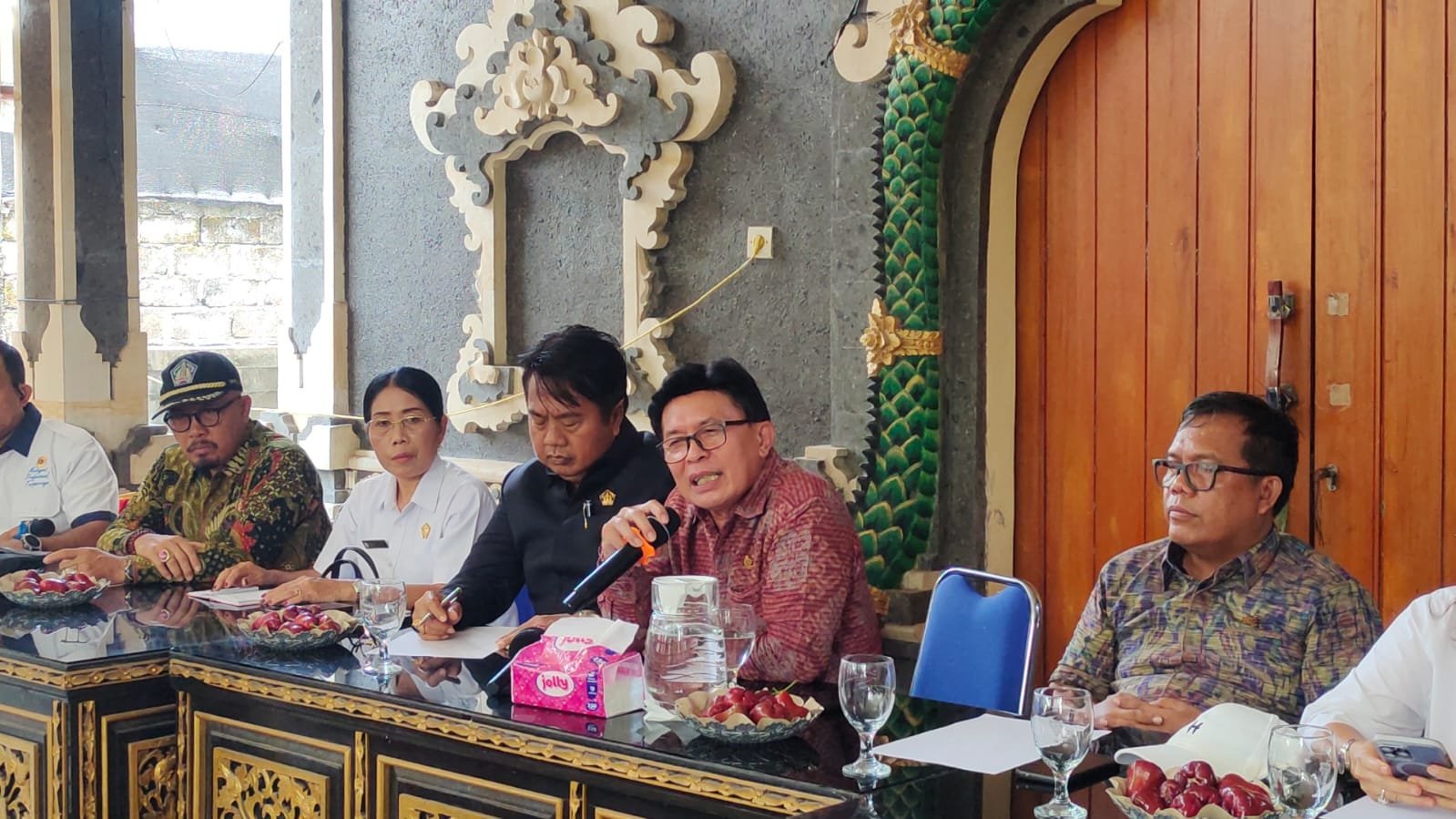
BALINEWSID.COM, JEMBRANA — A special committee of the Bali Provincial Legislative Council has uncovered significant discrepancies in a land swap scheme involving mangrove areas and PT BTID, raising concerns over compliance, legality, and environmental risks. April 22, 2026.
The Special Committee on Spatial Planning, Assets, and Licensing (Pansus TRAP) revealed its findings following an inspection held on Wednesday at the Budeng Village Office in Jembrana District. The probe focused on the company’s obligation to provide replacement land to the government as part of an alleged mangrove land exchange.
Committee Chair I Made Supartha said the company was required to provide around 44 hectares of replacement land. However, investigators found that only 15 land ownership certificates, covering approximately 18.2 hectares, could be presented.
“From our findings, only 15 certificates have been shown, covering just over 18 hectares. Even those are not registered under PT BTID’s name,” Supartha said. “Meanwhile, around 20 other certificates, representing roughly 22 hectares, could not be presented and are suspected to be problematic.”
The findings were supported by data from the Jembrana Land Agency, which indicated a lack of clarity regarding several certificates claimed in the land swap process.
The inspection was attended by several officials, including Deputy Chair Gede Harja Astawa and committee members I Wayan Bawa, I Nyoman Oka Antara, and Komang Dyah Setuti, along with representatives from the Jembrana Regional Legislative Council and related government agencies.
Supartha said the situation suggests potential irregularities, particularly if the land swap was carried out without clear and legitimate ownership status.
“We do not want a situation where state land is exchanged for state land, but investors end up benefiting the most. This is what we are investigating thoroughly,” he said.
He emphasized that the committee would not rely solely on administrative documents or unilateral claims, but would prioritize on-site verification to ensure transparency.
“We cannot simply rely on paperwork. Field facts are our main reference. If something cannot be proven, it cannot be considered valid,” he added.
According to Supartha, the issue has persisted for more than two decades without resolution, and recent findings point to multiple inconsistencies.
“This has been ongoing for over 20 years, yet remains unresolved. In fact, we are now uncovering more discrepancies that must be addressed,” he said.
Beyond legal concerns, Supartha also highlighted the environmental implications of the case. The mangrove areas involved are part of a protected coastal ecosystem, governed by national regulations, including Law No. 27 of 2007 and its amendments.
He warned that damage or незакон conversion of mangrove forests could lead to serious consequences, including flooding, coastal erosion, and threats to strategic areas in Bali.
“This is not merely an administrative issue. If mangroves are damaged, the impacts are severe — from flooding and abrasion to risks for vital regions in Bali. This concerns public safety,” he said.
The committee vowed to continue its investigation through further hearings with relevant agencies and law enforcement authorities, focusing not only on land ownership clarity but also on the protection of coastal ecosystems.
“We are starting with asset verification, but we will go deeper into ecological aspects. This is a natural heritage that must not be sacrificed for short-term interests,” Supartha concluded.



Discussion (0)
No comments yet.