
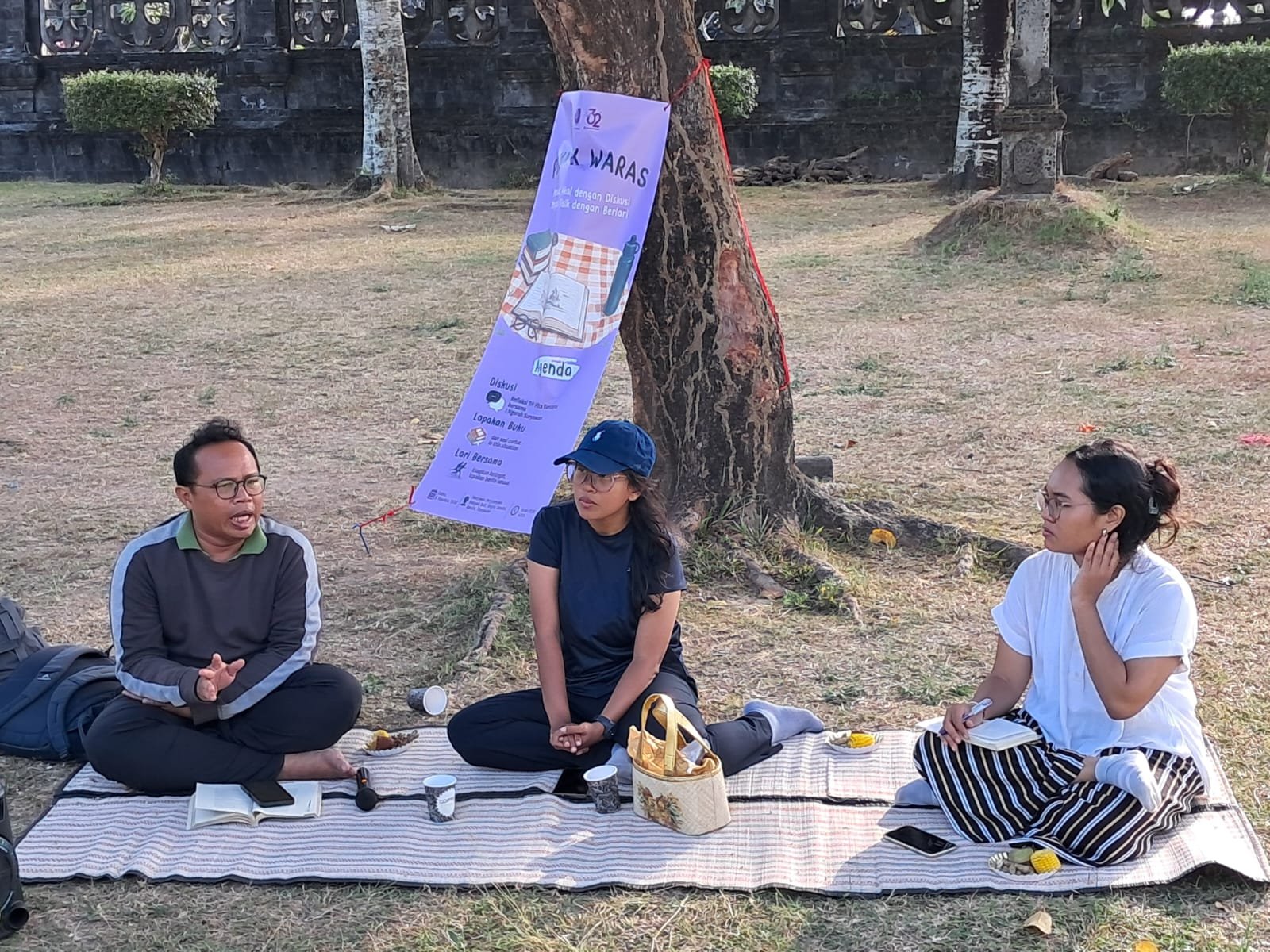
BALINEWSID.COM. DENPASAR — The Denpasar chapter of the Alliance of Independent Journalists (AJI Denpasar) marked its 32nd anniversary by holding “Piknik Waras: Nurturing the Mind Through Discussion, Strengthening the Body Through Running” at Niti Mandala Renon Field in Denpasar on Saturday (Aug. 8, 2026).
The event combined a relaxed outdoor gathering with a reading corner and a public discussion titled “Reflecting on Tri Hita Bencana Amid Bali’s Current and Future Conditions.” The discussion focused on environmental degradation in Bali and its implications for journalists and the wider public.
The discussion was moderated by AJI Denpasar Education Division Coordinator Ni Komang Yuko Utami, who also coordinated the event. She said the outdoor format was deliberately chosen to create a more open and engaging space for critical discussion.
“This discussion was designed differently from our usual events. The reflective approach, combined with a picnic in a public green space, allows us to interact in a more relaxed way while maintaining serious discussion,” Yuko said.
She added that public spaces could serve as venues for critical conversations across generations about Bali and the future of the island’s living environment.
The discussion was prompted by Tri Hita Bencana: Ekonomi Politik Keserakahan Manusia Bali Kontemporer, a book by academic and anthropologist I Ngurah Suryawan that examines Bali’s growing ecological problems and their social and cultural dimensions.
Suryawan, who attended the event as a speaker, argued that environmental destruction cannot be attributed solely to oligarchic interests. He said it was also aggravated by what he described as a “comprador class” — people who, in his view, tend to accommodate those in power while exerting pressure on those below them.
“What I have seen is that there has long been a comprador class — flattering those above while suppressing those below,” Suryawan said.
He described his 150-page book as a collection of essays that emerged from his concerns over the condition of Bali. Responding to criticism that the book lacked methodological rigor, Suryawan said its primary purpose was to stimulate social movements.
“This book is intended as a trigger for social movements,” he said.
During the discussion, Suryawan also addressed the history of land and public space in Bali, the impact of the 1965 events, the intervention of capital, and gender issues within Balinese traditional rituals.
He highlighted the often-overlooked role of women in traditional ceremonies, arguing that while men are frequently placed at the forefront of rituals, women often bear much of the work involved in preparing them.
“Attention is always placed on ceremonial funding and social assistance, while the contribution of women’s bodies and labor is often overlooked,” he said.
His presentation sparked an interactive discussion among participants. Issues raised included concerns over limited transparency in government budgets and what participants viewed as declining civic activism in Bali, particularly among university communities.
The event attracted participants from various backgrounds, including journalists’ organizations, student media, academics and members of the public. Representatives of PWI Bali, PFI Denpasar, IWO Bali and IJTI Bali were among those attending.
AJI Denpasar Chairperson Ni Kadek Novi Febriani said AJI’s 32nd anniversary, which fell on Aug. 7, carried the national theme “Survive, Speak Up, Create.”
She said the ecological crisis was closely connected to press freedom because journalists play an important role in ensuring the public’s right to information.
Journalists, she said, have a responsibility to report facts in accordance with Indonesia’s Press Law No. 40 of 1999. However, journalists remain vulnerable to political, economic and legal pressures, while critical voices are increasingly subjected to negative labeling.
“Bali’s ecological condition is becoming increasingly worrying. Nature is often treated merely as an asset to be exploited, rather than as a living space that must be protected,” Febriani said.
She stressed that journalists covering environmental issues have an important role in providing clarity and defending humanitarian interests.
“It is important for journalists covering ecological issues to become a source of clarity and to stand on the side of humanity. They cannot remain neutral,” she said.
Febriani said there was still hope of preventing further ecological damage as long as journalists, activists, academics and civil society continued to speak critically about the island’s environmental challenges.
At the end of the discussion, participants were invited to write down their concerns about Bali on pieces of paper. The papers were then passed around in a circle seven times.
The exercise revealed several shared concerns, including development policies that participants felt were not sufficiently oriented toward local communities and the lack of adequate public transportation facilities across Bali.
After “nurturing the mind” through discussion, participants continued the event by “strengthening the body” through a 3.2-kilometer run.
The route began at Niti Mandala Renon Field and ended at the AJI Denpasar Secretariat on Jalan Sedap Malam. The 3.2-kilometer distance was deliberately chosen as a symbolic representation of AJI’s 32 years of existence.







Discussion (0)
No comments yet.