
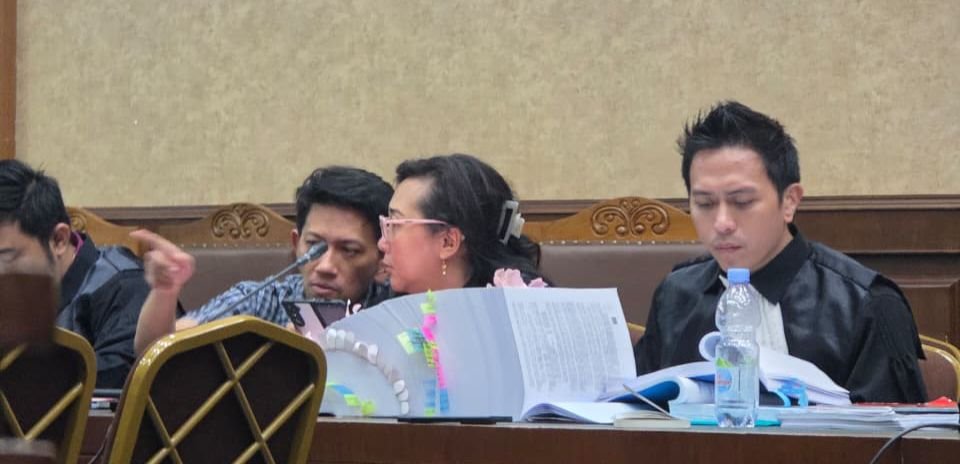
BALINEWSID.COM, JAKARTA – The defense team of Gamaginta, former Head of Sharia Financing Department at the Indonesia Eximbank (Lembaga Pembiayaan Ekspor Indonesia/LPEI), has requested the Corruption Court in Central Jakarta to summon key officials involved in the financing process at the center of an ongoing corruption case.
The request was made during a hearing at the Jakarta Corruption Court on Wednesday (June 17, 2026), where prosecutors presented four witnesses from LPEI: Rani Kusnaeni, Pramudi Irawan, Mariani Siswiandi, and Gama Ahmad Nova.
Before witness examinations began, the panel of judges allowed the defense team to deliver an opening statement. Defense counsel Prof. Dr. Werdhi Sutisari, S.H., M.H., Ph.D., urged the court to consider hearing testimony from Tito Andrian, who served as Head of LPEI’s Risk Department during the relevant period, and Meta, the official who succeeded Gamaginta after August 2018.
According to Werdhi, both individuals possess information that could help clarify the financing process currently under judicial scrutiny.
“Tito Andrian headed the Risk Department and played an important role in financing risk analysis and mitigation. Meanwhile, Meta replaced the defendant after he was no longer effectively serving at LPEI as of August 1, 2018. Their testimonies are therefore relevant to understanding the facts being examined in court,” Werdhi told reporters after the hearing.
During the witness examination, the defense focused on several issues related to the Letter of Undertaking (LoU), Standard Operating Procedures (SOP), and Financing Analysis Memorandum (MAP), particularly concerning activities that occurred after Gamaginta ceased actively performing his duties at LPEI.
One of the key issues raised involved documents that allegedly still carried Gamaginta’s signature after August 1, 2018. The defense questioned witnesses regarding the coordination and administrative procedures that resulted in the defendant’s name appearing on documents processed after he had effectively left his position.
“We asked the witnesses to explain the coordination mechanisms that allowed documents processed after Mr. Gamaginta was no longer effectively working at LPEI to still bear his signature. This is important in establishing the facts objectively,” Werdhi said.
The defense argued that legal responsibility in a financing process must be assessed comprehensively and in accordance with the institution’s governance structure and allocation of authority.
Werdhi cited regulations governing governance and risk management within LPEI, including provisions related to risk management and decision-making processes. He emphasized that the risk management function operates independently and is responsible for identifying, measuring, monitoring, and mitigating risks associated with financing proposals.
As such, he argued that officials responsible for risk assessment have a direct connection to the financing process currently under examination.
The defense further stressed that establishing material truth in a criminal proceeding requires a thorough review of the entire chain of business processes and decision-making.
“Justice should not stop at the implementing level. It must examine who proposed the financing, who analyzed it, who conducted the risk mitigation, who provided recommendations, and who ultimately had the authority to make decisions,” Werdhi stated.
He added that criminal liability should be based on an individual’s actual authority, actions, and involvement rather than solely on the appearance of a person’s name in administrative documents.
The defense team expressed hope that witness testimonies would provide a more comprehensive understanding of financing mechanisms, risk management implementation, and decision-making processes within LPEI, enabling the judges to reach conclusions based on facts revealed during the trial.
As of publication, prosecutors had not issued an official response to the defense’s request to summon Tito Andrian and Meta as witnesses.
The trial is scheduled to continue with further examination of evidence and testimony as the court seeks to establish the facts surrounding the case.





Discussion (0)
No comments yet.