
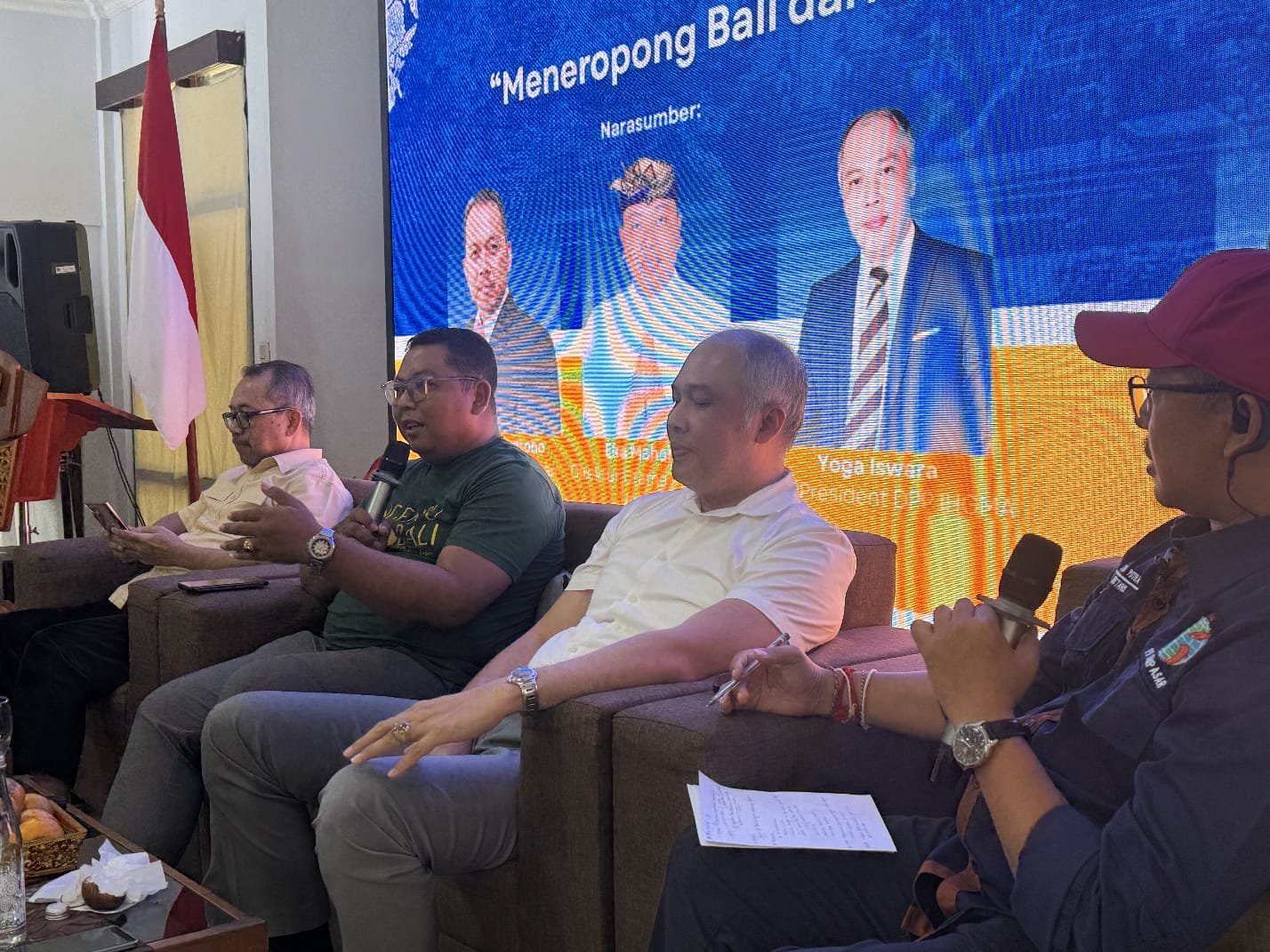
BALINEWSID.COM, DENPASAR — Economist and tourism observer Trisno Nugroho has warned Bali against relying too heavily on tourism as its sole engine of economic growth.
He made the statement during a public dialogue titled “Viewing Bali from a Different Perspective,” held as part of the 14th anniversary of the Indonesian Online Journalists Association (IWO) and the first anniversary of IWO Bali at the Bali Provincial Tourism Office Hall on Sunday (August 30, 2026).
Trisno said Bali’s economy has continued to perform strongly in recent years. Economic growth reached 5.48 percent in 2024 and rose to 5.82 percent in 2025, both above the national growth rate. In the first quarter of 2026, Bali’s economy grew 5.58 percent year-on-year, followed by 5.78 percent in the second quarter.
However, Trisno cautioned that the positive figures should not make Bali complacent.
“Bali has succeeded, but that success remains vulnerable,” Trisno said during his presentation.
He pointed to several structural challenges, including the concentration of economic activity in certain sectors and regions, economic value leakage, and growing pressure on the island’s environmental carrying capacity.
According to Trisno, Bali does not need to abandon tourism. Instead, the island should diversify its economy around tourism and use the sector as a major market for local products and services.
“Diversification should take place around tourism, not by abandoning it,” he said.
Tourism, he explained, should create stronger connections with agriculture, fisheries, handicrafts, small and medium-sized enterprises, the creative economy, education, healthcare, and the green economy.
Spending by tourists at hotels, restaurants, attractions, and other tourism businesses should generate wider economic benefits for local farmers, fishermen, artisans, and small businesses.
The key measure of success, he said, should not simply be the number of tourists visiting Bali, but how much economic value remains, circulates, and grows within the island.
Five Principles for a Stronger Bali Economy
Trisno proposed five principles for building a more resilient economic structure in Bali.
The first is increasing local added value so that Balinese products are not limited to raw materials. The second is strengthening connections between sectors so tourism can generate demand for local businesses.
The third is ensuring fair economic opportunities through broader access to markets, capital, technology, and skills. The fourth is regional economic development, allowing each regency to grow based on its respective strengths.
The fifth is respecting ecological limits, ensuring that investment and economic growth remain within Bali’s environmental and cultural carrying capacity.
Trisno also proposed five new growth engines for Bali: value-added food production, the creative economy, the digital economy, healthcare and education, and the green economy.
“These sectors should be viewed as a portfolio for Bali’s economic resilience,” he said.
Four Keys to Inclusive Growth
Trisno stressed that economic growth must go hand in hand with greater inclusion.
He identified four key areas that must be opened simultaneously: skills, markets, financing, and technology.
Training programs, he said, should be linked directly to employment opportunities and business needs. Small businesses should have better access to markets through product curation, aggregation, local procurement, and supply chains.
Access to financing should be supported by proper financial records, credit facilities, and data-based productive capital. Meanwhile, technology should be used to improve business processes, marketing, payment systems, and productivity.
“Assistance without access to markets creates dependency. Markets without capacity leave small businesses behind,” Trisno said.
One Bali, Multiple Growth Centers
Trisno also called for a more balanced distribution of economic activity across the island, rather than allowing development to remain concentrated in southern Bali.
Southern Bali, he said, could serve as a global gateway and a center for high-value services, MICE activities, and innovation.
Western Bali could be strengthened through food production, conservation, and the marine economy. Northern Bali has opportunities in logistics, education, fisheries, and nature-based tourism.
Eastern Bali could focus on culture, village tourism, agriculture, and the creative economy, while Central Bali could develop as a knowledge-based, wellness, and value-added agricultural hub.
The approach is summarized in the concept of “One Bali, Multiple Growth Centers.”
From Sustainable to Regenerative Tourism
Another key point in Trisno’s presentation was the need to shift from sustainable tourism toward regenerative tourism.
While sustainability seeks to prevent further damage, regenerative tourism aims to ensure that tourism activities leave Bali’s environment, culture, and local communities in better condition.
This can be achieved by reducing the use of water, energy, and land, as well as minimizing waste. At the same time, local communities should not merely be spectators or workers but should also have roles as owners, suppliers, skilled workers, entrepreneurs, and decision-makers.
Under this approach, tourism would no longer focus solely on visitor numbers and economic transactions but also on restoring destinations and improving their overall quality.
Turning Ideas into Action
Trisno said the ideas could be translated into concrete measures, starting with mapping supply chains and economic value leakage, establishing local spending targets, and developing comprehensive data on small businesses and workforce skills.
The next steps could include establishing business aggregators and quality standards, expanding data-based productive financing, and developing new economic growth centers outside southern Bali.
In the longer term, Bali should develop new export-oriented economic sectors, introduce local-benefit and environmental carrying-capacity assessments, and measure not only economic growth but also public welfare, resilience, and environmental recovery.
The public dialogue held as part of the IWO anniversary celebrations delivered a clear message: Bali does not have to choose between tourism and other economic sectors.
Tourism will remain one of Bali’s main economic strengths. However, it must also become a catalyst for local businesses, community prosperity, cultural preservation, and environmental recovery.
A stronger Bali, Trisno emphasized, is a Bali with multiple engines of growth; an inclusive Bali is one that provides broader access to opportunities; an equitable Bali gives every region room to develop; and a regenerative Bali ensures that development today leaves the island in better condition for future generations.


Discussion (0)
No comments yet.