
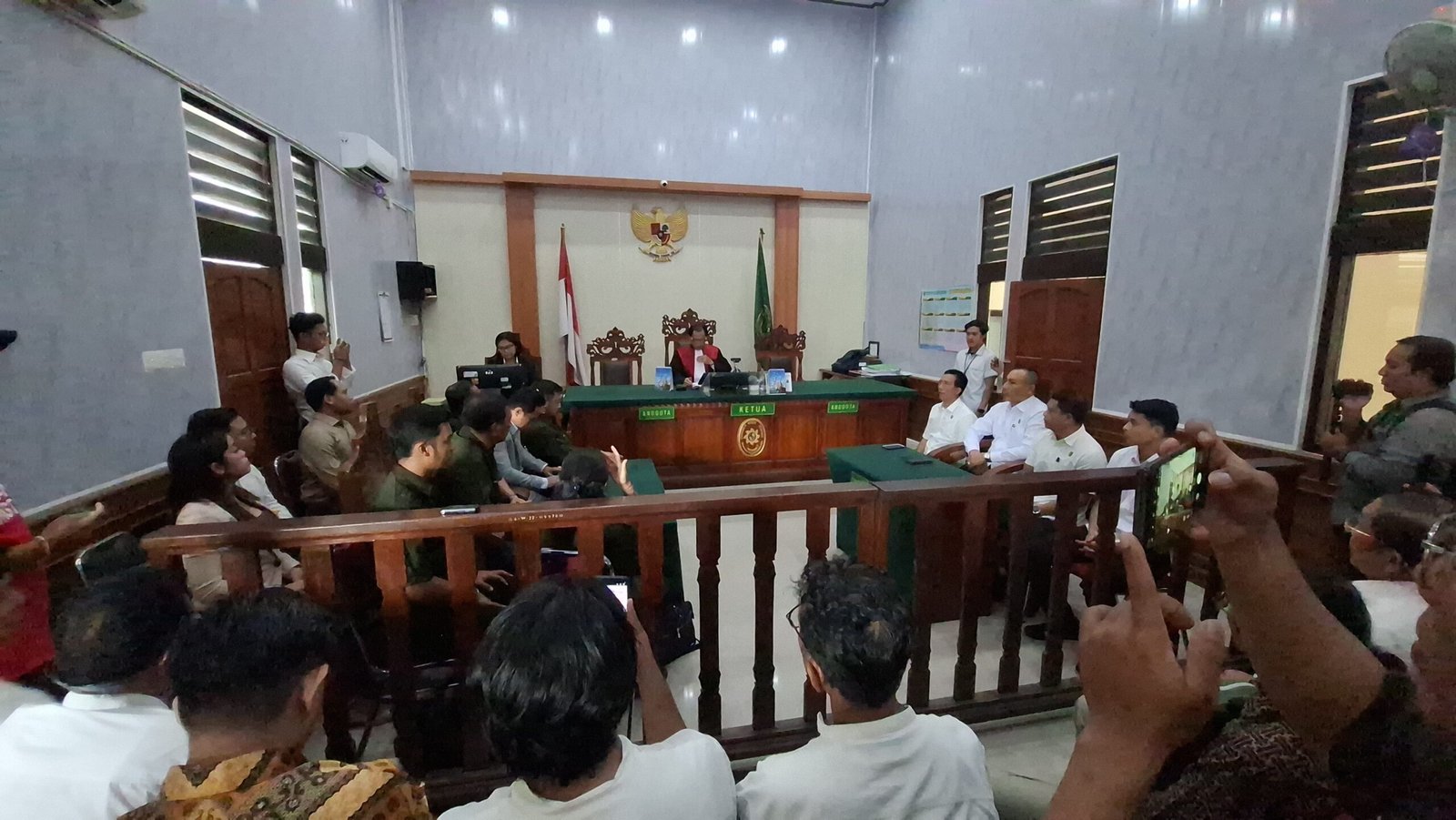
BALINEWSID.COM, DENPASAR — The Denpasar District Court (PN Denpasar) has rejected in its entirety the pretrial motion filed by the Head of the Bali Regional Office of the National Land Agency (Kakanwil BPN Bali), Made Daging. The verdict was delivered on Monday (February 9, 2026), with the court ruling that the designation of Made Daging as a suspect in an archival administration case at the Badung Land Office was legally valid.
The sole judge presiding over the pretrial hearing, I Ketut Somanasa, stated that a pretrial court does not have the authority to assess the applicability or validity of criminal provisions used as the basis for a suspect’s designation. According to the judge, the scope of pretrial proceedings is limited to examining whether the procedure for naming a suspect was conducted lawfully, particularly whether it was supported by at least two valid pieces of evidence.
Following the decision, Made Daging’s legal team said they respected the ruling but emphasized several important notes. Defense counsel Gede Pasek Suardika (GPS) explained that while the verdict was accepted, the defense would continue to prove its arguments in the main trial.
The legal team stressed that in Indonesia’s criminal justice system, all parties are obliged to respect judicial processes and court decisions. Law enforcement, they argued, must always be carried out with full respect for established legal mechanisms.
Despite appreciating the legal arguments presented by all parties during the hearing, the defense highlighted what they described as fundamental legal issues in the case. According to the legal team, the suspect designation was based on Article 421 of the old Criminal Code (KUHP), which has explicitly been declared no longer in force, as well as Article 83, which they claimed has expired. They stated that the non-applicability of these provisions was acknowledged by both the police and expert witnesses, including two experts presented during the hearing.
The defense questioned how a suspect designation could be deemed lawful when its legal basis was no longer valid. They argued that if the suspect designation was still considered legitimate, then the applicability of Articles 421 and 83 should logically be examined in the main trial. However, they questioned when such an examination could take place, given that the legal provisions in question were already recognized as having no binding force.
The legal team reaffirmed their adherence to the principle of legality, which they described as the most fundamental principle in criminal law. Under this principle, no one can be punished without a prior criminal provision regulating the act. Therefore, they argued, before someone can be named a suspect, it must be ensured that the alleged conduct is clearly regulated under a provision that is still in force.
During the hearing, the defense also referred to Article 3 paragraph (2) of Law Number 1 of 2023 on the Criminal Code, which states that criminal provisions that are no longer applicable must be terminated “by operation of law.” According to the defense, this phrase legally means that proceedings must be stopped, not continued. They criticized the court’s interpretation, which they claimed effectively treated the provision as allowing cases to proceed.
Meanwhile, the Bali Police Legal Division (Bidkum Polda Bali), represented by Wayan Kota and Nyoman Gatra, maintained that the designation of Made Daging as a suspect had been carried out in accordance with applicable legal procedures.
According to Bidkum Polda Bali, the pretrial motion primarily challenged the legality of the suspect designation. However, the police argued that the petitioner’s claims were unfounded and could not be proven during the hearing.
Addressing the media after the verdict, the police legal team stated that the court’s decision confirmed the legality of the investigators’ actions during the investigation stage. All arguments presented by the petitioner, as considered by the judge, were rejected.
The police emphasized that any court decision must be respected as a form of respect for legal process and the supremacy of law. They also stated that ongoing and related cases would be handled and followed up in accordance with the court’s ruling and applicable legal procedures.
The Bali Police Legal Division also apologized to members of the media for limited communication during the trial, explaining that their focus on court proceedings and adherence to standard operating procedures restricted the information they could share.
They concluded by noting that Indonesia is currently in a transitional period in implementing new legislation, which has led to differing legal interpretations among parties. Nevertheless, they stressed that these differences had been considered and resolved by the court in its decision. (FF)




Discussion (0)
No comments yet.