
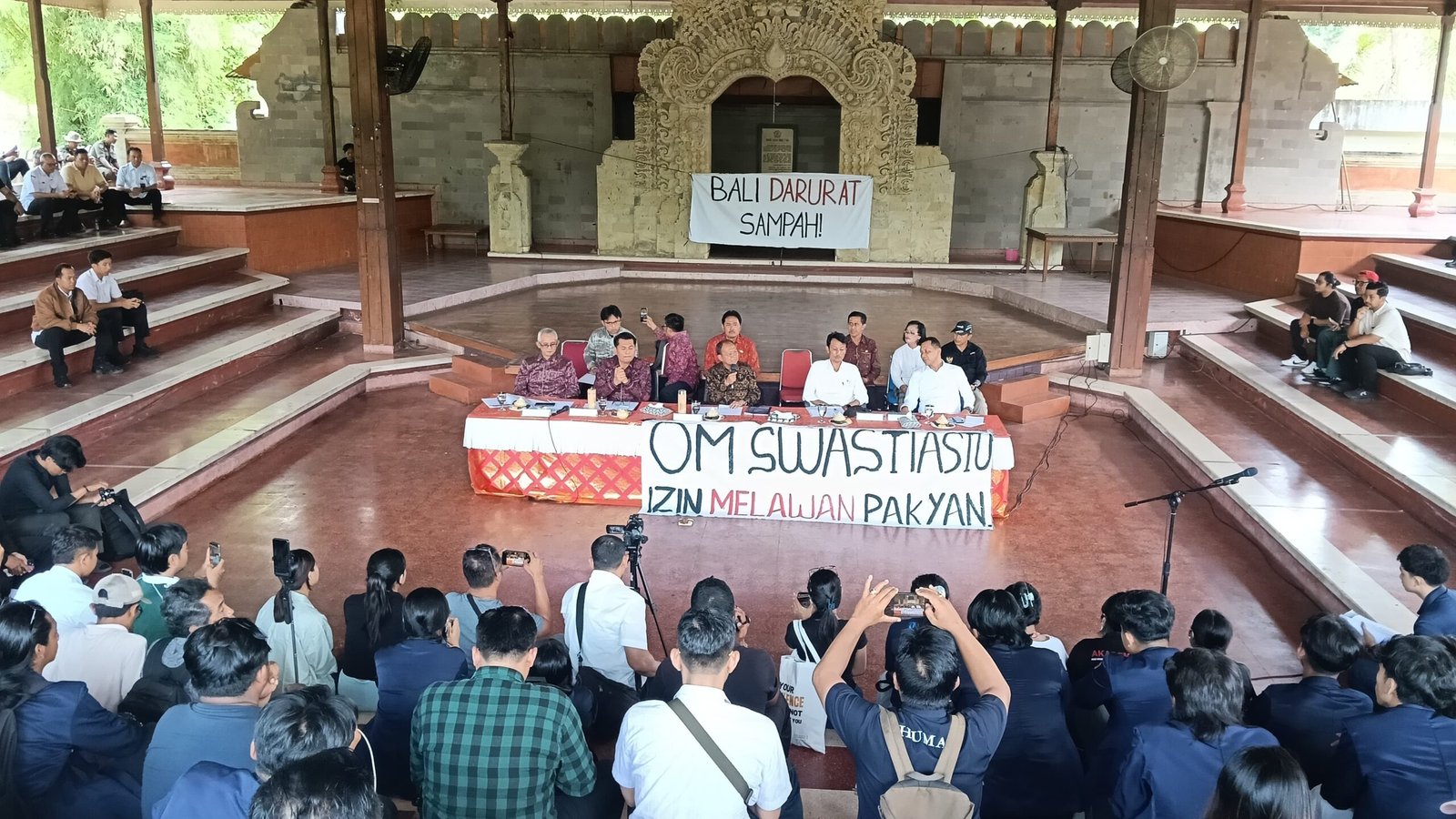
BALINEWSID.COM, DENPASAR — Concerns over Bali’s escalating waste crisis resurfaced after the Student Executive Board (BEM) of Udayana University staged a peaceful demonstration followed by an open dialogue at the Bali Provincial DPRD building on Wednesday. April 22, 2026.
During the forum, students argued that waste management across the island remains far from optimal, citing gaps in regulation, implementation, and the resulting impacts on public health and the environment. They warned that the issue has evolved into a serious and widespread social threat, urging authorities to adopt concrete and integrated measures.
The students also called for more transparent and inclusive communication between the government and the public in formulating long-term solutions to the island’s mounting waste problem.
Responding to the concerns, Bali Governor Wayan Koster said the provincial government continues to pursue comprehensive waste management strategies involving multiple levels of administration. He referred to Law No. 18 of 2008 on Waste Management as the legal framework guiding the division of responsibilities between central, provincial, and local governments.
Koster emphasized that Bali’s approach is not sectoral but integrated within the broader regional development vision. A key focus is source-based waste management, including strengthening modern “teba” systems, expanding the use of composters, and optimizing TPS3R (Reduce-Reuse-Recycle Waste Processing Sites) and TPST (Integrated Waste Processing Facilities) across the island.
In addition, the provincial government is promoting waste-to-energy (PSEL) technology as a long-term solution, in collaboration with the central government, to reduce reliance on conventional disposal methods.
Despite these efforts, Koster acknowledged ongoing challenges. He reiterated the government’s commitment to completely halt open dumping practices at all landfill sites by August 1, 2026, including the heavily scrutinized Suwung Landfill.
“All open dumping must be fully stopped by August 1. This practice must end in 2026 as it pollutes the environment. We need to return to proper waste management systems based on sorting at the source,” he said.
Koster also expressed appreciation for the students’ action, describing it as an important form of social oversight and public participation. He acknowledged that government communication may not have been optimal and pledged improvements moving forward.
The demonstration and dialogue are expected to mark a starting point for stronger collaboration between the government, academics, and the public in addressing Bali’s increasingly urgent waste crisis.



Discussion (0)
No comments yet.