
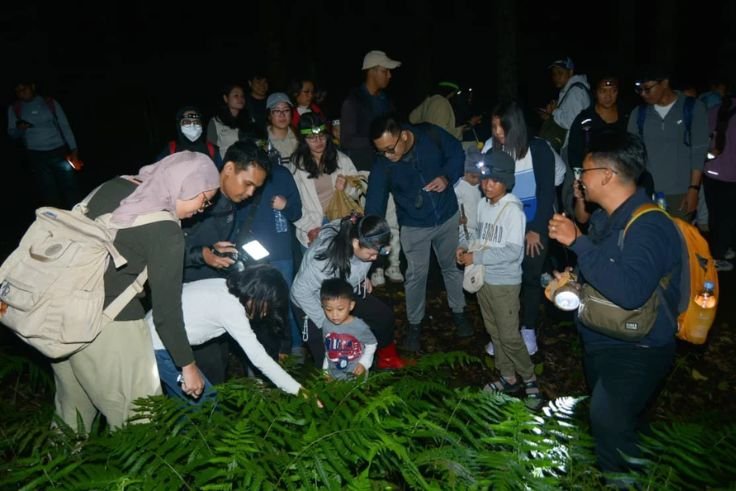
TABANAN, BNEWSID – In collaboration with Nusantara Wilderness, Bali Botanic Garden, also known as Bedugul Botanic Garden, held a biodiversity exploration activity focusing on flora and fauna, with special attention given to firefly conservation.
The activity aimed to increase public awareness of the role of fireflies as indicators of a healthy environment, emphasizing their importance in maintaining the balance of natural ecosystems.
East Deputy of Horticulture for Eastern Region Botanic Gardens, Hadhiyyah N. Cahyono, explained that the function of a botanic garden extends beyond plant conservation to also serve as a habitat for various wildlife species.
“Bali Botanic Garden is a living conservation space. When the environment is well preserved, wildlife such as fireflies and herpetofauna can continue to find shelter here,” Hadhiyyah said.
Meanwhile, Bella Evanglista, a representative of Nusantara Wilderness, noted that the exploration encouraged participants to understand ecosystems in a holistic way.
“This activity is not just about observing wildlife, but about understanding how the environment works to maintain natural balance,” she explained.
The exploration was attended by more than 40 participants from both domestic and international backgrounds and took place from 4:00 p.m. to 9:00 p.m. WITA. The schedule coincided with the crepuscular period, the transition from day to night, when fireflies are most active.
Participants explored several areas, including the Lake View, Giant Tree area, Tropical Forest, and the Panca Yadnya Thematic Garden.
Throughout the exploration route, participants observed various nocturnal fauna, including fireflies from the Lamprigera spp. and Abscondita spp. genera, as well as amphibians, reptiles, arachnids, birds, and vegetation such as Ficus spp., Bischofia javanica, Cyathea spp., and Liquidambar excelsa.
Director of Botanic Garden Management, Marga Anggrianto, expressed hope that the biodiversity exploration program would continue to grow in the future.
“We hope activities like this can become a sustainable agenda involving more collaborators, communities, and the public, so conservation efforts go beyond protecting areas and help foster collective awareness of the importance of maintaining ecosystem balance,” he said.
In the Panca Yadnya and Lake View areas, participants recorded abundant firefly activity dominated by the Lamprigera spp. and Abscondita spp. genera.
Stable microclimate conditions, characterized by high humidity, cool temperatures, good air circulation, and low levels of artificial light create an optimal habitat for fireflies.
The presence and activity of fireflies indicate that the area still maintains good air quality and environmental conditions, serving as a bioecological indicator of a relatively healthy ecosystem. (*)



Discussion (0)
No comments yet.