
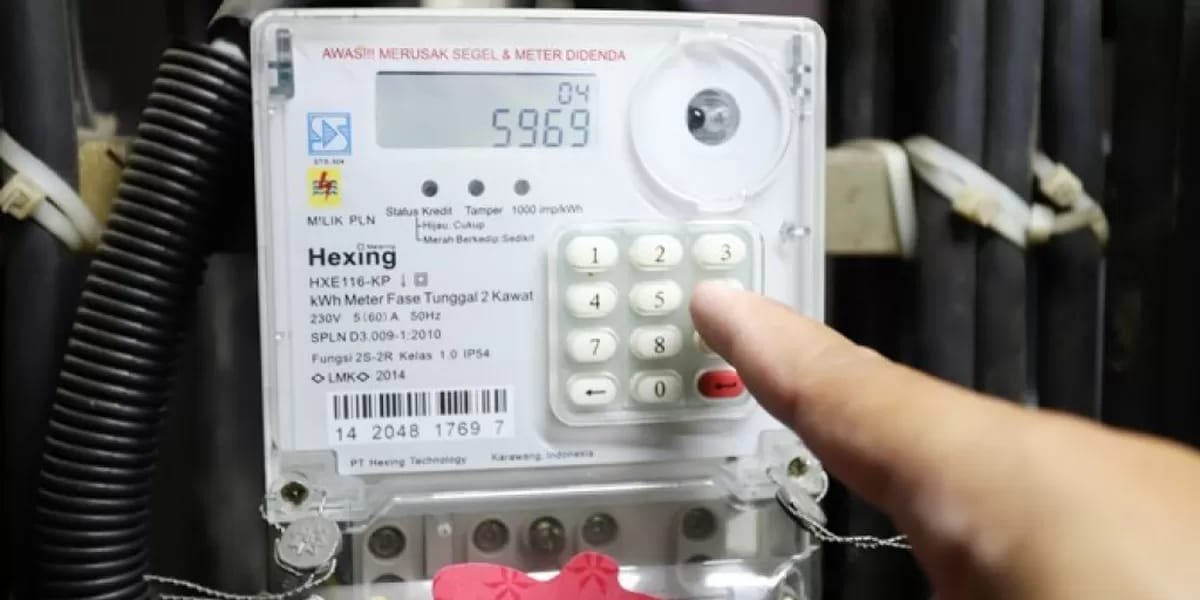
BALINEWSID.COM, JAKARTA – Allegations of corruption and collusion have once again struck PT PLN (Persero). This time, scrutiny centers on the Advanced Metering Infrastructure (AMI) project, a digital transformation initiative valued at more than Rp5 trillion, which is now facing serious questions over its implementation and governance.
Launched during the tenure of President Director Darmawan Prasodjo, the AMI project was promoted as a milestone in modernizing Indonesia’s national electricity distribution system. However, behind the ambitious digitalization drive, allegations have surfaced involving irregularities, conflicts of interest, and the flow of substantial funds, prompting calls for law enforcement agencies to intervene.
Teuku Yudhistira, National Coordinator of Relawan Listrik Untuk Negeri (Re-LUN), revealed that Phase I of the contract was signed on December 22, 2022, between PLN and PT State Grid Power Indonesia (SGPI). The contract is valued at approximately Rp4.2 trillion under a 10-year managed service (lease-to-own) scheme, covering 1,217,256 customers.
Under the scheme, PLN is obligated to pay around Rp25,251 per customer per month, equivalent to Rp409 billion annually. The scope of work includes the provision of smart meters, Data Concentrator Units (DCU), and a Head End System (HES), with a commercial operation target set for December 20, 2023.
“Conceptually, AMI aims to improve efficiency and accuracy. But the availability/performance fee model places a significant long-term financial commitment on PLN, while the operational risks of the equipment remain with PLN,” Yudhistira said on Thursday (February 26, 2026).
He argued that the imbalance in risk allocation is a critical issue, particularly as early-stage implementation reportedly has not demonstrated optimal performance.
The most striking allegation involves the suspected transfer of up to USD 50 million — nearly Rp800 billion — to senior PLN officials.
Yudhistira disclosed the existence of an intermediary figure allegedly linking an affiliate of State Grid Corporation of China (SGCC) with PLN’s management during the project process. The individual, identified as Chen Jian (initials AL), is suspected of acting as both liaison and provider of the alleged cashback.
“Information suggests that AL is strongly suspected of providing a USD 50 million cashback to top PLN executives. Everyone already knows where the money was allegedly directed,” he asserted.
The funds were allegedly channeled through another intermediary, identified by the initials JS, linked to two vendor companies involved in the multi-trillion-rupiah project.
If proven, such practices could fall under corruption and money laundering offenses. Yudhistira has urged the Corruption Eradication Commission (KPK) and the Attorney General’s Office to immediately launch a comprehensive investigation.
Beyond bribery allegations, the AMI project has also drawn criticism from technical and business perspectives. Issues raised include the replacement of still-functional legacy meters, rental prices allegedly exceeding market benchmarks, devices and services not yet operating optimally, and indications of long-term vendor lock-in.
Based on rough calculations compiled by Re-LUN, potential state losses in Phase I alone are estimated between Rp5.5 trillion and Rp7.5 trillion.
If a similar model is applied to the planned nationwide expansion targeting 40–60 million customers, fiscal exposure could rise significantly and burden state finances over the long term, according to the group.
Further scrutiny emerged in late 2024 when some AMI devices were reportedly found not to meet contractual performance parameters, yet payments to SGPI were allegedly still made.
The payments were said to have been authorized directly by the PLN President Director, reportedly based on a study prepared by the late Nanang Harianto of LAPI ITB, who was appointed as the project’s consultant.
Questions are now being raised about the independence of the appointment and the contents of the study. If payments were made before performance obligations were fully met, observers say it could open the door to deeper legal and governance examinations.
Structurally, a strategic project worth trillions of rupiah involves multiple decision-making layers, including the President Director, Directors of Distribution and Commerce, the Finance Director, the Investment Committee, the Procurement Committee, and the Internal Supervisory Unit.
Governance analysts note that examining these parties would not constitute a presumption of guilt but rather reflect the principle of public accountability in the use of state funds.
“Digital transformation is important. But without clean and transparent governance, modernization can turn into a scandal,” Yudhistira said.
He called on the KPK and the Attorney General’s Office to summon and question all relevant parties, including PLN’s President Director.
“This is a multi-trillion-rupiah project. If there are indications of grand corruption, it must be thoroughly investigated. The public must not perceive that anyone is above the law,” he concluded.
As of press time, neither PLN nor SGPI had issued an official statement regarding the allegations.



Discussion (0)
No comments yet.