
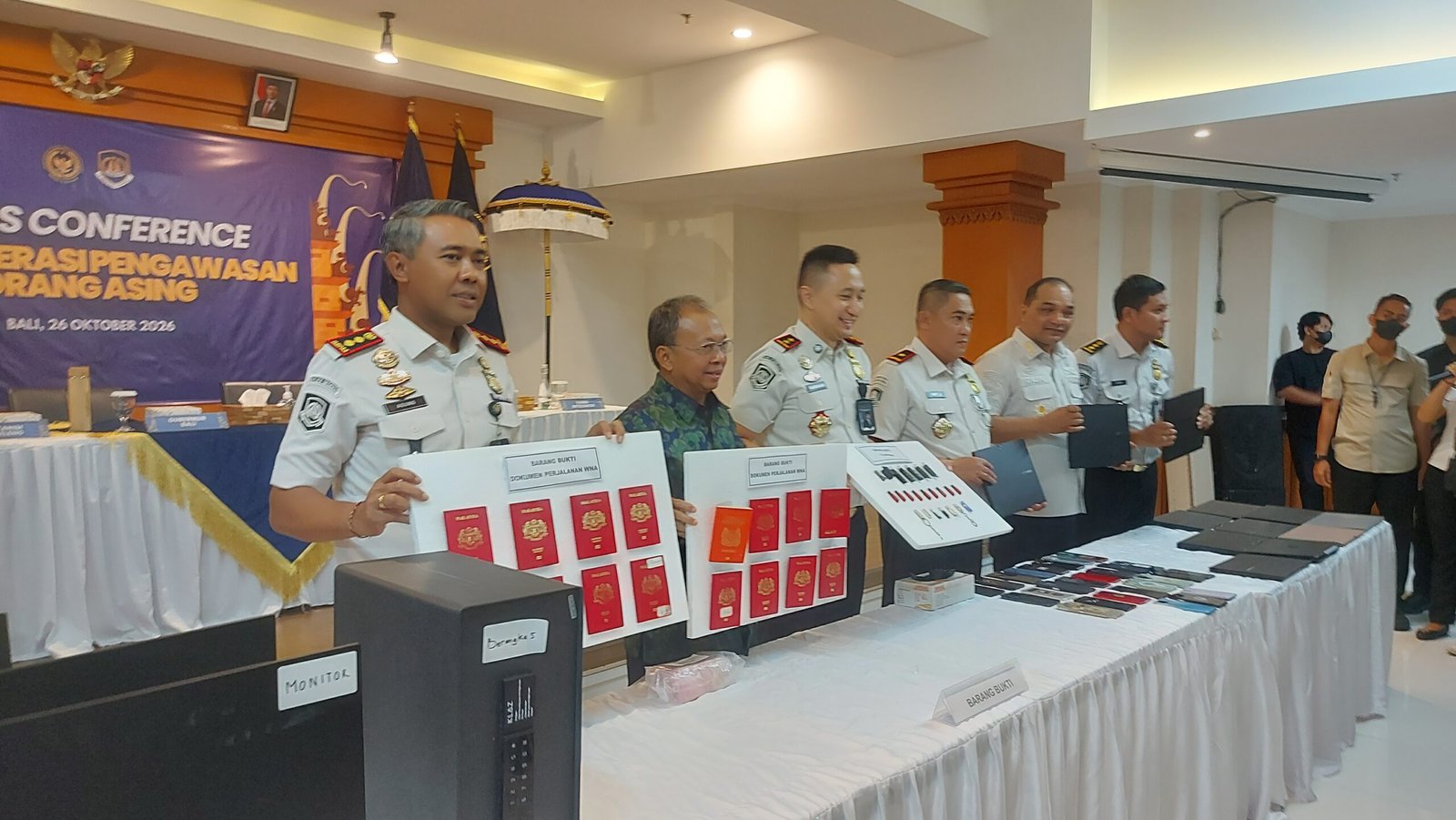
BADUNG, BALINEWS — Immigration authorities at I Gusti Ngurah Rai Immigration Office have detained 17 foreign nationals suspected of abusing their residence permits to operate an online personal lending business from a villa in Dalung, North Kuta, Badung, Bali.
The group consists of 15 Malaysian nationals and two Singaporean nationals. They allegedly operated an online lending business targeting foreign customers outside Indonesia, charging interest rates of up to 30 percent.
Head of Ngurah Rai Immigration Office, Muhamad Novyandri, said the case was uncovered following intelligence information about suspected immigration violations involving several foreign nationals staying at a villa on Gang Batu Lumbung, Jalan Raya Dalung.
After conducting surveillance for several days, immigration officers raided the property on Thursday, October 22, 2026.
“Seventeen foreign nationals detained in North Kuta are currently undergoing further examination. We will take firm action against any foreign nationals who misuse their residence permits to work illegally, without exception,” Novyandri said during a press conference at the Ngurah Rai Immigration Office on Monday, October 26, 2026.
During the operation, officers were deployed to several locations around the villa to prevent occupants from escaping. After calling out to the occupants three times without receiving a response, officers forced open the front door.
Three occupants were subsequently found attempting to flee by jumping over a wall at the back of the property. However, officers positioned in the area stopped them from escaping.
On the villa’s second floor, immigration officers discovered three rooms equipped with electronic devices and other items, including computers, laptops, mobile phones, monitors, USB flash drives, passports, a safe, and cash.
Preliminary investigations indicated that the operation was managed by three individuals acting as managers, while the remaining occupants worked as administrative staff.
The group allegedly advertised its lending services on Facebook, directing prospective customers to several WhatsApp numbers. Applicants were asked to provide personal information, including employment details, salary slips, emergency contacts, and other personal data to assess their profiles and determine applicable interest rates.
“The interest rates ranged from 20 to 30 percent, depending on the customer’s profile,” Novyandri said.
He added that each group reportedly had a monthly profit target of US$7,800. Individual foreign workers were estimated to earn between US$1,200 and US$1,600.
Immigration authorities suspect the operation had been running for approximately six months. However, investigations are ongoing to establish the full extent of the activities and determine whether similar operations are being conducted at other locations.
According to preliminary findings, the business targeted foreign nationals residing outside Indonesia. Authorities have not identified any Indonesian citizens among the customers so far.
All 17 foreign nationals are currently being held at the Ngurah Rai Immigration Office detention facility while further examinations continue.
They are suspected of violating Article 75, paragraph (1), of Indonesia’s Law No. 6 of 2011 on Immigration concerning alleged misuse of residence permits. Authorities are also examining allegations that false information may have been provided during the visa and residence permit application process.
Head of the Bali Regional Office of the Directorate General of Immigration, Ramdhani, said immigration surveillance of foreign nationals across Bali would continue to be strengthened.
He emphasized that support for Bali’s tourism industry must go hand in hand with the enforcement of immigration regulations.
“We fully support Bali’s tourism industry, but we will not tolerate foreign nationals who misuse their residence permits, violate the law, or damage Bali’s tourism reputation,” Ramdhani said.
He also urged members of the public to report suspicious activities involving foreign nationals in their neighborhoods.
Immigration authorities said the administrative sanctions that may be imposed include deportation and placement on the immigration blacklist, in accordance with applicable regulations. The case remains under investigation.






Discussion (0)
No comments yet.