
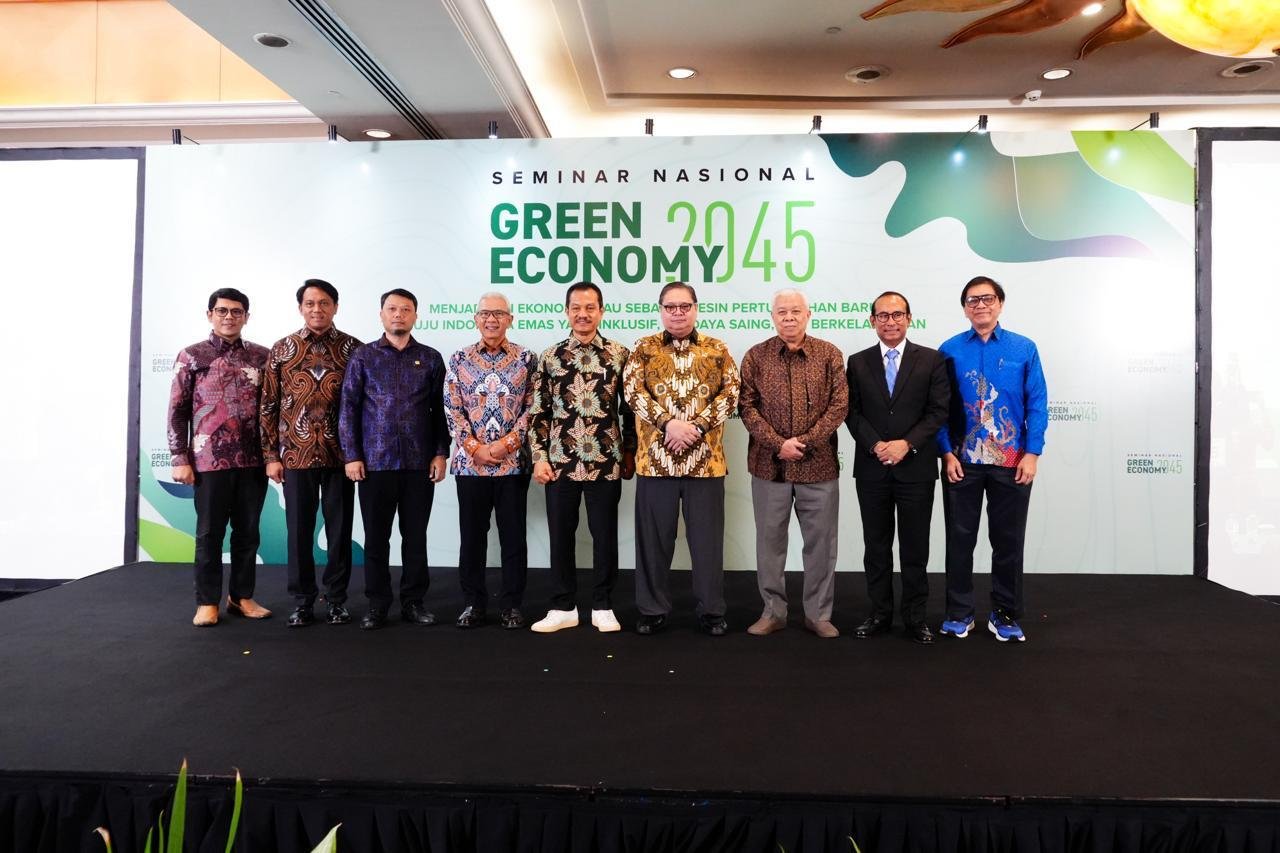
BALINEWSID.COM, JAKARTA — Coordinating Minister for Economic Affairs Airlangga Hartarto has identified green energy and digital development as two key engines of Indonesia’s economic growth as the country seeks to maintain momentum amid global uncertainty.
Airlangga said the development of both sectors would play an important role in the government’s efforts to achieve its target of 6 percent economic growth in 2027 while strengthening Indonesia’s competitiveness over the longer term.
“So this is the twin engine between green energy and digital development, and this presents an opportunity for Indonesia to become the host of energy in its own country,” Airlangga said at the Investortrust National Seminar titled Green Economy 2045: Making the Green Economy a New Growth Engine Toward an Inclusive, Competitive and Sustainable Golden Indonesia in Jakarta on Tuesday (Sept. 29, 2026).
Indonesia’s economy grew 5.45 percent in the first half of 2026 on a cumulative-to-cumulative basis, while annual inflation stood at 3.19 percent in August.
To achieve 6 percent economic growth in 2027, the government estimates that investment needs to grow by around 8 to 9 percent, with required investment estimated at between Rp2.218 quadrillion and Rp2.258 quadrillion.
According to Airlangga, reliable and affordable energy is a key prerequisite for attracting higher-value investment. National electricity demand is projected to reach 700-800 terawatt-hours by 2030.
In line with this projection, President Prabowo Subianto has called for electricity generation capacity to be increased to 100 gigawatt-peak over the next several years.
Government Seeks Faster Energy Transition
Airlangga said the use of solar power combined with battery storage systems could help reduce emissions from the electricity sector.
“If electricity is based on solar panels and battery storage systems, emissions would be zero. So our target of bringing emissions close to zero by 2060 could potentially be brought forward by 10 to 15 years. This is certainly a challenge for all of us,” he said.
In addition to expanding generation capacity, the government plans to build approximately 47,758 circuit-kilometers of transmission infrastructure to strengthen electricity reliability.
The transmission network is also expected to provide industries with greater flexibility in choosing energy sources based on their needs.
The government is also expanding electricity access through its Village Electrification Program. The program completed projects in 1,505 locations in 2025 and is targeting 4,390 locations in 2026.
“If all of this goes according to plan, electrification will approach more than 99 percent and the energy resilience index will also increase to 7.13. Energy remains the largest source of emissions, which is why the President is pushing the 100-gigawatt program,” Airlangga said.
Critical Minerals Support Green Industry
Indonesia’s green economy ambitions are also supported by its strategic mineral resources, including nickel, tin, bauxite, copper, gold and coal.
The government is promoting downstream processing of these resources using clean, reliable and affordable energy to increase domestic added value.
The development of the electric vehicle ecosystem is among the sectors being prioritized. The government estimates that the sector has the potential to generate 67 times greater added value, with demand projected to reach US$5.91 trillion by 2045.
Airlangga said the development of critical mineral and electric vehicle ecosystems could strengthen Indonesia’s position in global clean-energy supply chains.
He noted interest from several countries and regions, including the European Union, the United States and Canada, in cooperation with Indonesia on critical minerals.
Indonesia also has significant silica sand resources, which Airlangga said could support the development of a domestic solar panel industry.
“This is truly a golden moment for Indonesia to develop these opportunities. We also have significant amounts of silica sand, which could help us become a host for solar panel production,” he said.
Green Financing and Digital Economy
To support clean-energy projects, the government is encouraging the use of various green financing instruments, including green bonds, blended finance, the Just Energy Transition Partnership (JETP) and the Asia Zero Emission Community (AZEC).
The government is also strengthening human resources through university graduate internship programs and vocational programs aimed at creating jobs and meeting workforce demand in the green economy.
Airlangga said the development of green energy would also be closely linked to Indonesia’s digital transformation.
A reliable and clean energy supply is expected to provide an important foundation for the expansion of digital industries, including data centers, which are projected to continue growing in the coming years.
The government is therefore positioning green energy and digital development as interconnected drivers of Indonesia’s economic transformation toward 2045.



Discussion (0)
No comments yet.