
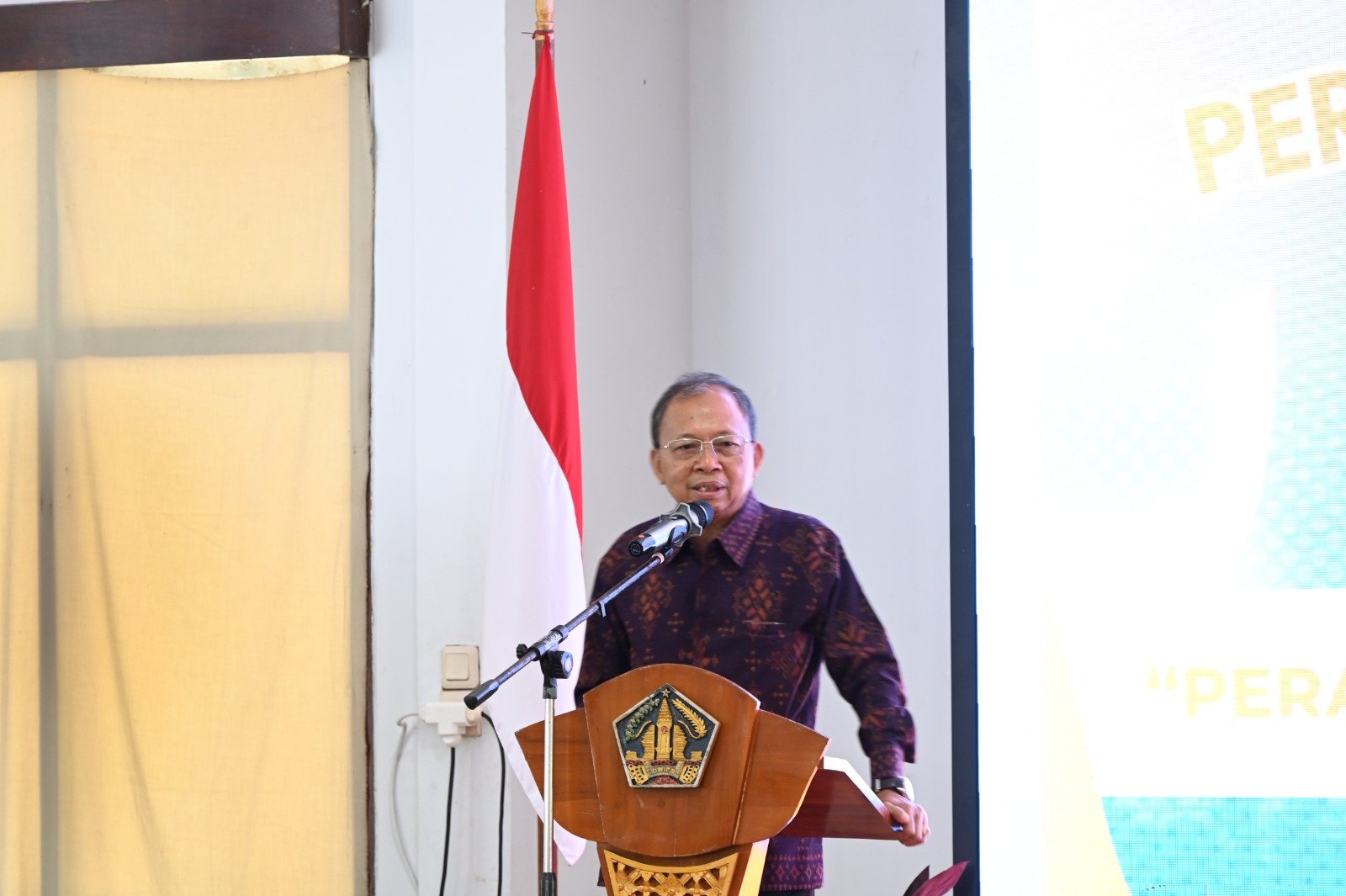
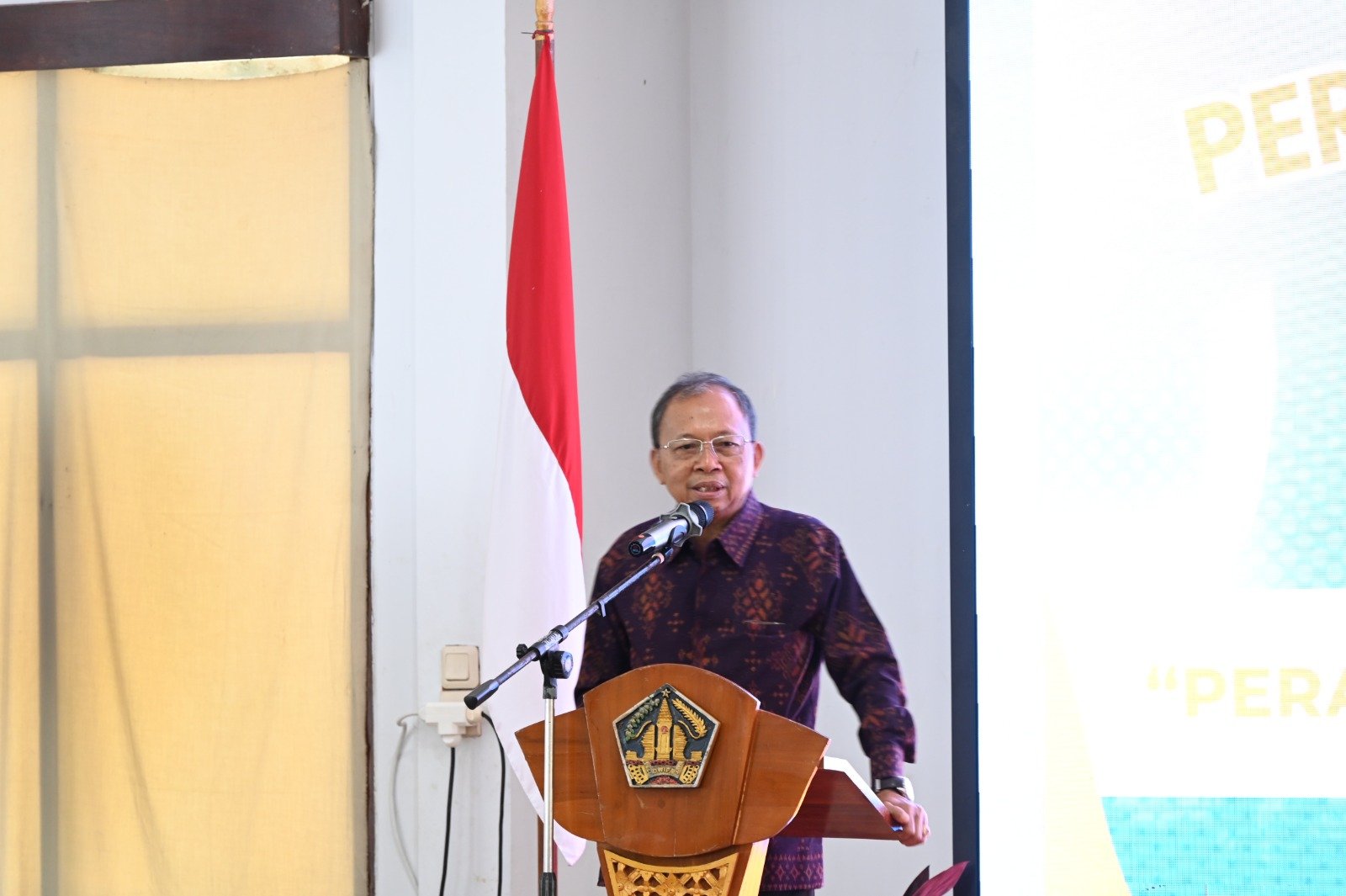
BALINEWSID.COM, DENPASAR — Bali Governor Wayan Koster has called for stronger protection of agricultural land as investment and tourism development continue to put pressure on the island’s limited land resources.
“Do not sacrifice Bali just because of money,” Koster said while delivering a keynote address at a seminar on protecting agricultural land amid investment pressures and promoting sustainable development in Bali at Hongkong Garden Restaurant in East Denpasar on Sunday (Sept. 20).
Koster said restrictions on land conversion alone would not be sufficient to protect farmland. Farmers must also receive economic incentives that make agriculture a viable livelihood.
“If we only impose restrictions without providing incentives to farmers, it will be difficult,” he said.
Bali, which covers about 5,590 square kilometers and has a population of around 4.4 million, faces growing competition for land as investment and tourism expand.
Koster said selling farmland could become an attractive option for farming families when investors offer prices equivalent to 10 to 20 years of agricultural income. Without economic support, he said, farmers could find it increasingly difficult to resist selling their land.
The governor also linked farmland protection to Bali’s food security. Continued conversion of agricultural land, he said, could threaten the island’s ability to maintain food production.
The issue is compounded by the aging agricultural workforce. Many of Bali’s farmers are over 50, while fewer young people are entering the sector.
“Protecting agricultural land without ensuring that there are farmers to work it will not solve the problem,” Koster said, emphasizing that land protection must be accompanied by efforts to improve farmers’ welfare and encourage generational renewal.
Tourism Growth Adds Pressure
The pressure on land comes as Bali’s tourism sector continues to expand.
In 2025, Bali recorded about 7.05 million international tourist arrivals, an 11.4 percent increase from the previous year. Domestic tourist visits reached about 9.3 million, bringing total tourist visits to roughly 16.3 million.
Koster said Bali’s tourism sector generated around Rp176 trillion in foreign exchange earnings, or about 55 percent of the national tourism foreign exchange earnings of Rp319.9 trillion.
Bali’s economic indicators also improved in 2025. Economic growth reached 5.82 percent, up from 5.48 percent in 2024, while gross regional domestic product (GRDP) per capita rose to Rp72.66 million from Rp67.32 million.
The province’s poverty rate declined from 3.80 percent to 3.42 percent, while the open unemployment rate fell from 1.79 percent to 1.45 percent. Bali’s Human Development Index increased from 78.63 to 79.37.
Despite the economic gains, Koster highlighted a significant development gap between the Sarbagia area and other parts of Bali.
Sarbagia, covering about 16 percent of Bali’s territory, contributes around 83 percent of the province’s locally generated revenue, or approximately Rp10.9 trillion. Areas outside Sarbagia, which cover about 84 percent of Bali, contribute only about 17 percent, or Rp2.3 trillion.
Koster said more balanced infrastructure development was needed to reduce the disparity. However, Bali’s limited fiscal capacity means the province needs greater cooperation with the central government to finance major infrastructure projects.
Stronger Controls on Land Ownership
Bali has introduced Provincial Regulation No. 4 of 2026 on the control of productive land conversion and a ban on nominee-based land ownership.
Koster also urged notaries and land deed officials, known as PPAT, to take a more active role in preventing nominee practices.
“Notaries and PPATs are at the forefront of preventing nominee practices,” he said.
Koster said the role of notaries and PPATs should go beyond formalizing transactions, with greater attention to preventing land ownership arrangements that circumvent Indonesian land ownership rules through nominee schemes.
The land protection policy is part of Bali’s broader development framework based on the Nangun Sat Kerthi Loka Bali vision and the Haluan Pembangunan Bali Masa Depan, 100 Tahun Bali Era Baru 2025–2125, established through Bali Provincial Regulation No. 4 of 2023.
The framework emphasizes the protection of Bali’s natural environment and community life through the six principles of Sad Kerthi: Jana Kerthi, Jagat Kerthi, Atma Kerthi, Segara Kerthi, Danu Kerthi and Wana Kerthi.
Koster said Bali’s development should not focus solely on short-term economic gains. The protection of water sources, lakes, springs, rivers, coastal areas, conservation zones, forests and agricultural land, he said, must remain part of the province’s long-term development strategy.
The seminar was attended by Joko Subagya, Director of Land Affairs Case Management at the Ministry of Agrarian Affairs and Spatial Planning/National Land Agency (ATR/BPN); Eko Priyan, Head of the Bali Regional Land Office; I Wayan Muntra, chairman of the Bali chapter of the Indonesian Notary Association; and members of the association from across Bali.





Discussion (0)
No comments yet.