
BALINEWSID.COM, JAKARTA — The Ministry of Home Affairs has called for a comprehensive evaluation of government interventions to stabilize food prices after price increases continued to occur in a number of regions across Indonesia.
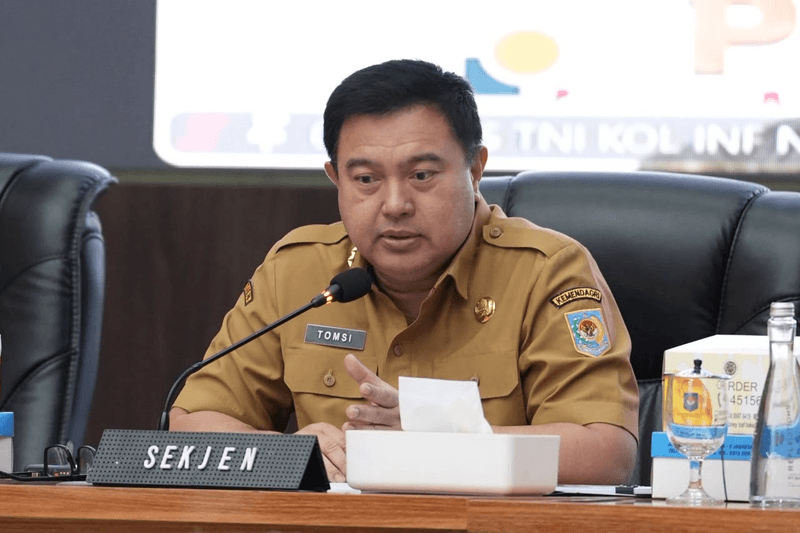
Secretary General of the Ministry of Home Affairs Tomsi Tohir made the call during the 2026 Regional Inflation Control Coordination Meeting, held alongside an evaluation of local government support for the government’s 3 Million Homes Program at the ministry’s headquarters in Jakarta on Monday (Sept. 21, 2026).
Tomsi said food price controls must be carried out consistently as food prices have a direct impact on people’s purchasing power. He added that the weekly regional inflation control meeting, which has been held nearly 200 times, would continue as part of efforts to maintain price stability.
“Today marks nearly 200 weekly meetings, and we will continue holding them to keep the prices of goods, particularly food, stable, so that people’s purchasing power can be maintained,” Tomsi said.
According to data presented by Statistics Indonesia (BPS), Indonesia recorded monthly inflation of 0.21 percent in August 2026. The food, beverages and tobacco group recorded inflation of 0.57 percent, contributing 0.17 percentage points to overall inflation.
Several commodities contributed to the increase, including chicken, bird’s eye chili, fresh fish and rice.
Price increases were also recorded in several provinces. North Sulawesi and Gorontalo recorded relatively high Price Development Index (IPH) figures of 12.45 percent and 10.25 percent, respectively.
The commodities contributing to price increases in the two provinces included bird’s eye chili, red chili, beef and rice.
Tomsi stressed that government interventions should not be assessed merely by whether programs have been implemented, but also by their actual impact on prices in the market.
He called for regions that have received government assistance to be invited to a special meeting with the Ministry of Agriculture to assess whether the assistance has effectively contributed to controlling food prices.
Tomsi also raised concerns over rice prices following a presentation by state-owned logistics company Bulog. According to the presentation, 135 regencies and municipalities were still experiencing increases in rice prices.
Among the areas with relatively high rice prices were Mahakam Ulu Regency and Maybrat Regency. Tomsi urged Bulog to work with the affected local governments to identify the reasons rice prices had yet to decline.
“The efforts have been good, and I really appreciate them. But we cannot have good efforts while the results are not yet good. We have to find out why,” Tomsi said.
Tomsi acknowledged the various price stabilization measures undertaken by Bulog. However, he emphasized that further work was needed to ensure government interventions translated into tangible benefits for the public.
“There is still a lot of work to do to maintain price stability,” he said.





Discussion (0)
No comments yet.