
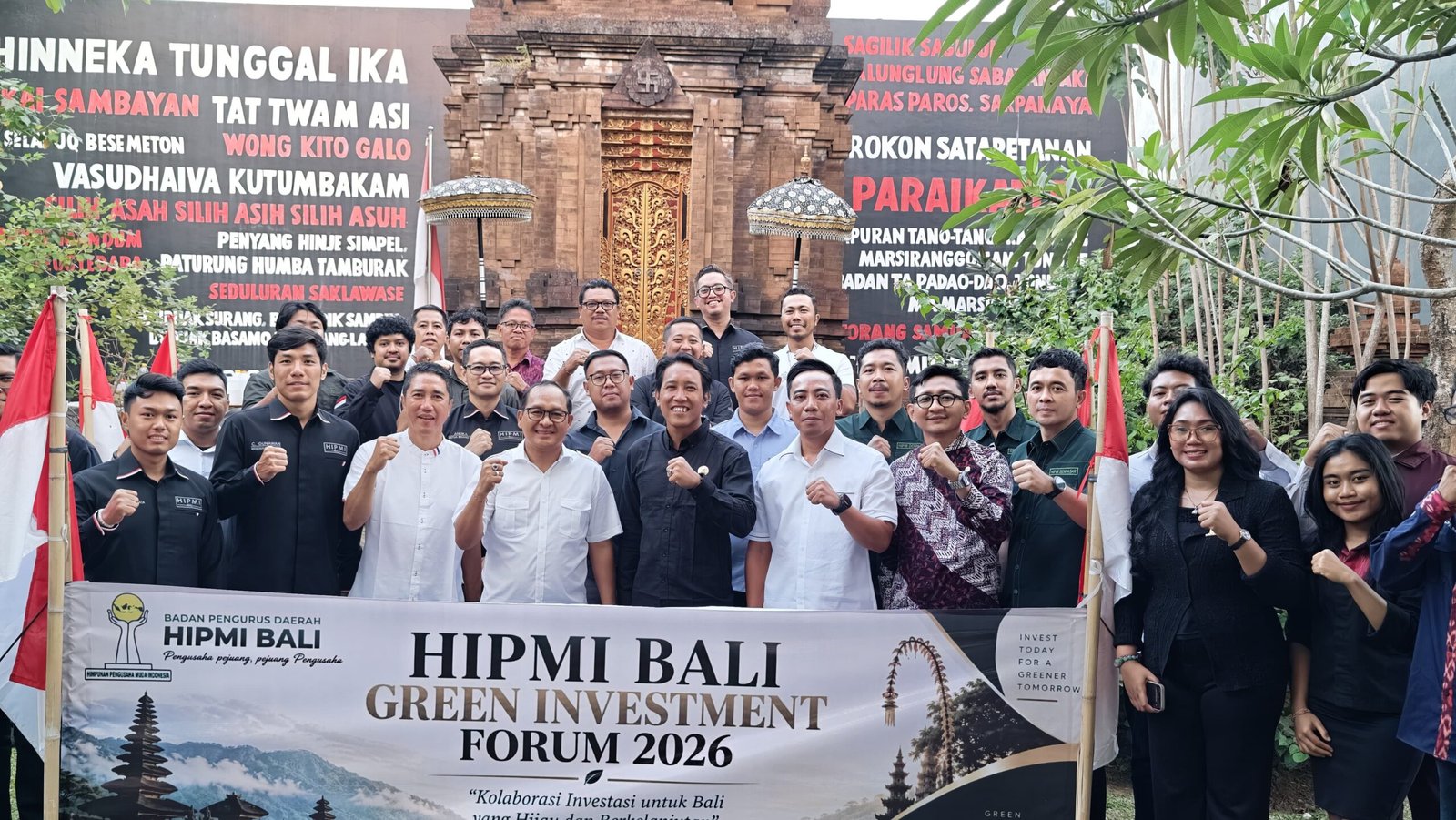
BALINEWSID.COM, DENPASAR – The Indonesian Young Entrepreneurs Association (HIPMI) Bali has reaffirmed that Bali remains open to investment, but stressed that investment must not come at the expense of the island’s environment, culture, water resources, spatial planning, or local communities.
The statement was made during the HIPMI Bali Green Investment Forum 2026, themed “Investment Collaboration for a Green and Sustainable Bali,” held in Denpasar on September 4, 2026.
Chairman of the HIPMI Bali Regional Board, Agung Bagus Pratiksa Linggih, said Bali needs high-quality investment that generates added value for the region, creates jobs, strengthens the local economy, and does not increase the island’s ecological burden.
“Bali is open to investment, but such investment must provide added value, create jobs, strengthen the local economy, and not add to Bali’s ecological burden,” Agung said.
He emphasized that the success of investment in Bali should no longer be measured solely by investment value and economic growth. The benefits received by local communities, the number of jobs created, environmental impacts, and respect for Balinese culture and local wisdom should also be taken into account.
HIPMI Bali believes the ideal investment model is one that creates not only economic value, but also social and environmental value.
Meanwhile, HIPMI Bali’s Head of Division 3, I Ketut Sae Tanju, stressed that the concept of green investment must be translated into measurable standards and practices rather than remaining merely a slogan.
“Green investment must comply with spatial planning and environmental carrying capacity. Water is a strategic asset for Bali, so investment must protect water resources while promoting a circular economy, clean energy, waste management, and sustainable tourism,” Sae Tanju said.
The forum produced the 10-point HIPMI Bali Green Investment Declaration, which emphasizes the need for investments to generate added value, reject investment practices that sacrifice the environment, protect water resources and spatial planning, and strengthen the local economy.
The declaration also calls for Balinese culture and local wisdom to become integral components of investment models. HIPMI Bali further proposed the establishment of a Bali Green Investment Catalogue as a roadmap for green investment projects across the island.
The catalogue is expected to help connect sustainable development priorities with potential investors while providing clearer opportunities for investment that meet Bali’s environmental and social requirements.
HIPMI Bali also called for stronger collaboration among the government, business community, investors, traditional villages, local communities, academics, and environmental groups.
Such collaboration, the organization said, is essential to ensure that investment growth remains aligned with Bali’s environmental carrying capacity and long-term sustainability.
HIPMI Bali is seeking to shift the investment paradigm from simply attracting capital to ensuring that only investments considered appropriate and beneficial for Bali are allowed to proceed.
“We want to change the paradigm from ‘investment coming in’ to ‘investment that is worthy of entering Bali.’ This is what will make green investment a reality and bankable,” Sae Tanju said.
The forum concluded with HIPMI Bali’s central message: “Investment Grows, Bali Remains Whole.”




Discussion (0)
No comments yet.