
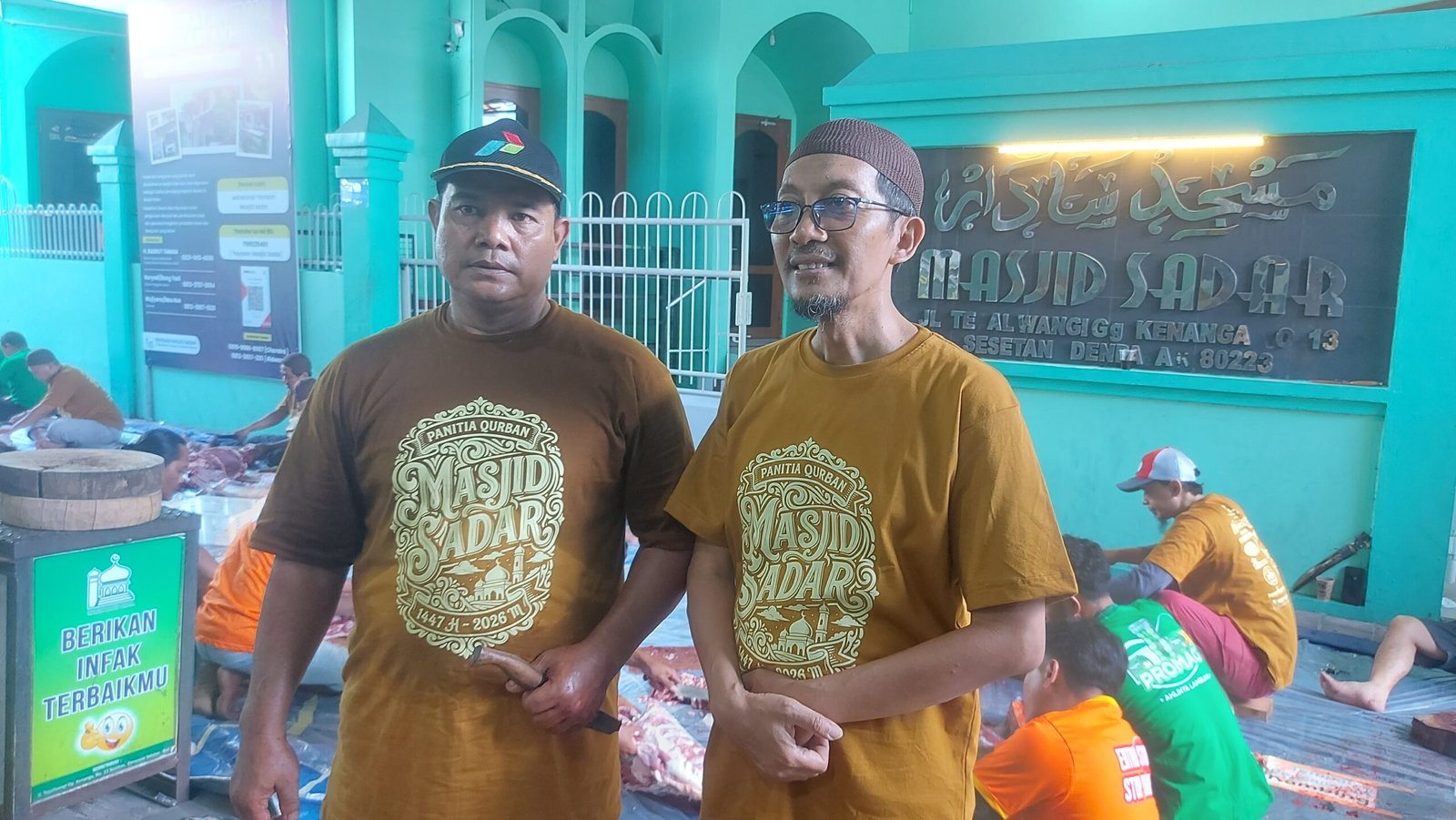
BALINEWSID.COM, DENPASAR — Eid al-Adha 1447 Hijriah celebrations at Mosque Sadar in the Tukad Tegal Wangi area of Sesetan, South Denpasar, were marked by strong community participation and environmental awareness on Wednesday (May 27, 2026).
This year, the mosque’s qurban committee slaughtered 13 cows and 57 goats while ensuring that animal waste was managed properly to prevent environmental pollution around the mosque complex.
Chairman of the Mosque Sadar Foundation, Badrut Tamam, said the annual qurban program continued to grow due to increasing participation from worshippers and donors.
“Alhamdulillah, today we carried out the slaughter of 13 cows and 57 goats. These are mandates entrusted by donors to the committee,” Badrut said on the sidelines of the event.
He explained that most of the sacrificial animals were donated by members of the mosque congregation, while others came from companies and families participating collectively in the qurban program.
The committee aims to distribute around 4,000 packages of qurban meat to nearby residents. In addition to Muslim recipients, about 500 packages will also be distributed to non-Muslim communities as a symbol of social harmony and tolerance.
“Approximately 500 packages are allocated for non-Muslim residents in the surrounding area, including village officials, pecalang, and community leaders,” he said.
A total of 230 people, including youth mosque members and volunteers, were involved in this year’s qurban activities. The slaughtering process was targeted to be completed within half a day so that meat distribution could begin in the afternoon.
Apart from community service, the foundation also paid close attention to waste management. The mosque has prepared a special treatment system resembling a septic tank to accommodate both solid and liquid waste from the sacrificial animals.
“We already have a treatment facility on the western side. The waste is managed independently to ensure it does not pollute the environment,” Badrut explained.
The foundation also collaborated with local researchers to apply special microorganisms designed to reduce odors from blood and animal waste.
“Hopefully this year will be better than before because we are already using certain microorganisms to eliminate odors,” added Badrut, who is also a lecturer at Poltekkes Kemenkes Denpasar.
To reduce plastic waste, the committee also began limiting the use of single-use plastic bags by utilizing woven bamboo containers, locally known as besek, for part of the meat distribution, particularly for cow donors.
Meanwhile, Head of the Eid al-Adha Committee, Rustam Effendy, said the increase in goat donations this year was supported by the foundation’s “Tabakur” (Qurban Savings) program.
Through the program, worshippers can save money flexibly on a daily, weekly, or monthly basis to prepare for purchasing sacrificial animals.
“The number of goats increased from 50 to 57 this year because the community was greatly helped by the qurban savings program,” Rustam said.
To ensure the health of the sacrificial animals, the foundation also collaborated with veterinarians from Udayana University and the Bali branch of the Indonesian Veterinary Medical Association. Health inspections were conducted before slaughter, and all animals were declared healthy and fit for sacrifice.




Discussion (0)
No comments yet.