
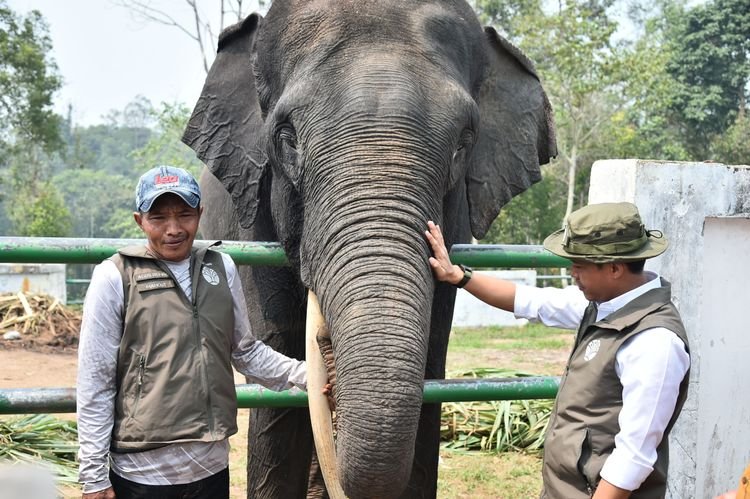
BALINEWSID.COM, JAMBI — The Ministry of Forestry is strengthening the protection of Sumatran elephant habitats and movement corridors across the Bukit Tigapuluh Landscape in Jambi and Riau provinces to maintain habitat connectivity and reduce potential human-elephant conflict.
The Bukit Tigapuluh Landscape is an important habitat for Sumatran elephants. Their range extends across areas with different functions, management statuses and stakeholders, making habitat connectivity a key component of long-term conservation efforts.
Protecting elephant corridors is intended to ensure that the animals retain connected areas for movement, feeding, access to water and natural breeding. Maintaining habitat connectivity can also help reduce pressure on elephant populations and minimize negative interactions between wildlife and local communities.
Forestry Minister Raja Juli Antoni highlighted the issue during a visit to the Elephant Conservation Information Center (PIKG) Tebo in Muara Sekalo Village, Tebo Regency, Jambi.
Raja Juli said elephant conservation could not rely solely on protected-area management. Communities living and working around elephant habitats must also be involved in conservation efforts.
“Law enforcement is important. But at the same time, we also need to provide alternatives. What are the ideal alternatives we can offer them? I think this is part of community empowerment that needs to be discussed properly. After all, protecting an area like this must also involve the community,” Raja Juli said.
He said law enforcement against activities that violate regulations should be accompanied by social and community empowerment measures, including alternative livelihoods that can reduce pressure on forest and elephant habitats.
PROTECT30 Supports Landscape Conservation
Protection of the Bukit Tigapuluh Landscape is also being strengthened through PROTECT30 (Promoting Sustainable Landscape Management through Biodiversity Conservation and Forest Positive Action in the Bukit Tigapuluh Landscape).
The initiative is a multi-stakeholder collaboration involving Proforest, WWF-Indonesia and KKI Warsi, with support from APP Group and coordination with the government, area managers, local communities, the private sector and other stakeholders.
Implementation also involves the Jambi Natural Resources Conservation Agency (BKSDA), the Jambi Provincial Forestry Office, Bukit Tigapuluh National Park authorities and local governments.
PROTECT30 focuses on habitat protection and restoration, strengthening elephant movement corridors, building the capacity of communities and stakeholders, developing alternative livelihoods and improving landscape governance.
The PROTECT30 consortium presented updates on the program and its planned activities, including monitoring elephant habitats and movement routes, improving habitat quality, strengthening landscape governance and supporting local communities.
One field intervention involves enriching elephant food sources across approximately 2.8 hectares by planting sugarcane, bananas, pineapples and elephant grass. The initiative is intended to improve food availability while supporting habitat quality.
Private-sector support, including from APP Group, is also part of the multi-stakeholder collaboration supporting conservation and landscape management efforts.
Balancing Conservation and Community Needs
Jambi Governor Al Haris emphasized the need to balance elephant conservation with the interests of communities living around wildlife habitats.
“What is being done here is extraordinary, from caring for elephants and planting grass for their food to providing education. What is also important is that the minister directly listened to community concerns about the elephants. So we need to ensure that the elephants are protected while also paying attention to the people living around them,” Al Haris said.
The Ministry of Forestry said a landscape-based approach is essential because the natural range of Sumatran elephants does not follow administrative boundaries or the boundaries of individual conservation areas.
Protecting elephant corridors therefore requires coordination across regions and institutions, data sharing, field monitoring, habitat management, mitigation of human-wildlife interactions and sustained community participation.
Going forward, the government plans to strengthen monitoring of elephant habitats and movement routes, improve habitat quality, enhance landscape governance, mitigate human-elephant interactions and develop sustainable livelihood options for local communities.
The efforts are intended to ensure that Sumatran elephants retain sufficient habitat to move, forage and reproduce naturally while allowing conservation, sustainable landscape management and community livelihoods to coexist.







Discussion (0)
No comments yet.