
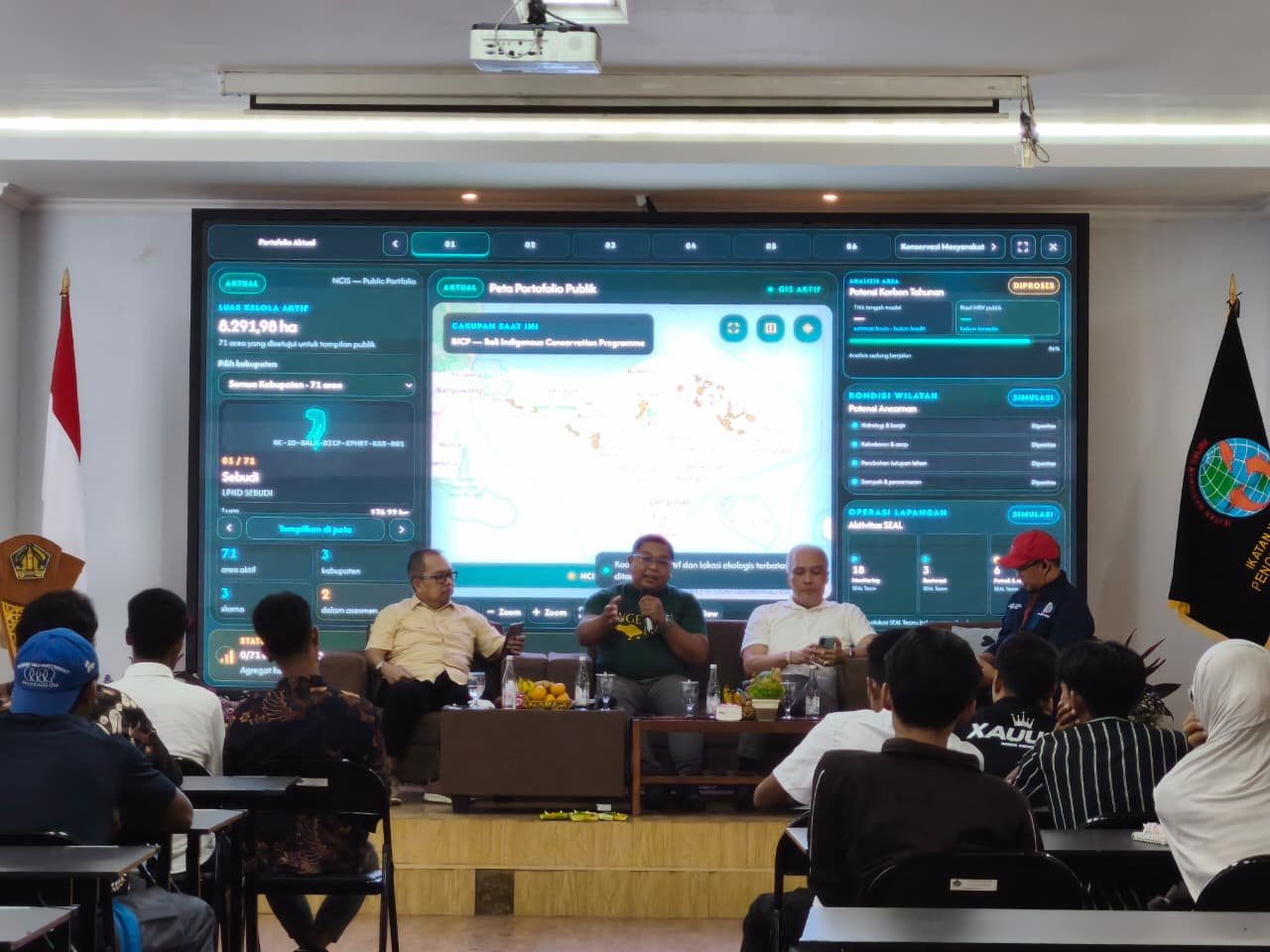
BALINEWSID.COM, DENPASAR — Mahardhika Institute President Director Eka Mahardhika has introduced the concept of “Ngempu Bali,” a cultural movement aimed at bringing Bali’s tourism development back to three fundamental pillars: nature, people and culture.
Eka presented the concept during a public discussion titled “Viewing Bali from a Different Perspective,” organized by the Bali chapter of the Online Journalists Association (IWO) as part of the celebrations marking the 14th anniversary of IWO Indonesia and the first anniversary of IWO Bali. The event was held at the Bali Tourism Office auditorium in Renon, Denpasar, on Sunday, August 31, 2026.
According to Eka, the rapid expansion of Bali’s tourism industry needs to be accompanied by greater awareness of the island’s identity and cultural roots. He said tourism should not be driven solely by commercial interests and economic growth.
“In Balinese, ngempu means to care for, preserve and educate. The term is closely associated with the role of someone who looks after and takes responsibility for something entrusted to them,” Eka said.
He explained that Ngempu Bali is based on the principle of Tri Dharma Wangsa Bali, which consists of Ngempu Alam (caring for nature), Ngempu Manusia (caring for people), and Ngempu Budaya Bali (caring for Balinese culture).
For Eka, ngempu goes beyond physical preservation. It also involves education, responsibility and a reciprocal relationship between humans and the things they are entrusted to protect.
In the context of Bali, he said, the principle is particularly important because tourism cannot be separated from the island’s environment, communities, traditional institutions, culture and spirituality.
“Bali is not merely a tourist destination, but a living space that must be protected collectively,” he said.
Drawing on Ancestral Values
Eka said the Ngempu Bali concept is closely connected to the ancestral values of Balinese society, including those reflected in the Bhisama Lontar Batur Kelawasan.
According to Eka, the traditional teachings emphasize the importance of protecting mountains and the sea as essential elements of life. Mountains are regarded as sources of sacredness, while the sea is viewed as a place for cleansing impurities.
The teachings also remind people to live from the fruits of their own labor and avoid building their livelihoods by damaging nature.
Eka said these ancestral values remain relevant as Bali faces growing challenges from population growth, development, environmental pressure and increasingly intensive tourism activity.
Aligned with Nangun Sat Kerthi Loka Bali
The Ngempu Bali concept is also positioned within the framework of Nangun Sat Kerthi Loka Bali, a development vision that places nature, people and culture at the foundation of Bali’s future.
The vision is reflected in the Sad Kerthi, six principles covering Atma Kerthi, Segara Kerthi, Danu Kerthi, Wana Kerthi, Jana Kerthi and Jagat Kerthi.
Under the Ngempu Bali framework, these six principles are translated into concrete responsibilities for protecting life in Bali.
Atma Kerthi, for example, focuses on preserving Balinese spirituality, traditional villages, temples, sacred objects, religious symbols, as well as the Balinese language, script, literature and cultural heritage.
Segara Kerthi emphasizes protecting the sea and coastal areas, including beaches and rivers, while raising public awareness about waste and environmental issues.
Danu Kerthi focuses on protecting springs and lakes as vital sources of life, while Wana Kerthi emphasizes the preservation of vegetation and plants, including native Balinese species.
Meanwhile, Jana Kerthi focuses on developing Bali’s human resources and ensuring that local communities remain subjects of development while maintaining their cultural roots.
Jagat Kerthi, meanwhile, represents the broader responsibility of protecting the entire island of Bali as a complex living environment that requires focused, consistent and sincere management.
From Concept to Movement
Eka emphasized that Ngempu Bali should not remain merely a philosophical idea, but should be translated into concrete action across various areas of life.
In the fields of spirituality and culture, the concept includes strengthening traditional villages, protecting sacred areas, preserving Balinese culture, and promoting the Balinese language, script and literature.
In environmental protection, Ngempu Bali promotes the preservation of lakes, springs, rivers and seas, reductions in single-use plastic waste, source-based waste management and the conservation of native Balinese plants.
In terms of human development, the concept includes strengthening the traditional economy, improving the quality of human resources, protecting Balinese migrant workers, promoting traditional healthcare and supporting cultural development programs.
At the island-wide level, the concept also encompasses initiatives such as Organic Bali, energy independence through clean energy, battery-powered electric vehicles, the Kerthi Bali Economy, balanced development between regions, and high-quality and dignified cultural tourism.
It also includes strengthening local products, protecting Balinese intellectual property, digitalization, developing cultural centers, improving interregional connectivity and positioning Bali as a maritime tourism hub.
Tourism Must Not Lose Its Identity
Eka said the success of Bali’s tourism development should not be measured solely by tourist arrivals, investment figures or economic growth.
He argued that a more fundamental measure is whether development can protect nature, uphold human dignity and preserve culture as the core identity of Bali.
Under the Ngempu Bali perspective, local communities should not merely serve as supporting players in the tourism industry.
“Local communities must be positioned as an integral part of development and as drivers of change,” Eka said.
Eka, who also currently serves as an adviser to the Bali governor, said Ngempu Bali is ultimately an invitation to view Bali as a shared home—a place that sustains its people while requiring respect and responsibility from everyone who lives in it.
“When nature is protected, people are respected and culture is preserved, tourism is no longer merely an economic engine. It can grow as part of Bali’s way of life while remaining rooted in values, balance and identity,” he said.


Discussion (0)
No comments yet.