
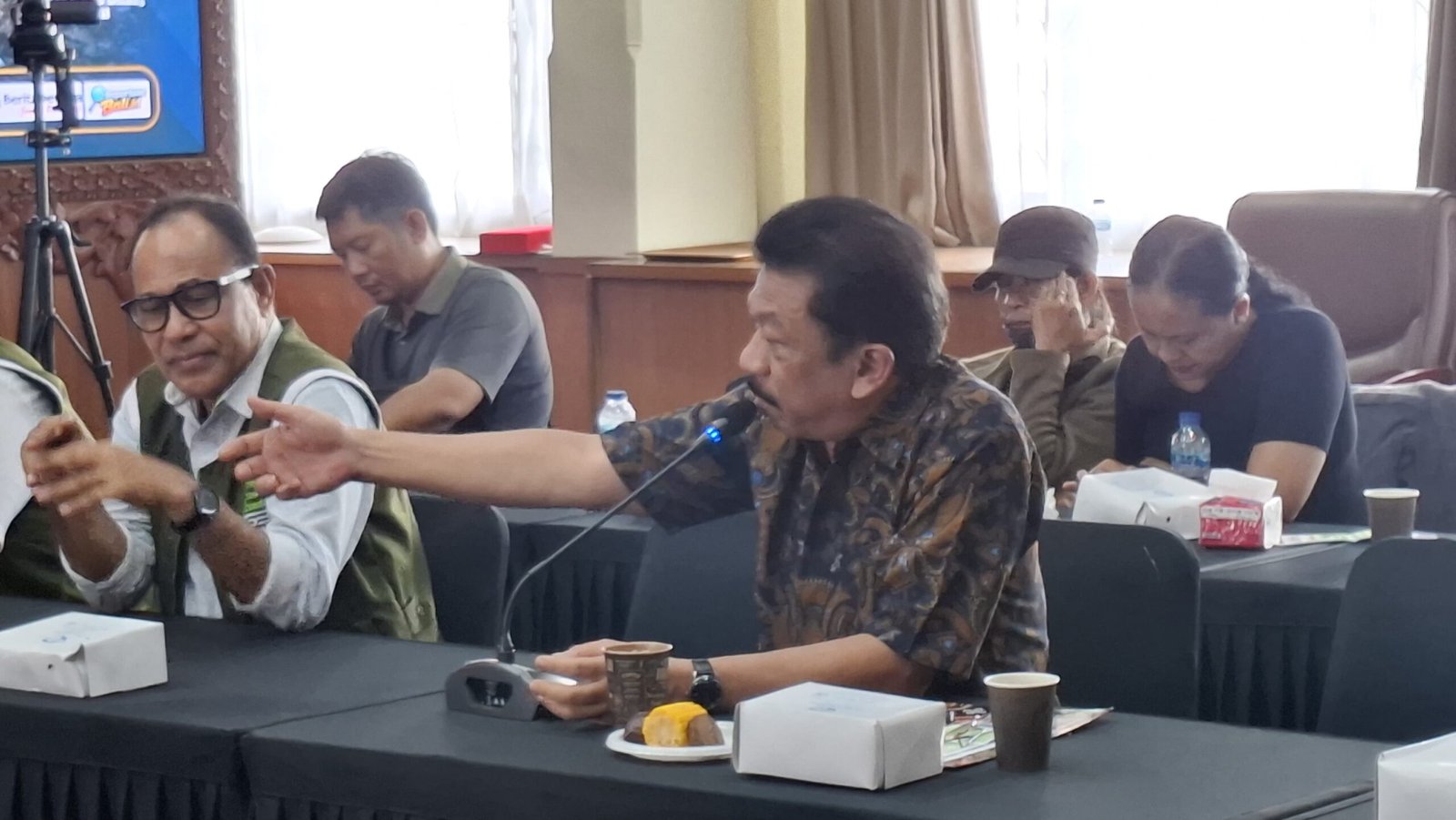
BALINEWSID.COM, DENPASAR — Bali’s ongoing waste crisis has once again come under sharp public scrutiny, with environmental activists and civil society representatives criticizing what they describe as weak inter-agency coordination and poor grassroots supervision in handling the island’s mounting garbage problem.
The concerns were raised during a Focus Group Discussion (FGD) titled “Behind the Closure of Suwung Landfill, Who Benefits?” held in Denpasar on Saturday.
Environmental activist Syamsunar said Bali’s waste issue is not merely about building new landfill sites, but rather the lack of strong government commitment to improving the waste management system from upstream to downstream.
According to him, the problem will never be fully resolved as long as sectoral ego among government institutions continues to hinder cooperation. He stressed that all stakeholders — including the government, military, police, media, and the public — must unite in one coordinated movement.
“If the government does not have the full determination to solve this, the problem will continue like this,” he said.
Syamsunar also warned that constructing landfill facilities without strengthening public education and changing community behavior would only create temporary solutions. He pointed to urban areas, traditional markets, and the hospitality industry as major contributors to daily waste generation, particularly plastic waste and food leftovers.
He highlighted the high volume of waste produced daily by hotels in tourism hubs such as Kuta and Legian. Without disciplined waste management at both household and business levels, he said, even the largest waste management systems would struggle to operate effectively.
“Building landfill sites alone is pointless if the upstream problems are ignored. Education and synergy are the keys,” he added.
Syamsunar also called for stricter law enforcement against littering and illegal dumping. He argued that supervision should not rely solely on local governments, but must also involve traditional villages, banjar communities, and residents.
Meanwhile, civil society representative Anak Agung Ngurah Bagus Kesuma Yudha described Bali’s waste crisis as the accumulation of years of systemic failure in waste governance.
He said that despite the enactment of Indonesia’s Law No. 18 of 2008 on Waste Management, policy implementation in Bali has remained far from optimal.
Yudha noted that Bali has issued more than a dozen waste-related regulations between 2008 and 2025. However, he said there were long periods without significant progress, particularly in strengthening landfill infrastructure and waste management systems.
“It feels like the state’s responsibilities are being shifted onto the people. Communities are told to manage waste themselves and establish TPS3R facilities, while the government focuses only on socialization programs and pilot projects,” he said.
He emphasized that under Law No. 18 of 2008, regency and municipal governments have clear obligations in waste management, meaning the responsibility cannot be entirely transferred to communities.
Yudha also highlighted the large waste management budget currently allocated in Bali. He compared it with Banyumas Regency, which he said has managed waste effectively with a budget of around Rp54.3 billion, while Bali’s revised 2025 regional budget allocates hundreds of billions of rupiah for the waste sector.
According to him, the most fundamental step the government must take is ensuring that all existing regulations are properly implemented and supported by a clear monitoring system.
“If everything is thrown back to the community, today’s discussion will remain nothing more than a story,” he stressed.
During the discussion, both speakers agreed that Bali actually has the capacity to overcome its waste problems. However, they said a sustainable collective movement involving the government, lawmakers, businesses, academics, communities, and the media is urgently needed.
They also called for the creation of a “One Ecosystem Movement” based on the pentahelix collaboration model, which integrates five key elements — government, academia, private sector, communities, and media — through the spirit of mutual cooperation to address Bali’s waste crisis.






Discussion (0)
No comments yet.