
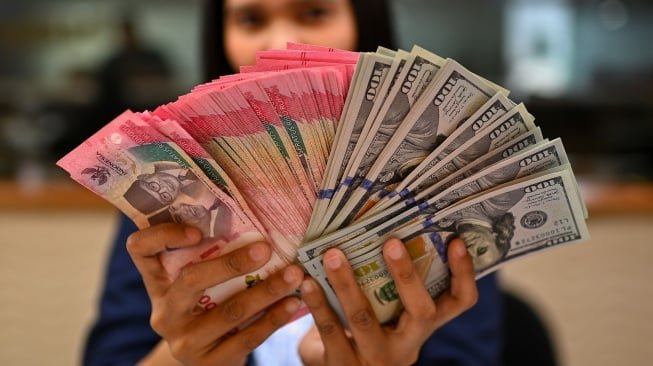
BALINEWSID.COM, JAKARTA — The Indonesian rupiah is nearing the psychological level of 18,000 per US dollar as rising global oil prices, higher US Treasury yields, concerns over global inflation and increased demand for foreign currency from importers put pressure on the currency.
In Tuesday’s trading session (September 29, 2026), the rupiah weakened by 3 points, or 0.02 percent, to Rp17,981 per US dollar in the spot market. The currency briefly fell to Rp18,036 per dollar before recovering some of its losses.
Meanwhile, based on Bank Indonesia’s Jakarta Interbank Spot Dollar Rate (JISDOR), the rupiah strengthened by 33 points, or 0.18 percent, to Rp17,998 per US dollar.
Erwin Gunawan Hutapea, head of Bank Indonesia’s Monetary and Securities Asset Management Department, said the rupiah was being pressured by growing concerns over global inflation and fiscal risks.
The pressure has intensified as global oil prices climbed above US$108 per barrel and US government bond yields increased.
“The depreciation of the exchange rate has been driven by continued concerns over global inflationary pressures and fiscal risks, in line with the increase in oil prices to above US$108 per barrel,” Erwin said.
The yield on 10-year US Treasury bonds has risen to 5.23 percent, its highest level since 2007. Higher US yields could limit capital flows into emerging markets as dollar-denominated assets become more attractive to investors.
The rupiah has also been affected by capital outflows from emerging-market portfolio assets. Domestically, demand for US dollars from importers ahead of the end of the third quarter of 2026 has added to pressure on the currency.
Bank Indonesia said the rupiah’s overall movement remained broadly in line with other regional currencies. On a quarter-to-date basis, the rupiah has weakened by 0.67 percent.
Despite the pressure on the currency, Indonesia’s foreign exchange reserves continued to strengthen. Bank Indonesia reported that reserves reached US$146.5 billion at the end of August 2026.
Bank Indonesia Steps Up Stabilization Measures
Bank Indonesia has strengthened measures to stabilize the rupiah through foreign exchange and financial market instruments without changing its benchmark interest rate.
At its Board of Governors meeting on September 23, 2026, the central bank kept the BI Rate unchanged at 5.75 percent.
Erwin said Bank Indonesia would continue to operate in the market to ensure that market mechanisms function properly and to maintain the rupiah’s stability in line with economic fundamentals.
The central bank has intervened through non-deliverable forward (NDF) transactions in offshore markets, spot and domestic non-deliverable forward (DNDF) transactions in the domestic market, as well as purchases of government bonds, or SBN, in the secondary market.
Bank Indonesia is also strengthening market-based monetary operations while maintaining adequate liquidity in the financial system.
Bank Indonesia Governor Destry Damayanti said the central bank was also using non-interest-rate measures to encourage capital inflows and increase the supply of US dollars in the domestic market.
“We are trying a new, targeted policy. How can we encourage inflows, because this is one of the things needed to increase the supply of US dollars and maintain rupiah stability,” Destry said at a press conference following the September 23 Board of Governors meeting.
Bank Indonesia has introduced incentives through reductions in premiums for conventional buy-side hedging swaps with the central bank. The premium reduction is set at 15 percent for three-month tenors, 20 percent for six-month tenors and 25 percent for 12-month tenors.
For DNDF instruments, the premium reduction is set at 25 percent for six-month tenors and 30 percent for 12-month tenors. Bank Indonesia is also continuing incentives for local currency transactions.
Destry said the expanded incentives would no longer cover only portfolio inflows but would also include external financing by banks and foreign direct investment (FDI).
Global Risks Remain in Focus
Pressure on the rupiah is closely linked to changing global financial conditions. Higher US Treasury yields can encourage investors to shift capital away from emerging markets toward dollar-denominated assets.
Destry said the increase in US Treasury yields could limit capital inflows into emerging markets, including Indonesia. In response, Bank Indonesia is optimizing its monetary policy mix, accelerating the deepening of money and foreign exchange markets and strengthening exchange-rate stabilization measures.
The government has also highlighted the potential impact of global monetary policy on domestic financial market stability.
The Ministry of Finance recorded cumulative foreign capital inflows into Indonesian government bonds and Bank Indonesia Rupiah Securities (SRBI) of Rp140.7 trillion as of September 14, 2026.
Finance Minister Suahasil Nazara said coordination between the government and Bank Indonesia was necessary to maintain macroeconomic stability and investor confidence.
The rupiah’s decline remains a concern because a weaker currency can increase the cost of imported goods and eventually add pressure to domestic inflation.
M. Rizal Taufikurahman, head of the Macroeconomics and Finance Center at the Institute for Development of Economics and Finance (Indef), said Bank Indonesia did not necessarily have to mechanically follow interest-rate moves by major global central banks as long as domestic inflation remained under control and the rupiah could still be stabilized.
However, Rizal said increasingly aggressive global monetary tightening could put greater pressure on the exchange rate and capital flows.
“An increase in the BI Rate could become an option when exchange-rate pressure becomes persistent and begins to spill over into inflation and market expectations,” he said.
Trioksa Siahaan, head of research at the Indonesian Banking Development Institute (LPPI), said Bank Indonesia needed strategies beyond the BI Rate to maintain rupiah stability.
One such measure, he said, was ensuring that domestic demand for US dollars was supported by clear underlying transactions.








Discussion (0)
No comments yet.