
BALINEWSID.COM, DENPASAR — Bali recorded Indonesia’s lowest official poverty rate in March 2026, with 3.44 percent of its population, or approximately 162,010 people, classified as poor under the national poverty standard used by Statistics Indonesia (BPS).
The figure marks a significant improvement from March 2025, when Bali’s poverty rate stood at 3.72 percent. However, the latest figure also highlights a more complex picture of welfare, particularly when poverty is measured using the international standard applied by the World Bank.
BPS data show that Bali’s poverty rate fell by 0.28 percentage points year-on-year. Yet compared with September 2025, the rate edged up slightly from 3.42 percent to 3.44 percent.
The number of poor people also declined by 11,230 from March 2025, but increased by 1,920 compared with September 2025.
Bali’s poverty line in March 2026 was set at Rp675,354 per person per month. Of this amount, Rp467,162, or 69.17 percent, represented the food poverty line, while Rp208,192, or 30.83 percent, represented the non-food component.
Nationally, Indonesia’s poverty rate stood at 8.07 percent in March 2026, equivalent to 22.93 million people. The national rate also declined from 8.47 percent in March 2025.
One Country, Two Poverty Pictures
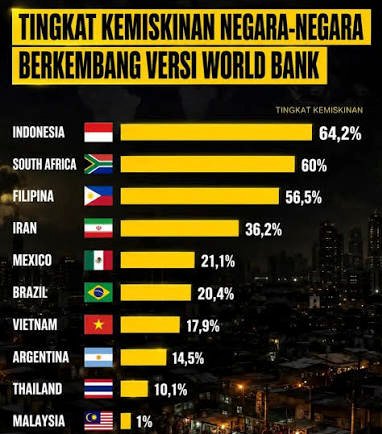
The contrast becomes more striking when Indonesia’s poverty is viewed through the World Bank’s international poverty benchmark.
In a joint statement released in September 2026, BPS and the World Bank explained that both institutions use the same underlying Susenas household survey data, but apply different methodologies because their measurements serve different purposes.
BPS measures poverty using a national poverty line based on living costs and consumption conditions in Indonesia. The national poverty line in March 2026 was Rp669,235 per person per month.
The World Bank, meanwhile, uses international poverty lines designed to facilitate comparisons of living standards across countries.
For upper-middle-income economies, the World Bank currently uses a threshold of US$8.30 in purchasing power parity (PPP) per person per day. In the joint statement, this was equivalent to approximately Rp51,087 per person per day.
Using that international benchmark, the World Bank estimated that 64.1 percent of Indonesia’s population in 2025 lived below the poverty line applicable to upper-middle-income countries.
That figure should not be interpreted as meaning that 64.1 percent of Indonesians were poor according to BPS’s national definition.
The two figures answer different questions and use different poverty thresholds.
The World Bank explained that the international threshold increased from US$4.20 to US$8.30 per person per day after Indonesia entered the upper-middle-income country group in 2023. The higher threshold naturally places a larger share of the population below the international line.
The change, however, does not mean that Indonesians’ living conditions automatically deteriorated. Rather, it reflects a change in the benchmark used to compare living standards internationally.
Bali’s 3.44 Percent Does Not Tell the Whole Story
For Bali, the 3.44 percent figure means that a relatively small proportion of the population falls below Indonesia’s official national poverty line.
But poverty statistics do not capture everyone who is financially vulnerable.
People living just above the poverty line may still face significant risks when food prices rise, housing costs increase, employment opportunities weaken or tourism activity slows.
That distinction is particularly relevant to Bali, whose economy has a strong dependence on tourism. Changes in tourist arrivals, household expenses and employment opportunities can affect households differently, including those that are technically above the official poverty line.
In other words, saying that Bali’s poverty rate is 3.44 percent does not mean that only 3.44 percent of the population faces welfare-related economic pressures.
Inequality Adds Another Layer
Bali’s inequality figures provide additional context.
BPS recorded a Gini ratio of 0.342 in March 2026, up from 0.333 in September 2025 but still below the 0.353 recorded in March 2025.
Meanwhile, under the World Bank’s distribution measure, the bottom 40 percent of Bali’s population accounted for 19.58 percent of total expenditure distribution.
Poverty and inequality measure different dimensions of economic welfare.
The poverty rate identifies the share of people living below a defined poverty threshold, while the Gini ratio and expenditure distribution indicators examine how economic resources are distributed across the population.
A low poverty rate, therefore, does not necessarily mean that income or expenditure is evenly distributed.
National Measure, Global Perspective
BPS and the World Bank emphasize that their respective poverty measures are not intended to replace one another.
For monitoring poverty trends in Indonesia and designing national policies, BPS’s national poverty measure remains the relevant benchmark.
By that measure, Indonesia’s poverty rate declined from 8.47 percent in March 2025 to 8.07 percent in March 2026.
The World Bank’s international poverty line serves a different purpose: providing a comparable measure of living standards across countries within similar income classifications.
This is why Bali’s 3.44 percent poverty rate and the World Bank’s 64.1 percent estimate for Indonesia cannot be directly compared as if they describe the same phenomenon.
The 3.44 percent figure answers one question: how many people in Bali live below Indonesia’s national poverty line?
The 64.1 percent figure answers another: how many Indonesians live below the World Bank’s international poverty threshold for upper-middle-income economies?
Both figures are based on socioeconomic data, but they use different thresholds and serve different analytical purposes.
For Bali, the policy challenge therefore extends beyond keeping the official poverty rate low. It also involves strengthening the economic resilience of households that have moved above the poverty line but remain vulnerable to rising living costs and economic shocks.







Discussion (0)
No comments yet.