
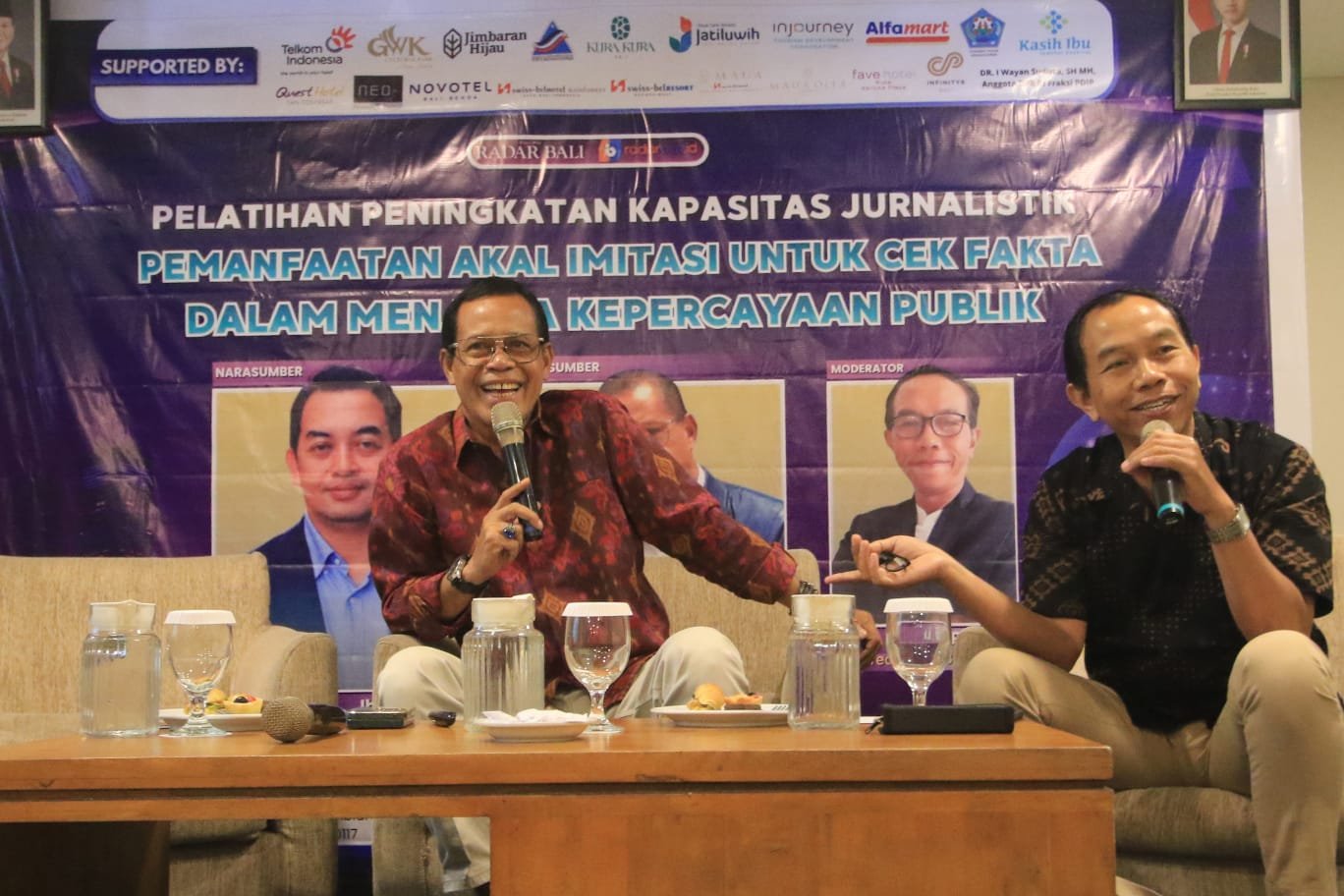
BALINEWSID.COM, DENPASAR – Radar Bali held a journalism capacity-building training session titled “Using Artificial Intelligence (AI) for Fact-Checking to Maintain Public Trust” at Quest Hotel in Denpasar on Saturday (September 5, 2026).
The training was aimed at strengthening journalists’ ability to respond to the disruption of information in the digital era while making responsible use of artificial intelligence for fact-checking and information verification.
Muhammad Ridwan, chairman of the organizing committee and editor-in-chief of radarbali.id, said adaptation and transformation were essential for journalists amid rapid technological developments.
“When we talk about journalism, whether at the basic or advanced level, the key is how we adapt to changes over time, from the conventional era to the digital era and now the era of AI,” Ridwan said after the training.
The advanced-level training was attended by journalists from various media platforms, including print, online, television and radio.
Ridwan, who also moderated the session, invited two media practitioners as speakers: Emanuel Dewata Oja, chairman of the Indonesian Cyber Media Association (SMSI) Bali, and Ibnu Yunianto, deputy director of Jawa Pos Radar Bali.
Emanuel Dewata Oja, popularly known as Edo, explained that the use of AI in journalistic work is governed by Press Council Regulation No. 1/Peraturan-DP/I/2025 on Guidelines for the Use of Artificial Intelligence in Journalistic Works.
Edo stressed that the use of AI is not prohibited in journalism. However, journalists must follow established guidelines and continue to prioritize the Journalistic Code of Ethics.
“Journalists must not become slaves to machines. A journalistic work can intersect with various legal regimes, so we have to be careful,” Edo said.
He said a proper understanding of AI-related regulations was important to prevent journalists from making mistakes that could lead to misinformation, disinformation or legal disputes.
Edo also highlighted various challenges faced by journalists, including legal pressure that may be deliberately used by certain parties to create a chilling effect on press freedom and journalistic work.
Meanwhile, media practitioner and digital media academic Ibnu Yunianto explained how currently available AI tools can be used to assist journalists, particularly in verifying information.
According to Ibnu, journalists should not be afraid that AI will take over their roles. Instead, AI should be treated as a tool to support and strengthen journalistic work.
He pointed to the growing dependence of journalists on social media as an initial source of information. Several studies presented during the training found that between 62 and 94 percent of journalists in different regions use social media as a reference when gathering material for news reports.
The high percentage, Ibnu said, demonstrated both the importance of social media and the significant challenge it poses to information verification, as much of the content circulating online has yet to be independently verified.
He urged journalists to sharpen their analytical and verification skills to avoid becoming part of the spread of hoaxes.
“Using AI for fact-checking can serve as a safeguard to ensure that our journalistic work remains precise and accurate while maintaining public trust,” Ibnu said.
He emphasized that public trust remains the media’s most valuable asset amid the massive flow of misinformation and social media content increasingly being used as a source for news.
The training featured an interactive discussion, with participants raising concerns and questions about the challenges, ethical considerations and boundaries surrounding the use of AI in everyday journalistic practices.
Ridwan said similar training programs could be expanded in the future to involve a wider range of participants, including not only field journalists but also editors and newsroom personnel.


Discussion (0)
No comments yet.