
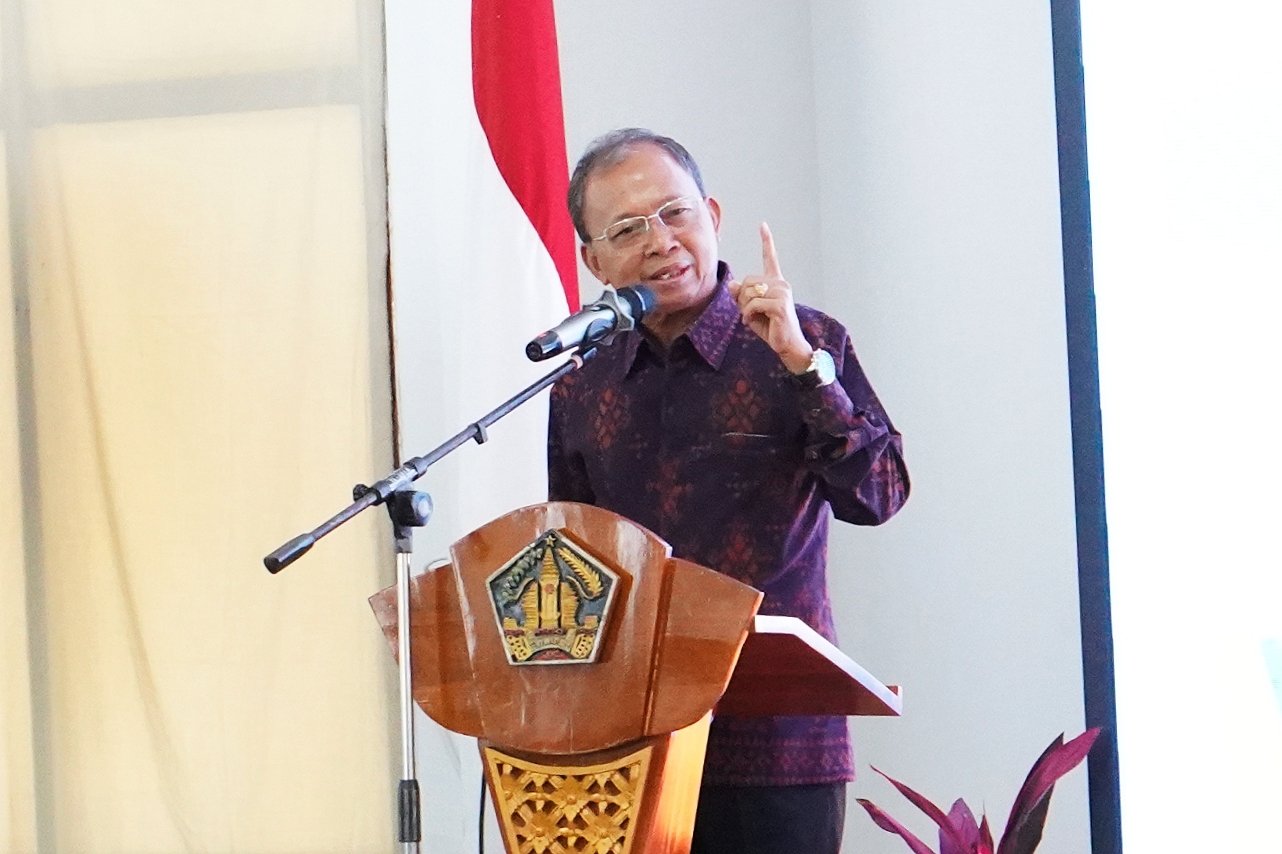
BALINEWSID.COM, DENPASAR — Bali must reduce its dependence on fossil fuels and electricity supplied from outside the island, Bali Governor Wayan Koster said, stressing that energy independence based on clean energy is crucial to the province’s future development.
Koster made the statement while attending the main celebration of the 14th anniversary of the Indonesian Online Journalists Association (IWO) and the first anniversary of IWO Bali at the Bali Provincial Tourism Office Hall in Denpasar on Sunday (August 30, 2026).
He said Bali’s development direction had been outlined in Bali Provincial Regulation No. 4 of 2023, which places environmental sustainability and the protection of the entire ecosystem alongside human needs.
“This needs to be communicated to the public so that people understand and know how they should contribute,” Koster said.
He highlighted the vulnerability of Bali’s current electricity system. The island currently has around 1,450 megawatts (MW) of available electricity capacity, consisting of approximately 1,100 MW generated within Bali and another 350 MW supplied from the Paiton power plant in East Java through the Java-Bali submarine cable.
Meanwhile, Bali’s electricity demand has reached around 1,300 MW, leaving only about 150 MW in reserve. Koster said an ideal electricity system should maintain a reserve margin of at least 30 percent of total demand.
The dependence on electricity from Paiton is also a major concern. If the submarine cable supplying 350 MW to Bali is disrupted, the island could immediately face an electricity deficit.
“If the 350-megawatt supply is cut, Bali will immediately be plunged into darkness,” Koster said.
He said a previous power outage that lasted around 12 hours should serve as a lesson that energy security cannot simply be measured by whether the lights are on.
“We should not only think about whether the lights are on. We must also ask where the electricity comes from, what lies behind it, and what type of energy is being used,” he said.
Koster said Bali therefore needs to build an energy system that is both self-sufficient and environmentally friendly.
Under the planned Electricity Supply Business Plan (RUPTL), construction of gas-fired power plants with a capacity of around 200 MW is scheduled to begin this year. The development is expected to continue until Bali reaches approximately 1,550 MW of generating capacity by 2032 at the latest.
However, Koster stressed that Bali does not need additional coal- or diesel-fired power plants. Future energy development should focus on natural gas as a transitional energy source and renewable energy, including solar, ocean wave and geothermal power.
The potential of ocean wave energy is currently being studied in Nusa Penida by a team from the Bandung Institute of Technology (ITB) in cooperation with overseas universities. The potential is estimated at at least 50 MW, while Nusa Penida’s current electricity demand is around 20 MW.
Among various clean energy sources, Koster placed particular emphasis on solar power.
He urged hotels, shopping malls, restaurants, offices, business districts and households to install rooftop solar panels.
The policy is in line with Bali Governor Regulation No. 45 of 2019 on Clean Energy in Bali, as well as a number of related circular letters.
Bali previously received a quota for developing around 1,000 MW of solar power capacity. With approximately one hectare of land required for every MW, the development would require about 1,000 hectares.
Koster encouraged the use of dry and unproductive land for solar power projects. In Jembrana, around 320 hectares have been prepared for surveys, while more than 700 additional hectares are currently being assessed. The total land targeted for potential utilization could reach around 1,500 hectares.
With that potential, Koster is optimistic that Bali’s solar power development quota could be increased to approximately 1,500 MW.
He said solar energy offers a major advantage because its primary source is naturally available and does not depend on fuel supplies from outside Bali or overseas.
“If we fully use solar power, it means we are using an energy source that cannot be controlled by anyone, whether for political reasons or other factors,” he said.
Koster said dependence on oil and coal carries risks because their prices and distribution can be affected by global geopolitical conditions. Solar energy, by contrast, is naturally available in Bali and can be harnessed directly.
Energy security, he added, is closely linked to Bali’s tourism industry. Power disruptions could affect the operations of hotels, restaurants, shopping centers and other businesses that support Bali as an international tourism destination.
“If the power goes out, hotels will also complain. That is why I have taken the position from the beginning that Bali must achieve energy independence through clean energy,” Koster said.
He emphasized that the energy transition must be implemented from upstream to downstream. Building clean power plants alone is not enough; the use of renewable energy must also be expanded across all sectors.
Koster called on the government, businesses, hotels, shopping malls, restaurants, commercial areas and households to participate in installing solar power systems to reduce dependence on fossil fuels.
“Bali is not only for us to live in today, but also for future generations,” Koster said.
He also urged the issue of energy security to be communicated seriously to the public. People, he said, need to understand not only whether electricity is available, but also where it comes from, what risks it carries and how Bali can prepare its energy needs for the future.







Discussion (0)
No comments yet.