
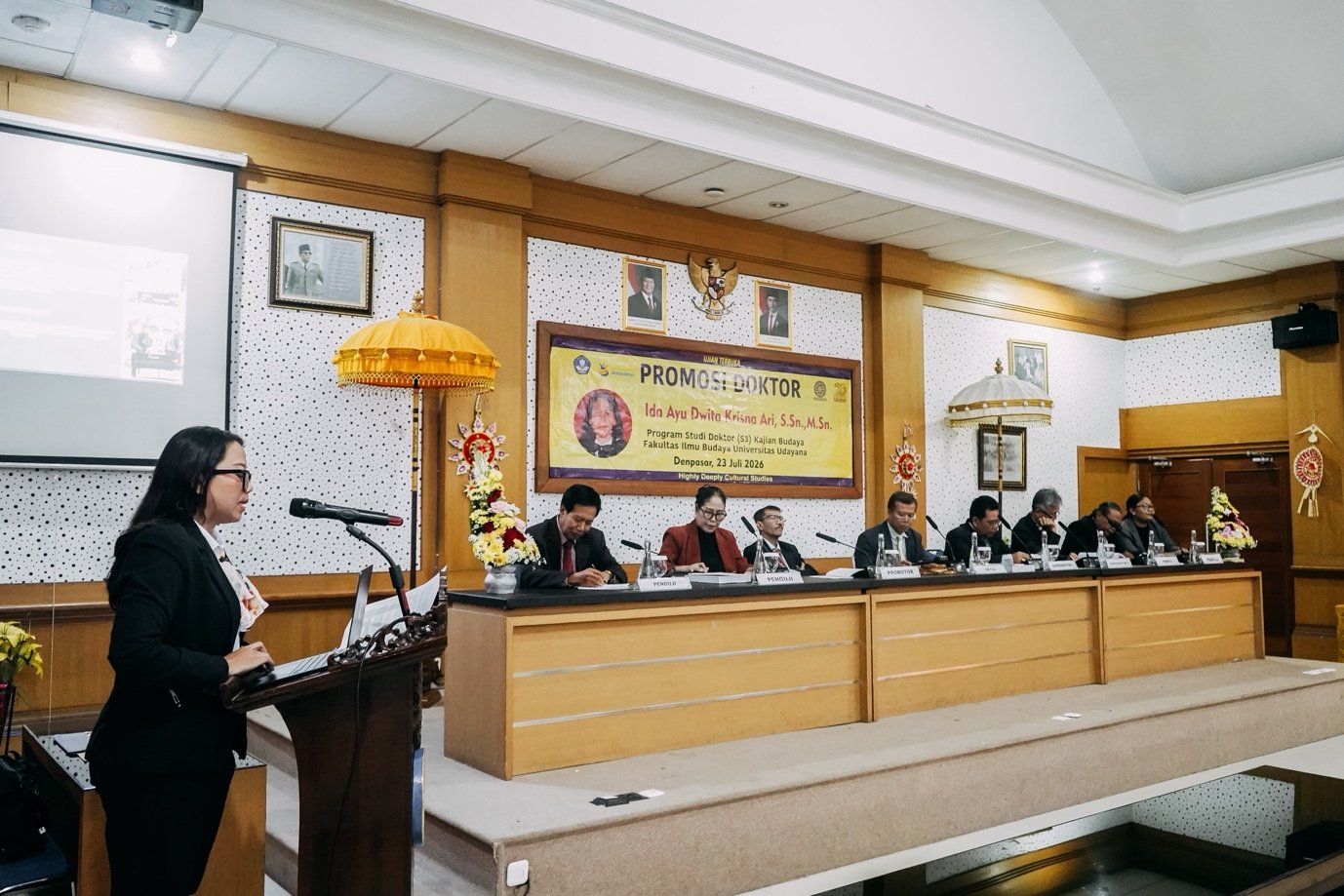
BALINEWSID.COM, DENPASAR — What appears on the back of a truck as a painting of a woman, a witty slogan, a joke, a rhyme, or sexually suggestive phrase may look like nothing more than roadside entertainment. But beneath the humor lies a complex cultural landscape shaped by gender, masculinity, social class, morality and power.
This is the central concern explored by Ida Ayu Dwita Krisna Ari, a lecturer at the Indonesian Institute of the Arts Bali (ISI Bali), in her doctoral dissertation, “Representasi Perempuan dalam Wacana Lukisan Bak Truk di Bali” (The Representation of Women in the Discourse of Truck Paintings in Bali).
Dwita defended her dissertation during the Open Examination of the Doctoral Dissertation in Cultural Studies at Udayana University on Thursday, July 23, 2026, at the Soekarno Room, Faculty of Cultural Sciences, Udayana University, Jalan Pulau Nias, Denpasar.
Her research challenges the conventional view of truck paintings as mere vehicle decoration or a form of street humor. Instead, she argues that the painted truck is a “moving gallery”—a mobile visual space carrying images and words from one public setting to another while exposing audiences to particular ideas about gender, relationships and society.
From the perspective of cultural studies, the truck body is not simply a surface decorated with pictures. It is a cultural text that can be read to understand how meanings are produced, circulated, reinforced and contested in everyday life.
From Humor to Power Relations
One of the study’s key findings is that representations of women in truck paintings cannot be understood merely by looking at their visual appearance.
Sensual female figures, sexual jokes, rhymes, slogans, metaphors and sarcastic expressions all contribute to broader social constructions of gender and power.
Women, family life, masculinity and social relationships become popular forms of visual and verbal communication. Yet behind seemingly harmless messages are assumptions about who holds power, how women should be judged and how men are positioned within social structures.
In several representations examined by Dwita, women do not appear as subjects with voices and agency. Instead, their bodies are presented as objects of the gaze, sexual desire, humor and moral judgment. At times, women are also transformed into symbols of men’s social status and economic capability.
The female body consequently becomes a symbolic battleground where morality, sexual fantasy, class relations, economic aspirations and gender power intersect.
When Women Become Part of a Logic of Consumption
One example analyzed in the dissertation is the phrase “Cewek Cicilan Laris Manis,” roughly suggesting a woman who can be acquired through installments and is highly desirable, accompanied by sexually suggestive language.
For Dwita, the expression cannot simply be dismissed as a joke. It places women within an economic and consumerist logic, implicitly treating them as objects that can be possessed.
In another example, experiences of hardship and sexual violence are packaged as humor. Humor can certainly serve as a coping mechanism for people dealing with the pressures of everyday life. But repeated humorous representations can also contribute to the normalization of violence when painful experiences are continuously presented as entertainment.
Women are also represented through visual characteristics such as urban fashion, sunglasses, off-the-shoulder clothing, tattoos, particular body poses and carefully directed gazes designed to create sensual appeal.
Dwita’s analysis suggests that such imagery constructs women as objects of visual pleasure for the viewer.
The verbal messages accompanying the images reinforce the same construction. One example reads: “Jatuh cinta pake perasaan, mempertahankannya pake penghasilan”—falling in love takes feelings, but maintaining a relationship takes income.
In the context of the dissertation, the phrase connects romantic relationships with economic capacity and reinforces the idea of men as financial providers. Love is therefore framed not only as an emotional relationship but also through material responsibility.
Narratives contrasting women based on whether they are “virgins” or “widows” similarly demonstrate how women’s sexual and social status can become measures of attractiveness and value.
Meanwhile, images emphasizing particular parts of the female body illustrate the mechanism of the male gaze—a visual perspective in which women are positioned primarily as objects of heterosexual male desire.
Humor Is Not Always Neutral
Dwita’s research also reveals the ambivalent role of humor in truck paintings.
On one hand, humor can provide a cultural strategy for working-class communities and people living with the pressures of economic hardship and life on the road. It can offer entertainment, release and a means of coping with difficult circumstances.
On the other hand, humor can continue to operate within a masculine framework that places men at the center of the discourse.
Humor, therefore, is not necessarily neutral.
Jokes, metaphors, life advice and seemingly simple phrases can carry particular ideologies. Something considered funny or entertaining may simultaneously normalize stereotypes, symbolic violence and patriarchal power relations.
Yet Dwita’s findings do not suggest that representations of women in truck paintings are entirely uniform.
Some representations are degrading and objectifying, while others express appreciation. However, even positive representations are frequently framed through ideas of domesticity, patience, sacrifice and women’s emotional roles.
Women consequently become a site of competing meanings. They may appear simultaneously as objects of desire, targets of symbolic violence and domestic figures, while also increasingly being negotiated as subjects possessing value and agency.
The Truck as a “Moving Gallery”
The dissertation also places truck painting within the context of technological and social change.
The practice has developed since at least the 1970s. While earlier truck paintings were produced manually through traditional painting techniques, technological developments have introduced new forms of visual reproduction, including digitally produced stickers.
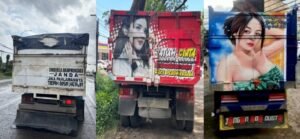
This transformation demonstrates that truck-based visual culture is not static. It continuously adapts to technological developments and changing social conditions.
Its location in public space also gives it considerable reach.
The repeated circulation of sexual imagery, vulgar language, humor and domestic narratives can potentially make stereotypes, objectification, double standards and symbolic violence appear ordinary within popular street culture.
This is where Dwita’s research expands the scope of visual cultural studies.
Truck paintings can be understood not simply as aesthetic products, but as cultural artifacts that participate in shaping how society perceives reality.
Images traveling along public roads do more than communicate messages. They can influence how people see, judge and talk about particular social groups.
Bridging Cultural Studies and Visual Communication Design
The findings of Dwita’s research could also be developed into teaching materials and modules for Visual Communication Design, particularly in understanding the relationship between visual culture, communication and society.

The study opens further opportunities for research into visual culture, the representation of women, street communication and the evolution of truck painting amid rapid technological change.
For that reason, Dwita’s doctoral examination represents more than an academic milestone.
It invites the public to reconsider something that is often taken for granted.
A truck traveling down a highway does not merely carry goods. On its rear panel may be images, colors, words, jokes and bodies that appear to be “speaking” to the public.
It is a moving gallery, but it is also a mirror of the society that produces it.
To critically read truck paintings is to examine how society constructs identity, negotiates values, preserves humor, and simultaneously reproduces or challenges power relations in everyday life.
In this sense, Dwita’s research shifts the way truck paintings can be understood—from simple vehicle decoration to cultural texts that both document and display the face of society in public space.
The dissertation examination was chaired by Prof. Dr. I Nyoman Darma Putra, M.Litt., with Prof. Dr. A.A. Ngurah Anom Kumbara, M.A. serving as Promoter, Prof. Dr. I Nyoman Suarka, M.Hum. as Co-Promoter I, and Dr. I Wayan Suardiana, M.Hum. as Co-Promoter II.
The examination panel also included Prof. Dr. I Nyoman Weda Kusuma, M.S.; Dr. Ni Luh Putu Ari Sulastri, S.S., M.Si.; Dr. Tjokorda Udiana Nindhia Pemayun, S.Sn., S.H., M.Hum.; and Dr. Ida Ayu Kade Sri Sukmadewi, S.Sn., M.Erg.
Dwita’s research ultimately offers a provocative proposition: understanding a society does not always require entering a museum, an art gallery or an elite cultural institution.
Sometimes, it is enough to look at what people paint and write on the back of a truck passing through the street.






Discussion (0)
No comments yet.