
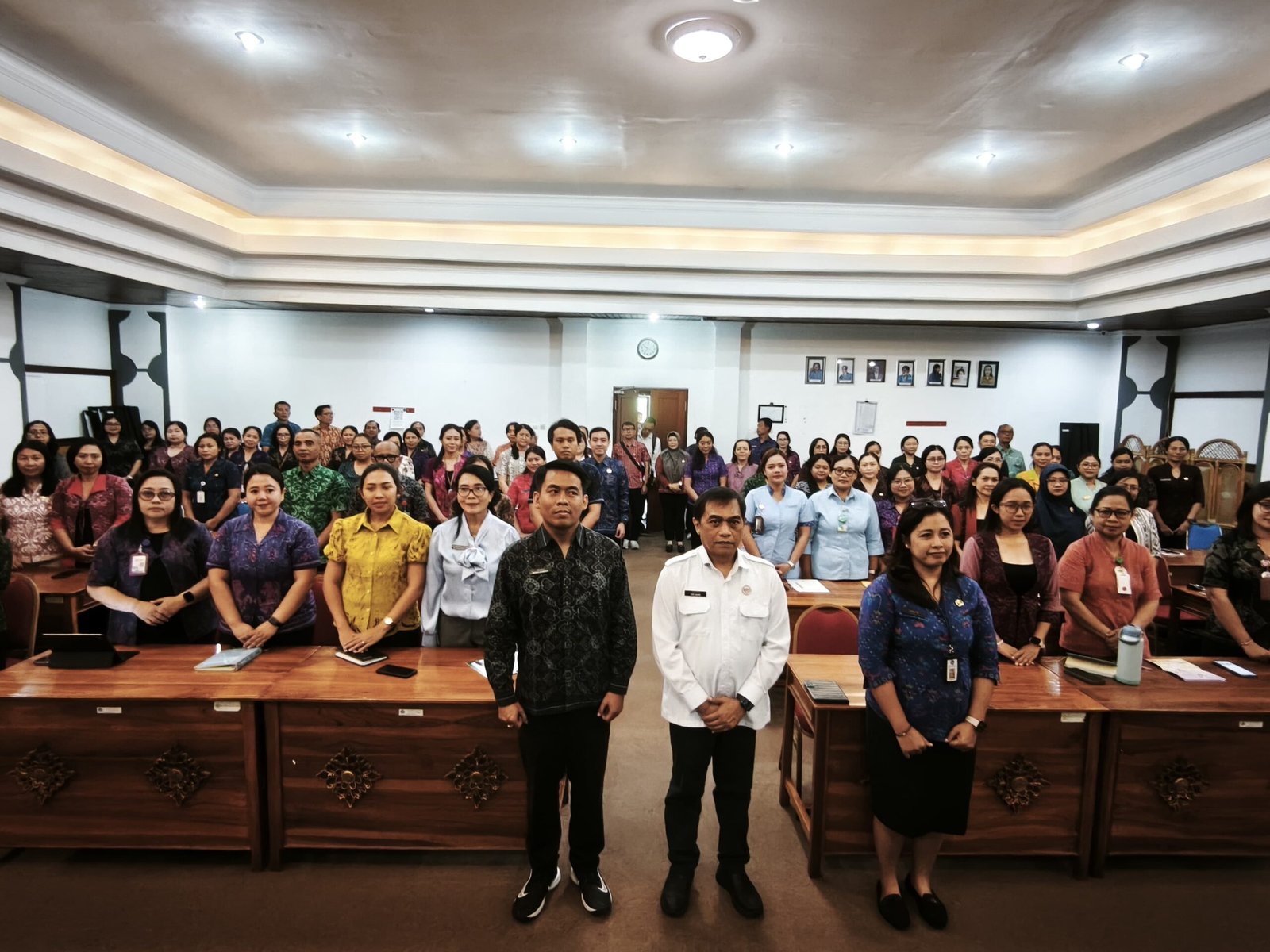
BALINEWSID.COM, DENPASAR – Bali recorded 678 new HIV cases from January to April 2026, raising renewed concerns over the spread of the virus across the island. Denpasar emerged as the highest contributor, prompting the Bali AIDS Commission (KPA Bali) to strengthen the capacity of hundreds of HIV/AIDS counselors in an effort to accelerate early detection and improve response measures.
The effort was carried out through the 2026 HIV/AIDS Counselor Coordination Meeting held at the UPTD Bapelkesmas of Bali Province on Tuesday (June 2, 2026). The program brought together hundreds of counselors from across Bali as part of a broader strategy to enhance counseling services, prevention efforts, and support for People Living with HIV (PLHIV).
Head of the Secretariat of the Bali Province KPA, A.A. Ngr. Patria Nugraha stated that based on data from the Bali Provincial Health Office, 678 new HIV cases were identified within the first four months of 2026. Denpasar accounted for the highest number with 274 cases, or around 40 percent of the total.
It was followed by Badung Regency with 157 cases (23 percent) and Buleleng Regency with 97 cases (14 percent).
Patria noted that the pattern of HIV transmission in Bali has shifted significantly over the past two decades. While before 2000 the epidemic developed slowly, since 2003 the number of cases has increased sharply, primarily through sexual transmission among key populations.
“Today, HIV cases have been found in all regencies and cities in Bali. Therefore, strengthening counseling services, early detection, and public education is crucial,” he said.
Meanwhile, Head of the Bali Provincial Health Office, Dr. dr. I Nyoman Gede Anom, M.Kes., emphasized that the reported figures likely represent only part of the actual situation, describing it as a “tip of the iceberg” phenomenon.
“In just four months, 678 cases have been found. This is like a tip of the iceberg because many cases remain undetected,” he said.
He reaffirmed the provincial government’s commitment to achieving the global 95-95-95 target and eliminating AIDS by 2030, which includes ensuring that 95 percent of people living with HIV know their status, 95 percent receive antiretroviral therapy (ARV), and 95 percent achieve viral suppression.
According to him, HIV is not only a medical issue but also has broad social, cultural, economic, educational, and security impacts, requiring a comprehensive and multi-sectoral response.
One of the major challenges remains the persistent stigma against PLHIV, which discourages people from undergoing testing and accessing healthcare services.
Dr. Anom stressed that individuals on consistent treatment who achieve viral suppression cannot transmit the virus and can live normal, productive lives.
“Stigma makes case detection difficult. In fact, PLHIV with suppressed viral loads do not transmit the virus and can live normal lives, just like people with hypertension or diabetes,” he explained.
The coordination meeting also focused on strengthening counselor competencies, improving referral networks between services, identifying field challenges, and sharing best practices in Voluntary Counseling and Testing (VCT) and Provider-Initiated Testing and Counseling (PITC) services.
Through this initiative, KPA Bali hopes to enhance collaboration among counselors across the island to improve early case detection, expand access to treatment, and strengthen prevention efforts.
With HIV cases now reported across all regions of Bali, counselors are expected to play a crucial frontline role in ensuring that the goal of ending AIDS by 2030 becomes an achievable reality through sustained and collaborative efforts.






Discussion (0)
No comments yet.