
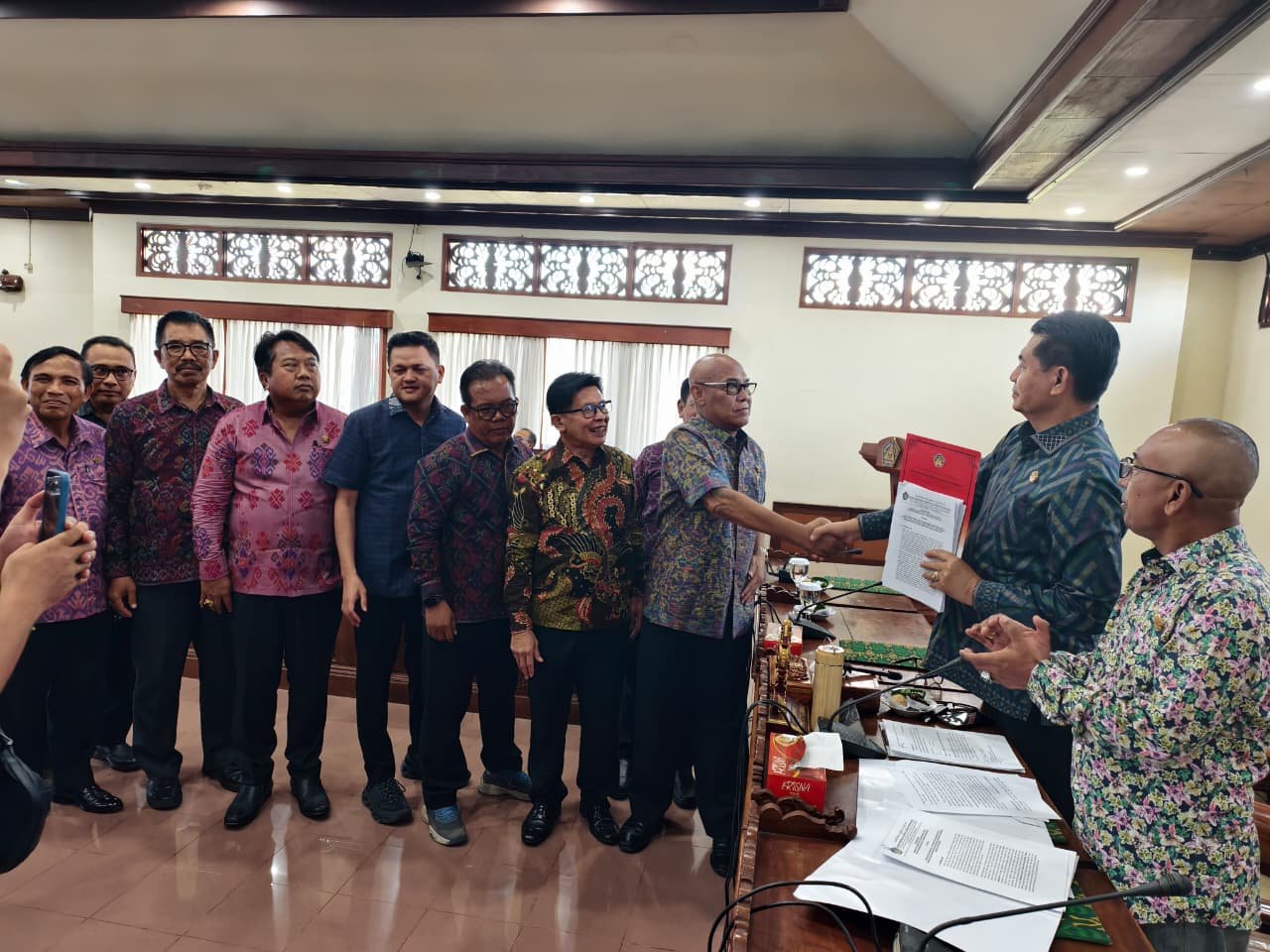
BALINEWSID.COM, DENPASAR – The Special Committee on Spatial Planning, Assets, and Licensing (Pansus TRAP) of the Bali Provincial Legislative Council (DPRD Bali) has officially submitted its recommendations regarding the development activities of PT Bali Turtle Island Development (BTID) to the leadership of the Bali DPRD, calling for a comprehensive audit and legal evaluation of the project.
The recommendations were formally handed over during a DPRD leadership meeting on Tuesday (June 2, 2026) by Pansus TRAP Chairman I Made Supartha, accompanied by Secretary Dewa Nyoman Rai and other committee members.
The document is the result of months of oversight activities, including field inspections, document reviews, hearings, consultations, and investigations conducted by the committee as part of its supervisory role over spatial planning, regional assets, and licensing issues in Bali.
Speaking after the submission, Supartha emphasized that the committee’s findings were not intended to obstruct investment but rather to ensure that all development activities comply with legal requirements, protect the environment, and safeguard the interests of the Balinese people.
According to the committee, several strategic issues were identified during its investigation. These include indications of spatial planning irregularities in coastal and mangrove areas within the Ngurah Rai Grand Forest Park (Tahura Ngurah Rai), uncertainties regarding replacement land under a forest land exchange scheme, alleged weaknesses in administrative oversight, and the need to review the legal framework governing the Kura-Kura Bali Special Economic Zone (SEZ).
The committee highlighted the ecological importance of the Ngurah Rai mangrove ecosystem, which serves as a natural barrier against coastal erosion, a significant carbon sink, and a habitat for numerous coastal species. Field inspections reportedly revealed indications of land compaction and activities suspected of resembling concealed reclamation practices in areas connected to the mangrove ecosystem.
Pansus TRAP also raised concerns about the management and control of approximately 82 hectares of land that was previously part of the protected Tahura Ngurah Rai area. The committee warned that the situation could lead to legal and environmental complications if there is no clear explanation regarding the land release process, fulfillment of replacement land obligations, and protection of the area’s ecological functions.
One of the most significant concerns outlined in the recommendations involves BTID’s obligation to provide replacement land under the forest land exchange mechanism. Based on documents reviewed by the committee, the company was required to provide more than 84 hectares of replacement land in Jembrana and Karangasem regencies as compensation for forest land released for tourism development in Serangan Island.
However, the committee stated that it had found indications of uncertainty regarding the physical existence, legal status, actual size, and ecological equivalence of the replacement land. The issue has raised questions about whether the material requirements of the forest land exchange agreement have been fully met.
“If the replacement land cannot be clearly verified from both legal and ecological perspectives, there is a potential gap between formal legality and the actual situation on the ground. This issue must be clarified transparently,” Supartha said.
The committee also cited indications of possible maladministration in the supervision and verification process dating back to the early stages of the development project. Concerns include allegations that reclamation-related activities may have proceeded before all administrative requirements were fulfilled, insufficient oversight of replacement land obligations, and unresolved land tenure issues involving local communities.
Regarding the Kura-Kura Bali Special Economic Zone, Pansus TRAP stressed that SEZ status does not exempt any development from compliance with Indonesian law. The committee noted that all activities within the zone remain subject to regulations governing forestry, spatial planning, environmental protection, coastal management, and small island development.
“An SEZ is not a law-free zone. Investment incentives and facilities provided by the state do not eliminate obligations related to environmental protection, land legality, or compliance with spatial planning regulations,” Supartha stated.
Through its recommendations, the committee has urged regional and central governments, relevant ministries, and law enforcement agencies to conduct a comprehensive review of all aspects of the BTID development project. The proposed evaluation includes examining the legality of forest area releases, verification of replacement land, compliance with spatial planning regulations, environmental permits, mangrove protection measures, and the overall conformity of the Kura-Kura Bali SEZ development with applicable laws.
The committee also recommended strengthening oversight of coastal and marine areas under Bali Provincial Government authority, extending up to 12 nautical miles offshore, to ensure that development activities align with sustainability principles and environmental protection standards.
Pansus TRAP Secretary Dewa Nyoman Rai said the recommendations represent the DPRD’s constitutional responsibility to oversee development governance in Bali and ensure that future growth remains grounded in legal certainty, environmental sustainability, and Balinese local wisdom.
With the recommendations now submitted to the Bali DPRD leadership, the committee expressed hope that the findings and strategic concerns identified during its investigation will be promptly followed up by the relevant authorities. The Bali DPRD has also reaffirmed its commitment to monitoring the process to ensure environmental sustainability, legal certainty, and responsible development across the island.






Discussion (0)
No comments yet.