
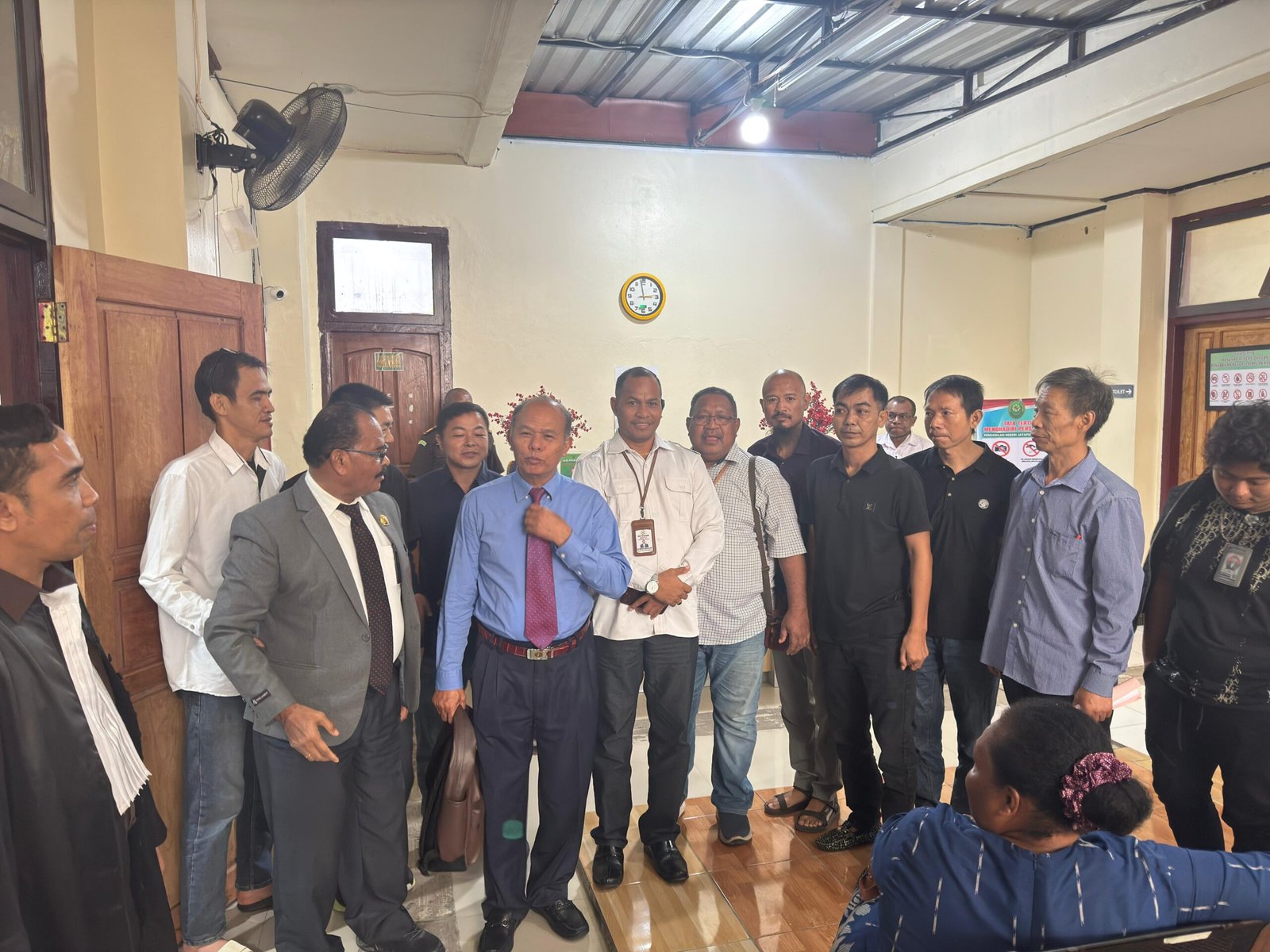
BALINEWSID.COM, JAYAPURA – Irregularities related to evidence handling surfaced during a court session at the Jayapura District Court in the case involving PT Sawerigading Internasional Group on Wednesday (March 11, 2026).
The issues came to light during a site inspection hearing linked to case number 2/Pid.Pra/2026/PN Jap, which concerns allegations of illegal mining activities. During the inspection, the panel of judges questioned several inconsistencies, including differences in the type of excavator presented as evidence, the altered condition of certain seized items, and the absence of 257 grams of gold that was listed as evidence in the case.
The site inspection was conducted at the Rupbasan Class I Abepura located in Asei Kecil Village, East Sentani District, Jayapura Regency. The session was attended by the panel of judges, the defendant, investigating officers, defense attorney Dr. Anthon Raharusun, and a team monitoring state policy implementation.
One of the key concerns raised by the judges was the discrepancy between the heavy equipment described in the indictment and the excavator shown during the inspection. Court documents and the investigation report listed the machine as an Excavator type PC200, while the equipment stored at the facility was identified as an Excavator type PC320 GX.
The judges directly questioned investigators regarding the mismatch and also asked why some of the seized items had already been dismantled and cut into pieces, leaving them no longer in their original condition as when they were first confiscated.
Another issue highlighted during the session was the absence of 257 grams of gold, which was mentioned as evidence in the case but was not physically presented during the site inspection.
The court also reviewed photographs and videos presented by prosecutors. However, these materials were questioned by the defense, which argued that the images and footage may not have been taken at the location or time of the alleged incident on August 26, 2025.
The hearing was also attended by representatives from the Political, Legal, and Security Affairs Working Group (Pokja Polhukam) of the BP3OKP RI under the Secretariat of the Vice President. The team was led by Albert Edison Rumbekwan as coordinator, accompanied by member Jan Christian Arebo.
Speaking at the premises of the Jayapura District Court, Rumbekwan said the team’s presence was part of its monitoring function regarding the implementation of Papua’s Special Autonomy policies, particularly those related to regional economic development, investment, and indigenous community participation.
He emphasized that development and investment initiatives involving indigenous communities are a key component of accelerating development in Papua under the Special Autonomy framework, requiring clear coordination between the central and regional governments.
During the hearing, a certificate issued by regional Energy and Mineral Resources (ESDM) and PTSP authorities regarding preliminary coordination for the activity preparation was also mentioned. The defense argued that the document represented an administrative step prior to further licensing procedures.
The situation has raised broader public questions regarding policy synchronization between the central government and the Papua Provincial Government, particularly in the management of natural resources and investment activities involving indigenous communities.
The defendant’s side stated that activities previously conducted in Senggi, Keerom Regency were part of an initial preparation and limited investment feasibility test, rather than mining production or the sale of extracted minerals.
According to the defense, the activities were part of the development plan for the Cendrawasih Gold Mining Project in Keerom. The project involves the Keerom Indigenous Community Producers Cooperative, which was established by PT Sawerigading Internasional Group in cooperation with the Keerom Indigenous Council with the approval and support of local indigenous communities. The cooperative reportedly holds a People’s Mining Permit (IPR) obtained through an official process that includes consent and release of customary land rights.
The developments revealed during the site inspection hearing have attracted significant attention, as they raise questions about the consistency of evidence, transparency in law enforcement procedures, and the importance of coordination among state institutions in managing Papua’s natural resources.
The trial will continue with the next agenda focusing on expert witness testimonies, aimed at clarifying the legal, technical, and administrative aspects of the case.


Discussion (0)
No comments yet.