
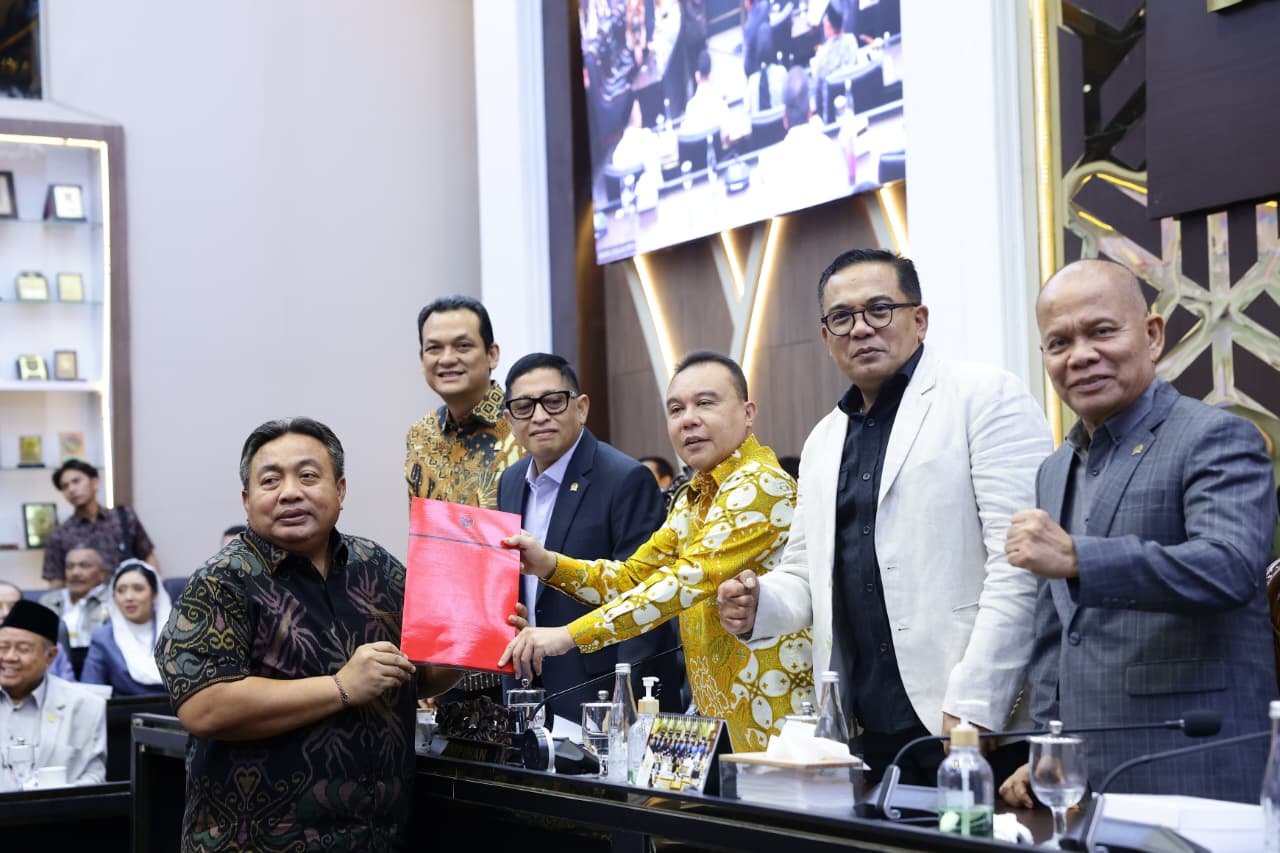
BALINEWSID.COM, JAKARTA — I Nyoman Parta, S.H., a member of Commission III of the Indonesian House of Representatives (DPR RI) representing Bali and a member of the DPR RI’s Legislative Body (Baleg), has called on the government to impose specific restrictions on corporate control and ownership of land on small islands that serve as major tourism destinations, including Bali.
Parta made the call during a plenary meeting to adopt the first-level decision on the Agrarian Reform Regulation Bill at the DPR RI complex in Senayan, Jakarta, on Monday (Sept. 21, 2026). The meeting was chaired by DPR RI Deputy Speaker Sufmi Dasco Ahmad and attended by several ministers.
Parta urged the government to take the issue into account when drafting implementing regulations for the bill, particularly government regulations and ministerial regulations.
“In the government regulation later, I ask the government, the Home Affairs Minister, the Ministry of Law, and the Ministry of Agrarian Affairs and Spatial Planning to impose restrictions on corporate land ownership on islands that function as tourism centers,” Parta said during the meeting.
According to Parta, each region has different characteristics, meaning that limits on land control and ownership should not be determined solely by the size of an area.
He referred to Article 37 of the Agrarian Reform Regulation Bill, which sets out provisions concerning minimum and maximum limits on land control and ownership.
Under the provision, the government is required to consider a number of factors, including land availability, population density, poverty levels, environmental conditions and functions, as well as the limited size of provinces and regencies or municipalities.
Parta said the provision was particularly relevant to island regions that have developed into tourism destinations.
“Our islands have different characteristics,” he said.
He cited Bali as an example of an area facing increasing pressure over land control and ownership due to its position as one of Indonesia’s major tourism hubs.
Parta described Bali as a small island where, in his view, land ownership had exceeded reasonable limits.
“We also have Bali, Mr. Dasco. Bali is a small island, almost the same size as Banyuwangi. The island has seen excessive land ownership beyond the limits,” Parta said.
He therefore urged the government not only to address existing agrarian conflicts but also to establish regulations aimed at preventing excessive concentration of land ownership in the future.
“Otherwise, our islands will eventually be taken over. Therefore, in addition to resolving existing conflicts, we must also prevent them from happening in the future,” he said.
Article 37 of the Agrarian Reform Regulation Bill stipulates that the government shall determine minimum and maximum limits on land control and ownership.
The maximum limit is to be determined with consideration given to equitable distribution of land control and ownership, the availability of productive and cultivation areas, population density, environmental carrying capacity, and the size of the relevant regency or municipality.
The provision also regulates cumulative limits on the control, ownership, utilization and use of land by a single business entity and/or affiliated business entities.
State-owned enterprises (BUMN), regionally owned enterprises (BUMD), and cooperatives are exempted from the maximum-limit provision.
The government is also required to consider the land ownership and control Gini ratio, land availability, population density, poverty levels, environmental conditions and functions, and the limited size of provincial and regency or municipal territories when determining land ownership and control limits.
The provision further states that a single parcel of land covering the entire area of a small island, or land directly bordering the coastline, cannot be granted as a single land right to one individual or one legal entity.
Responding to Parta’s proposal, DPR RI Deputy Speaker Sufmi Dasco Ahmad said the input would be conveyed to the government for consideration, including in the formulation of technical implementing regulations.
“Thank you for the input. We accept it and will convey it to the government. In addition to the government regulation, perhaps the ministerial regulations also need to be reviewed, because I think more technical matters will be regulated through ministerial regulations,” Dasco said.
The first-level discussion of the Agrarian Reform Regulation Bill was subsequently agreed to proceed to the second-level discussion at a DPR RI plenary session.
The bill consists of 14 chapters and 53 articles.
Parta’s proposal puts the focus on implementing regulations as an important part of efforts to regulate land control and ownership, particularly on small islands that have developed into major tourism destinations.







Discussion (0)
No comments yet.