
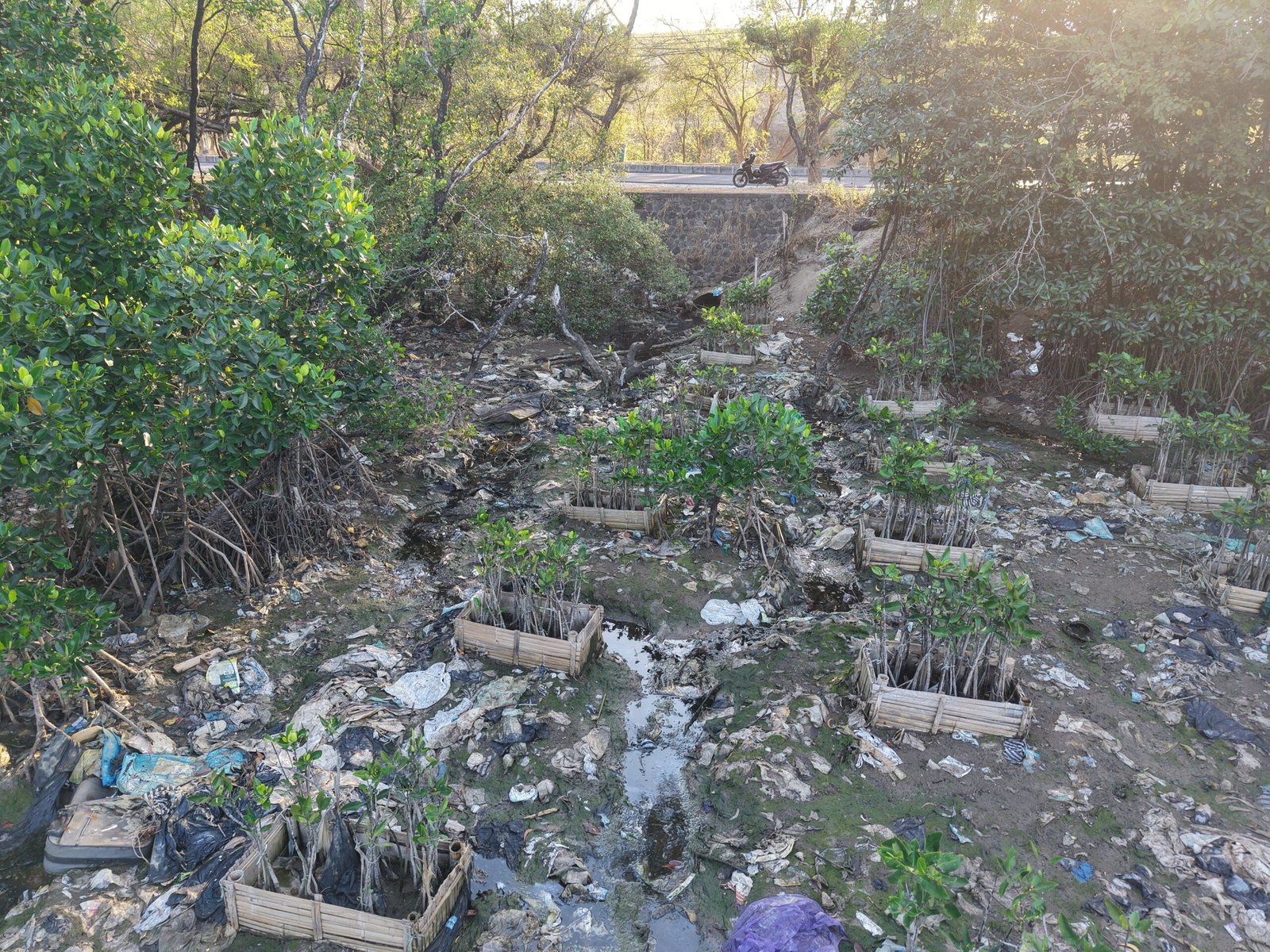
BALINEWSID.COM, DENPASAR – The mangrove conservation area along the coast of Serangan, South Denpasar, is facing a serious environmental threat, with leachate suspected of flowing from the Sarbagita Suwung landfill into the surrounding mangrove ecosystem.
Field observations on Friday, Sept. 18, 2026, found thick, dark-colored liquid flowing through a large drainage channel connected to the Suwung landfill before discharging into the mangrove conservation area.
The flow has raised concerns over the condition of the Ngurah Rai Mangrove Forest, part of the Tahura Ngurah Rai conservation area, which covers approximately 1,373.5 hectares.
Leachate is a contaminated liquid produced when water, including rainwater, passes through layers of waste and absorbs dissolved chemicals as well as organic and inorganic materials.
Environmental activist and Serangan resident Wayan Jecky said the most severe damage could already be seen in parts of the mangrove area.
“After conducting a more detailed survey, we found that the leachate from the landfill flows directly toward the mangrove area. Since the Suwung landfill handles mixed waste, the leachate is likely to contain iron and other toxic substances,” Jecky said on Tuesday, Sept. 22, 2026.
Jecky said the deteriorating condition of the mangroves could not simply be attributed to weather conditions or strong winds. He pointed to waste sediments carried by the flow that have formed foul-smelling mud deposits around the mangrove area.
According to Jecky, the deposits have covered mangrove roots and may have disrupted the plants’ growth, causing some vegetation to dry out and potentially die.
He urged the government to immediately investigate the suspected pollution and prevent further leachate from reaching the mangrove ecosystem.
“We are asking the relevant authorities to come to the field immediately. A solution must be found, and in-depth research is needed so that the leachate is not continuously discharged into the Tahura mangrove area because the ecological impact could be significant,” he said.
The environmental problems downstream of the Suwung landfill do not stop at leachate. Jecky said he frequently found piles of solid waste scattered around the conservation area, with some accumulating and obstructing drainage channels.
The situation comes as the Suwung landfill has resumed accepting organic waste shipments every Tuesday and Thursday. The emergency measure is being implemented while the government awaits the completion of the Waste-to-Energy project, known as Pengolahan Sampah menjadi Energi Listrik (PSEL).
Jecky said managing Bali’s waste problem requires greater cooperation among the government, private sector and state-owned enterprises operating around the landfill and Serangan area.
“There needs to be strong collaboration and effort from all parties. Private companies such as BTID, as well as state-owned enterprises operating around the landfill, including Pelindo and Pertamina, should also step in and help address Bali’s waste problem,” he said.
Further investigation, including laboratory testing of the leachate, sediment and affected mangrove vegetation, is needed to determine the substances present in the discharge and establish the extent of its impact on the Tahura Ngurah Rai ecosystem.


Discussion (0)
No comments yet.