
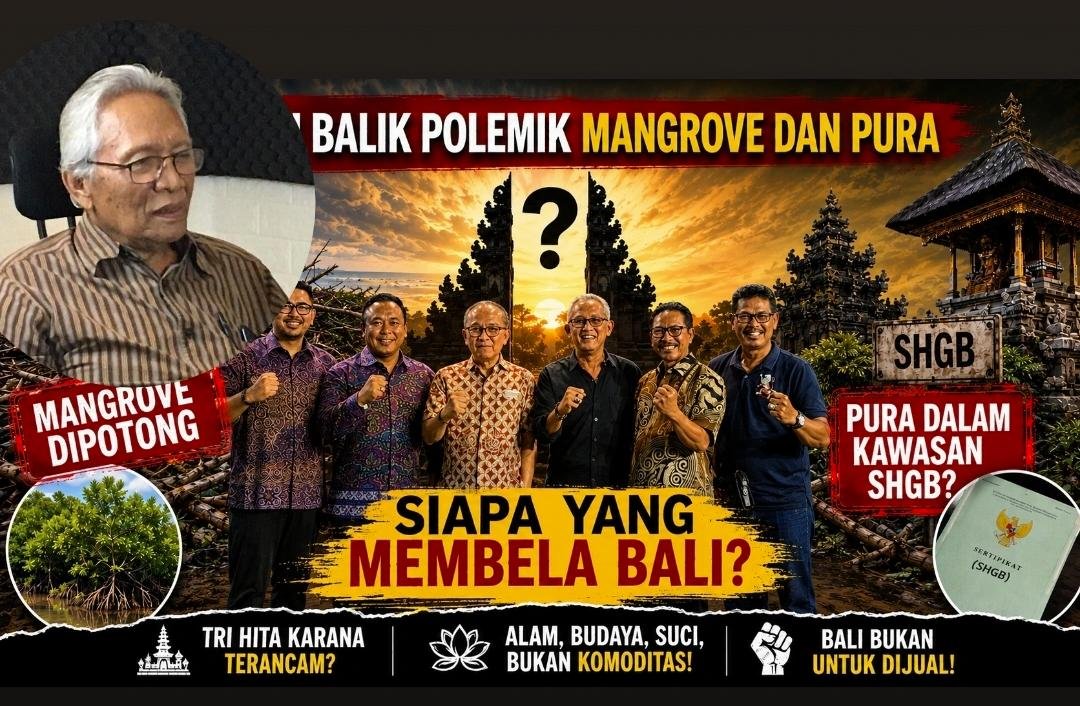
BALINEWSID.COM, DENPASAR — The controversy surrounding the Kura-Kura Bali Special Economic Zone (KEK) project on Serangan Island has intensified, evolving into a wider debate over the future direction of development in Bali. Amid ambitions to position Bali as a global investment and economic hub, concerns over spatial planning, mangrove conversion, and the sanctity of temple areas continue to draw strong public attention.
Public scrutiny is now directed not only at project developer PT Bali Turtle Island Development (BTID), but also at regional political elites and government officials over their stance on the contentious project.
Tensions escalated further after photos circulated on social media showing several members of the Bali Regional House of Representatives (DPRD Bali) together with PT BTID President Commissioner Tantowi Yahya. The viral images triggered public unease and raised questions about whether policymakers are prioritizing the interests of Balinese communities amid the influx of large-scale investment.
Amid growing public pressure, economist and environmental observer Jro Gde Sudibya said the Bali DPRD’s Special Committee on Spatial Planning, Regional Assets, and Licensing (Pansus TRAP) has become one of the few institutions willing to expose sensitive issues surrounding the Serangan KEK project.

According to Sudibya, the committee’s willingness to investigate alleged irregularities marks an important step rarely taken seriously in the past. The alleged issues include land swaps, mangrove conversion, and the issuance of land ownership certificates (SHM) believed to contradict existing regulations.
“Pansus TRAP is seen as one of Bali’s guardians because it dares to uncover facts that have long remained hidden,” Sudibya said on Wednesday (May 20, 2026).
He argued that the primary responsibility lies with the executive branch, namely the Bali Provincial Government and the Denpasar City Government, both of which serve ex officio as advisory authorities for the Serangan KEK area. However, Sudibya also criticized what he described as weak political oversight over the years, allowing unresolved problems to persist.
From the perspective of green economics, Sudibya described the alleged destruction of mangrove forests and the emergence of hundreds of land ownership certificates within the Ngurah Rai Grand Forest Park (Tahura Ngurah Rai) area as a major irony for Bali’s international image.
Bali’s mangrove ecosystem has long been promoted as a symbol of Indonesia’s sustainable development success. During the G20 Bali Summit, world leaders even participated in symbolic mangrove planting as a representation of commitment to green economy principles and low-emission development.
“Bali has been promoted as the face of global green development. But on the other hand, allegations of environmental destruction are emerging in the very same area,” he said.
The Kura-Kura Bali KEK dispute has also entered a highly sensitive area for Balinese society: spirituality and the sanctity of temple grounds.
Concerns over temples allegedly located within areas covered by Building Use Rights Certificates (SHGB) have sparked anxiety among customary communities. Although the Parisada Hindu Dharma Indonesia has assured worshippers they can continue praying at Pura Sakenan, Sudibya argued the issue goes far beyond access to worship.
According to him, what is truly at stake is Bali’s “taksu” — its spiritual essence — including sacred landscape vibrations and ancestral heritage that Balinese customary communities have preserved for centuries.
“Who will be responsible for safeguarding the spiritual sanctity and taksu of the temples if the surrounding natural landscape changes drastically?” he asked.
Sudibya also warned that Bali must not turn the tourism industry into a “new god” that sacrifices environmental sustainability and social justice for local communities.
“Bali remains open to investment, but such investment must be environmentally friendly and fair economically, culturally, and spiritually,” he stressed.
He linked the warning to the flash floods that struck Denpasar, Badung, and Gianyar on September 10, 2025, describing the disaster as a serious alarm over development policies that no longer prioritize Bali’s ecological balance.
The public is now awaiting concrete action from regional governments, DPRD Bali, and other policymakers. The Kura-Kura Bali controversy is increasingly viewed as a major test for the Island of the Gods: whether Bali will continue to uphold environmental and cultural preservation, or shift toward a development model driven primarily by investment interests alone.


Discussion (0)
No comments yet.