
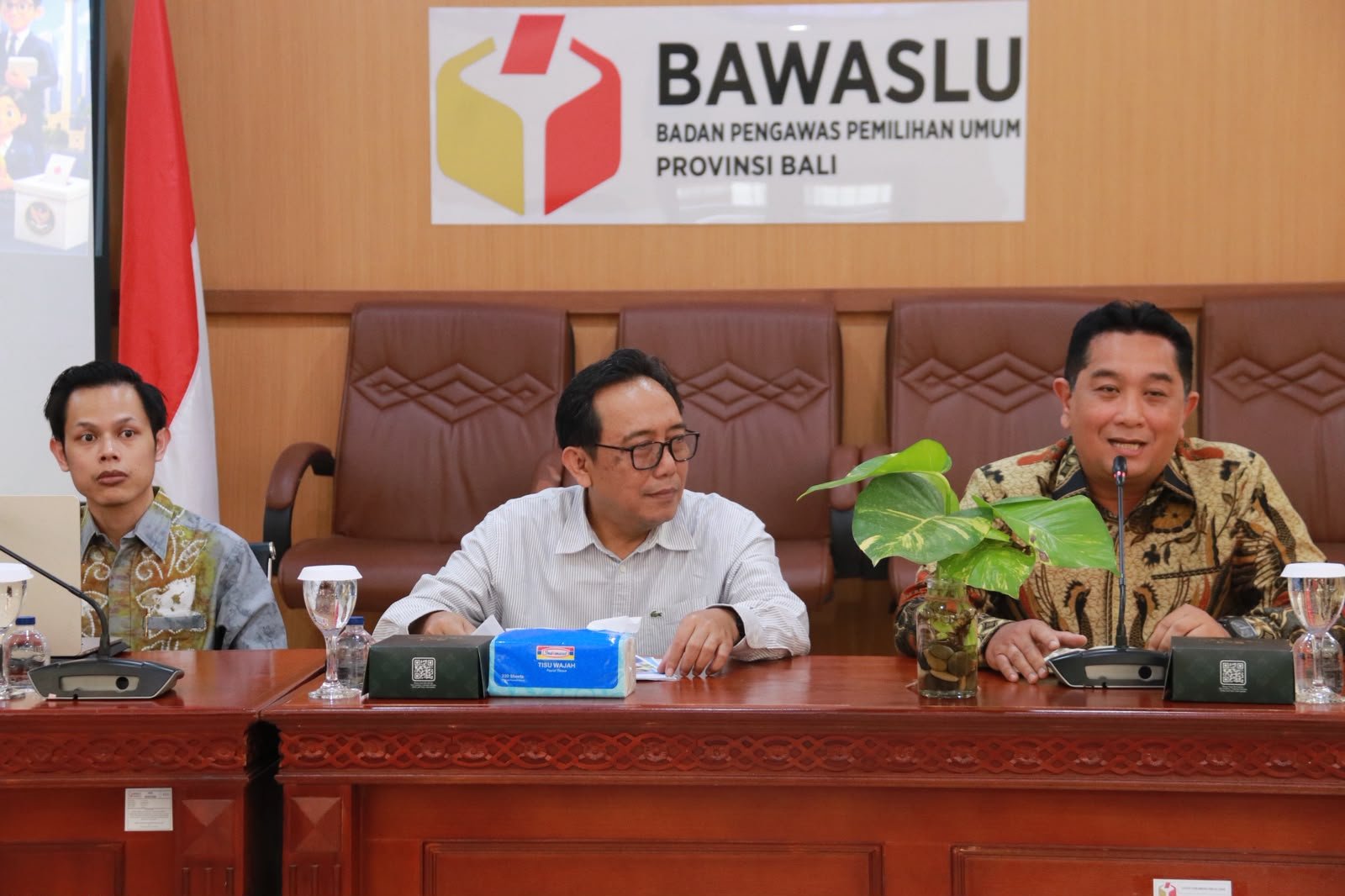
BALINEWSID.COM, DENPASAR — Indonesia’s Election Organizer Ethics Council (DKPP) has reviewed the performance of its Regional Examination Teams (TPD) and examined why no ethics complaints were filed against election organizers in Bali following the country’s elections and regional elections.
The review was conducted during a monitoring and evaluation meeting at the Bali Provincial Election Supervisory Agency (Bawaslu) office on Friday (Sept. 25, 2026).
The meeting was held as part of DKPP’s post-election evaluation and provided an opportunity to assess the effectiveness of election ethics enforcement while gathering input from election organizers in Bali.
DKPP member Dewa Kade Wiarsa Raka Sandi said the council’s visit to Bali was not related to any ongoing case or alleged violation.
“Our presence in Bali is not because there is a case. There have been no complaints or disputes, either before the Constitutional Court or the DKPP,” Dewa Raka Sandi said.
He said the absence of complaints needed to be examined further to determine whether it reflected genuinely stable conditions in the field or whether potential problems had been resolved at an earlier stage.
“We want to confirm whether the absence of complaints is because conditions in the field are genuinely conducive, because there are problems that have been concealed, or because they have already been resolved by Bawaslu. This is what we need to clarify,” he said.
Dewa also pointed to social and cultural factors in Bali, saying that local customs, traditions and the philosophical concept of Karma Phala could contribute to strong moral controls and help reduce the potential for ethical violations.
Bali Bawaslu Chairman I Putu Agus Tirta Suguna welcomed the evaluation, saying the meeting provided an opportunity to strengthen coordination among election institutions and assess the effectiveness of election supervision.
Meanwhile, Bali Bawaslu member Gede Sutrawan attributed the lack of ethics complaints partly to the handling of potential problems at an early stage through administrative verification and regulatory procedures.
He cited an internal dispute within a political party during the process of nominating a gubernatorial candidate. The issue did not proceed after administrative verification found shortcomings related to the complainant’s identity and internal requirements.
“When it was verified during a plenary meeting, the weaknesses were found to be on the complainant’s side, particularly regarding identity requirements and internal conditions. After realizing these shortcomings, they did not continue with their request for Bawaslu’s services,” Sutrawan said.
He said the matter was therefore resolved at an early stage and did not develop into a suspected ethical violation by an election organizer.
Bali Bawaslu member I Wayan Wirka, meanwhile, called for stronger internal guidance and supervision to prevent potential problems from developing into violations.
Wirka also proposed strengthening the role of the TPD so that it could function more effectively at the regional level, including in handling alleged violations involving ad hoc election officials.
“Regarding the TPD, an interesting point emerged when it was given room to handle violations at the ad hoc level. We need to consider how the DKPP can have a stronger and more functional extension at the regional level,” Wirka said.
The meeting also discussed a possible restructuring of the TPD’s term of office. DKPP considers the current practice of replacing TPD members every year to be less effective, as some newly appointed members may be replaced before they have the opportunity to conduct examinations.
One option being considered is extending the TPD’s term to five years in regions considered stable, while maintaining a periodic evaluation mechanism.
Input from Bali’s Bawaslu and General Elections Commission (KPU) will be taken into consideration by DKPP in efforts to improve national regulations and strengthen the governance of election ethics enforcement.


Discussion (0)
No comments yet.