
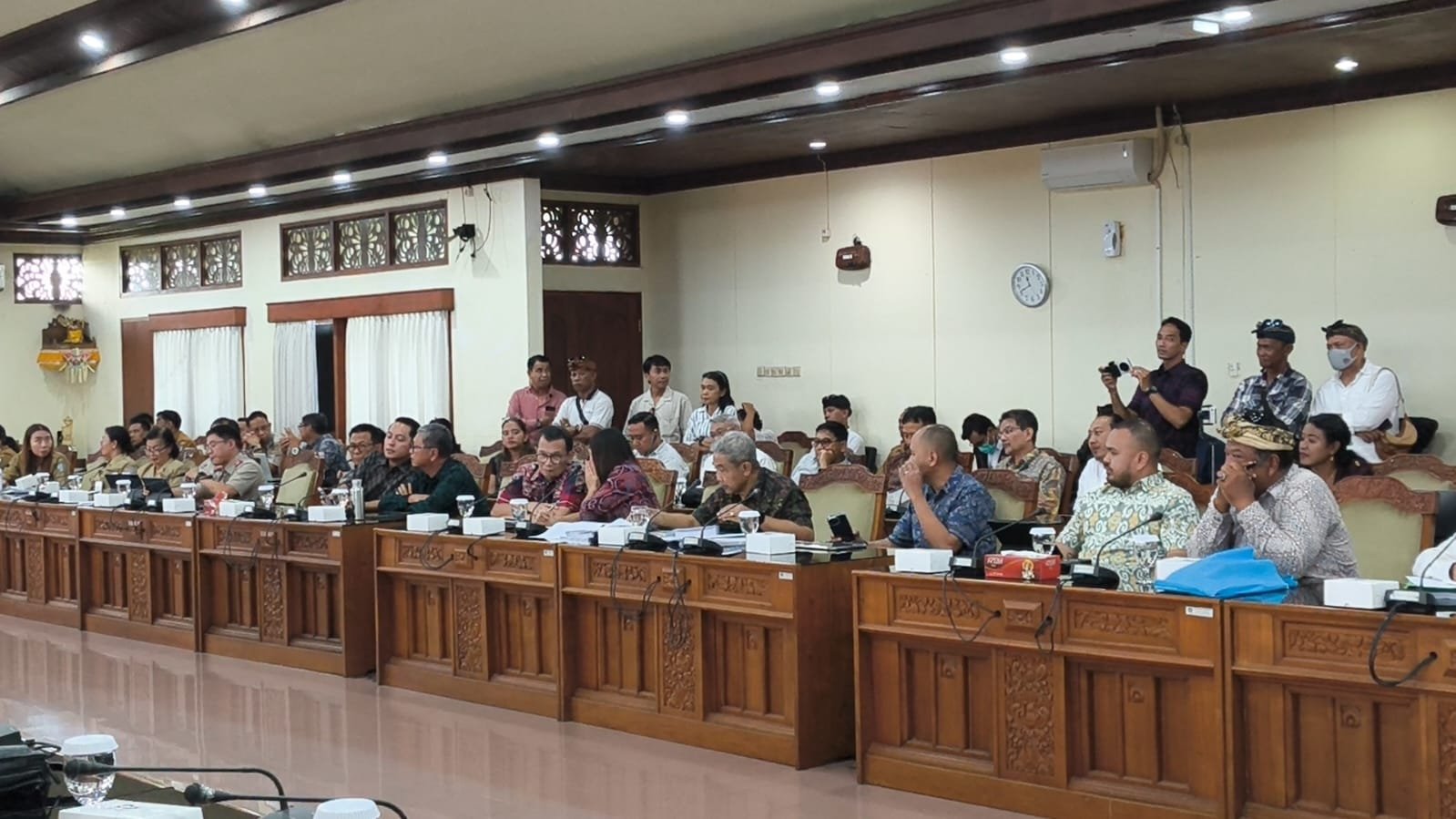
BALINEWSID.COM, DENPASAR — The Special Committee on Spatial Planning, Regional Assets, and Licensing of the Bali Regional House of Representatives (Pansus TRAP) sharply questioned PT Bali Turtle Island Development over the legal foundation for the proposed exchange of mangrove land during a heated hearing on Monday (May 11, 2026).
The session, held at the Bali DPRD building, focused on whether Indonesian law explicitly permits the exchange of ecological areas—particularly mangrove forests—based on economic considerations.
Chair of the committee, I Made Supartha, demanded clarity, pressing BTID to cite specific legal provisions that justify such a policy.
“I want to ask clearly—what article, in which law, provides room for ecological land swaps based on economic considerations? Mention the article and the law, then we can go deeper,” Supartha said during the hearing.
The politician from the Indonesian Democratic Party of Struggle continued to push BTID representatives to present a firm legal basis for what has been described as a land swap mechanism within the Tahura Ngurah Rai area.
According to him, ecological zones cannot simply be exchanged without a strong legal framework. He challenged anyone present at the hearing to point to regulations that explicitly allow such actions.
“If there is a law that allows ecological areas to be swapped, please present it. Anyone in this room who knows—speak up,” he insisted.
Supartha also highlighted concerns over the alleged use of economic considerations in the mangrove land swap process, warning that such reasoning must be transparently explained to avoid further controversy over the status of ecological zones and state assets.
Representing BTID, Head of License AA Ngurah Buana appeared unable to provide a clear answer. When asked to cite any regulation governing the obligation or allowance for ecological land exchanges, he admitted he had not encountered such provisions.
“No, we have never read such a regulation,” Buana said briefly.
Earlier, BTID had referred to ministerial decrees and several regulations, including Law No. 5 of 1967 and rules on natural resource conservation. However, Supartha dismissed the explanation as irrelevant to the core question.
“What does it say? That’s not what I’m asking. Which article specifically allows it?” he reiterated.
The hearing drew significant public attention as it addressed the controversial alleged mangrove land swap within Tahura Ngurah Rai, an issue that has sparked criticism from various stakeholders. The Pansus TRAP DPRD Bali affirmed it would continue to scrutinize the legal and regulatory basis of ecological area management in the region.


Discussion (0)
No comments yet.