
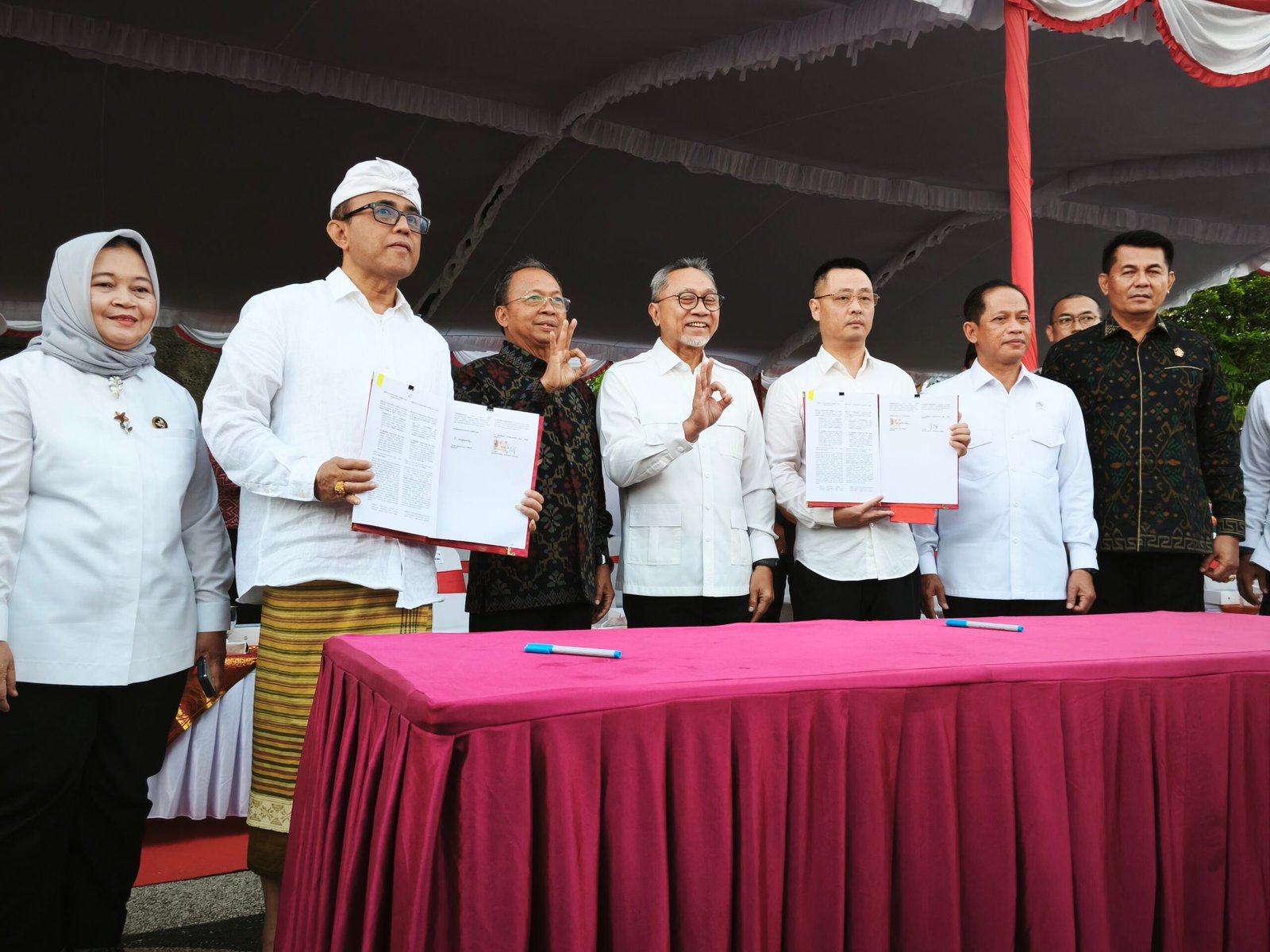
BALINEWSID.COM, DENPASAR – One day before the groundbreaking of Bali’s Waste-to-Energy Plant (PSEL) at the Pelindo area in Pesanggaran, South Denpasar, the Indonesian Government and the Coordinating Ministry for Food Affairs officially launched the Waste Sorting at Source Movement, marking a major step toward accelerating waste management reform across the island. The declaration was held on Tuesday (July 7).
The campaign brought together the Bali Provincial Government, regency and city administrations, the Indonesian National Armed Forces (TNI), the National Police (Polri), environmental organizations, and students. It aims to cultivate a culture of waste segregation at its source before construction of the Waste-to-Energy Plant officially begins.
Indonesia’s Coordinating Minister for Food Affairs, Zulkifli Hasan, confirmed that Bali will become the first province in the country to begin construction of a Waste-to-Energy Plant under the President’s directive.
“Tomorrow we will officially launch the construction in Bali. Bali is the first province because other regions are not yet ready,” Zulkifli said.
He added that the signing ceremony for the project would be attended by the Minister of Environment, the Bali Provincial Government, the Denpasar City Government, and other regional administrations.
Meanwhile, Deputy Coordinating Minister for Food Affairs Hanif Faisol Nurofiq praised Bali’s achievement in national food security. According to the National Food Security Index, Bali ranks third nationwide with a score of 79.89, while Badung Regency has been recognized as Indonesia’s highest-performing regency in food security.
Hanif said the achievement provides a strong foundation for tackling the island’s next major challenge—waste management. With a population of approximately 4.5 million, Bali generates around 3,500 tons of waste every day, making an integrated waste management system based on household waste segregation essential.
He also recalled the major landfill fires during the 2023 dry season, including the blaze at Suwung Landfill, as a reminder that organic waste should no longer be stockpiled without proper treatment. The government is targeting Bali to resolve its waste management issues by December 2026 through source-based waste sorting, reduced landfill disposal, and the construction of the Waste-to-Energy Plant.
At the same event, Bali Governor Wayan Koster reaffirmed that the province’s waste management policy is guided by Bali Governor Regulation No. 47 of 2019 on Source-Based Waste Management.
He emphasized that organic and inorganic waste must be separated at the source. In rural areas, organic waste can be processed into compost to support organic farming, while in urban areas such as Denpasar and Badung, waste segregation is mandatory before being transported to processing facilities.
“Waste sorting is the key to ensuring the Waste-to-Energy Plant operates more efficiently and delivers optimal results,” Koster said.
The governor explained that the PSEL facility, to be built on a six-hectare site in the Pelindo area of Pesanggaran, is designed to process approximately 1,200 tons of waste per day. Construction is expected to take about one and a half years.
Koster also noted that restrictions on waste disposal at Suwung Landfill have been tightened. Organic waste is now permitted to enter the landfill only twice a week, while the volume of waste sent there has already been reduced by around 70 percent.
“Ultimately, Suwung Landfill must be permanently closed,” he stressed.
As part of the declaration, the central government also introduced a household-scale waste sorting device developed by Badan Riset dan Inovasi Nasional for pilot implementation. Larger-capacity versions are expected to be developed for schools and public facilities, further strengthening source-based waste management throughout Bali.




Discussion (0)
No comments yet.