
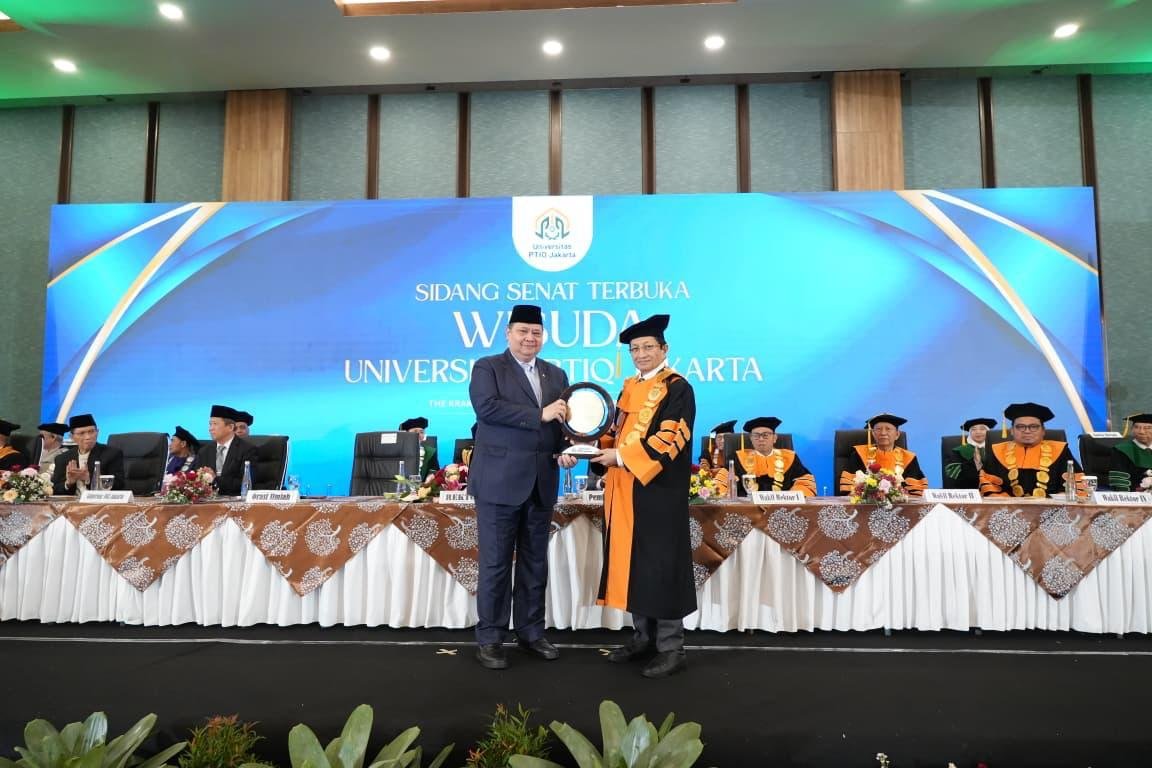
BALINEWSID.COM, JAKARTA – Coordinating Minister for Economic Affairs Airlangga Hartarto has urged university graduates to become problem solvers and innovators who can integrate Qur’anic values into economic policies and contribute to more equitable national development.
Airlangga made the remarks while delivering a scientific address at the Open Senate Session for the undergraduate and postgraduate graduation ceremony of Universitas PTIQ Jakarta in Jakarta on Wednesday, September 23, 2026.
He said Qur’anic principles, particularly justice (‘adl) and balance (mizan), could serve as fundamental values in building an economy that delivers not only strong growth but also broader social benefits.
“The Qur’an as a guide for life provides fundamental principles for economic governance, namely justice (‘adl) and balance (mizan),” Airlangga said, citing Surah An-Nahl verse 90, which calls for justice and good deeds while prohibiting wrongdoing and hostility.
Airlangga said Indonesia’s economic growth has been accompanied by improvements in several social indicators. The poverty rate fell to 8.07 percent in March 2026, while the Gini ratio stood at 0.368, the lowest level in a decade. The open unemployment rate was recorded at 4.65 percent.
Compared with March 2025, the number of people living in poverty had declined by approximately 926,000, according to the figures presented by Airlangga.
To ensure that the benefits of economic growth are distributed more broadly, the government has prepared 28 social protection programs covering different stages of people’s lives.
The programs include the Indonesia Smart Program (Program Indonesia Pintar) for 22 million students, Sekolah Rakyat for low-income communities, the Free Nutritious Meals Program targeting 74 million beneficiaries, Free Health Check-ups, the Family Hope Program (Program Keluarga Harapan) for 10 million beneficiary families, and government-funded BPJS Health contributions for 96.8 million people.
Energy subsidies and compensation schemes are also part of the government’s efforts to maintain people’s purchasing power.
The government is also expanding financial inclusion and literacy. Financial inclusion has reached 93.61 percent, while financial literacy stands at 69.57 percent, exceeding the OECD average of 63 percent.
However, Islamic financial inclusion remains at 13.14 percent, indicating room for further expansion of public access to and understanding of Islamic financial products. The government is also following President Prabowo Subianto’s direction to expand public access to bank accounts through Bank Rakyat Indonesia (BRI) and Bank Syariah Indonesia.
At the same time, the government continues to develop the Islamic economy and halal industry as part of its broader economic strategy.
Indonesia’s Islamic finance assets have reached approximately Rp3,131 trillion, placing the country fourth globally alongside Malaysia, according to the figures presented at the event. Indonesia also ranks first globally in Muslim modest fashion.
In the halal industry, 4.4 million halal certificates have been issued to 3.4 million businesses, covering 14.68 million products. Indonesia has also established mutual recognition arrangements for halal products with 39 countries.
Addressing the graduates, Airlangga emphasized the importance of combining academic knowledge, economics, technology and Qur’anic values to meet future challenges.
“I want to leave three main messages for the PTIQ Jakarta graduates. First, be problem solvers and innovators, and bring Qur’anic values into policy spaces,” he said.
“Second, master technology and digital literacy. Do not be left behind by developments such as artificial intelligence (AI) and other technologies. Third, make use of government programs such as MagangHub, GIG Economy training, the Digital Talent Scholarship, subsidized financing for entrepreneurs including Sharia KUR, and LPDP to pursue further education,” Airlangga added.
The graduation ceremony was also attended by Religious Affairs Minister and PTIQ Jakarta Rector Nasaruddin Umar, Secretary of the Coordinating Ministry for Economic Affairs Susiwijono Moegiarso, Chairman of the Board of Trustees of the Al-Qur’an Education Foundation (YPA) Ponco Sutowo, Chairman of the Management Board of the Al-Qur’an Education Foundation Achmad Zacky Siraj, PTIQ Jakarta’s academic leadership and Senate, professors, representatives of government ministries and agencies, as well as graduates and their parents or guardians.



Discussion (0)
No comments yet.