
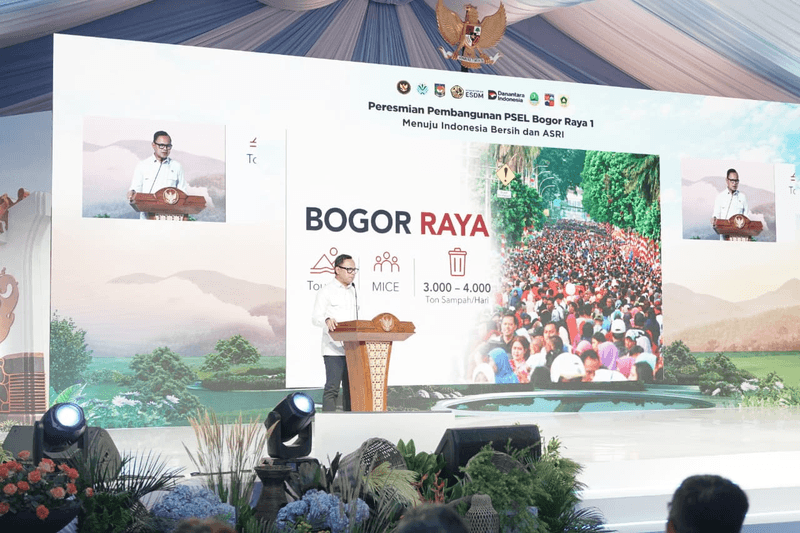
BALINEWSID.COM, DENPASAR — Indonesia’s Deputy Minister of Home Affairs, Bima Arya Sugiarto, has called for the Bogor Raya 1 Waste-to-Energy (PSEL) project to become a national model for tackling urban waste. His call, however, also places similar projects in other regions, including Bali, under pressure to demonstrate that waste-to-energy facilities can function as part of a comprehensive waste management system rather than simply become new infrastructure projects.
Bima made the statement during the groundbreaking ceremony for the Bogor Raya 1 PSEL facility at the Galuga landfill in Bogor Regency, West Java, on Thursday, September 17, 2026.
He stressed that the groundbreaking marked not the end of the waste problem, but the beginning of a waste management system that must be monitored from upstream to downstream.
According to Bima, the success of a PSEL facility cannot be measured solely by the completion of its physical construction. Local governments must also ensure a reliable supply of waste, transportation and distribution systems, community support, licensing, and consistent governance.
“This could be described as the marriage ceremony, the promise. But we still have to wait for the proof until the process is actually running,” Bima said.
His remarks are particularly relevant to Bali, where a PSEL project has already entered the construction phase.
The Bali provincial government, together with the Denpasar city and Badung regency administrations, has been preparing the Denpasar Raya PSEL project as part of efforts to address waste management challenges in southern Bali.
Construction of the Bali PSEL officially began in the Pedungan area of South Denpasar on July 8, 2026. The facility is expected to become part of Bali’s transformation of its waste management system, particularly amid mounting pressure on the capacity of the Suwung landfill.
The project occupies approximately six hectares in the Pesanggaran area of Denpasar. Waste generated in Denpasar and Badung is planned to serve as the facility’s feedstock.
Previously, the Bali provincial government said the PSEL would require approximately 1,200 tons of waste per day, consisting of around 700 tons from Denpasar and 500 tons from Badung.
This means the challenge facing Bali’s PSEL extends well beyond construction. The local governments must ensure a sustainable waste supply chain, including waste segregation at source, the strengthening of TPS3R and TPST waste management facilities, and an effective system for transporting waste to the PSEL facility.
The Bali provincial government has also emphasized that waste management at the source will remain essential while the PSEL project is being developed. The approach includes strengthening TPS3R and TPST facilities and improving household waste segregation so that waste delivered to the processing facility can be handled efficiently.
This is where Bima Arya’s message regarding Bogor becomes relevant to Bali. A PSEL facility cannot be treated as a project that is considered complete once its buildings are finished. Its real success will depend on whether the government can ensure that waste is consistently collected, segregated, transported, and supplied to the facility for processing.
Bali faces an additional challenge because waste management is closely linked to the island’s image as an international tourism destination.
Indonesia’s Ministry of Environment and the Environmental Control Agency (KLH/BPLH) has said that the PSEL project in Pedungan is being prioritized as part of efforts to address Bali’s waste problem, particularly in light of growing pressure on the Suwung landfill.
Danantara has also described the Bali PSEL project as part of Indonesia’s broader transformation of national waste management. The facility is expected not only to reduce environmental pressure but also to support sustainable tourism and turn waste into a source of energy.
If the Bogor Raya 1 PSEL project is to serve as a national benchmark, Bali’s PSEL will face a similar test: whether the facility can genuinely transform the region’s waste management system or merely shift part of the problem from the landfill to a new processing facility.
The physical construction is only the first stage. The real test will begin once the facility starts operating, when the government must simultaneously maintain a reliable waste supply, ensure technological performance, uphold environmental standards, establish effective governance, and secure public acceptance.
For Bali, the PSEL project is no longer merely an infrastructure development plan. Following the groundbreaking in July 2026, public attention is increasingly shifting toward more concrete questions: When will the facility become operational? How much waste will it actually be able to process? And to what extent will the PSEL reduce Bali’s dependence on landfills?
If the principles outlined by the Deputy Minister of Home Affairs are applied, the success of Bali’s PSEL ultimately cannot be measured by the groundbreaking ceremony alone.
Its true measure will be the tangible results delivered on the ground.



Discussion (0)
No comments yet.