
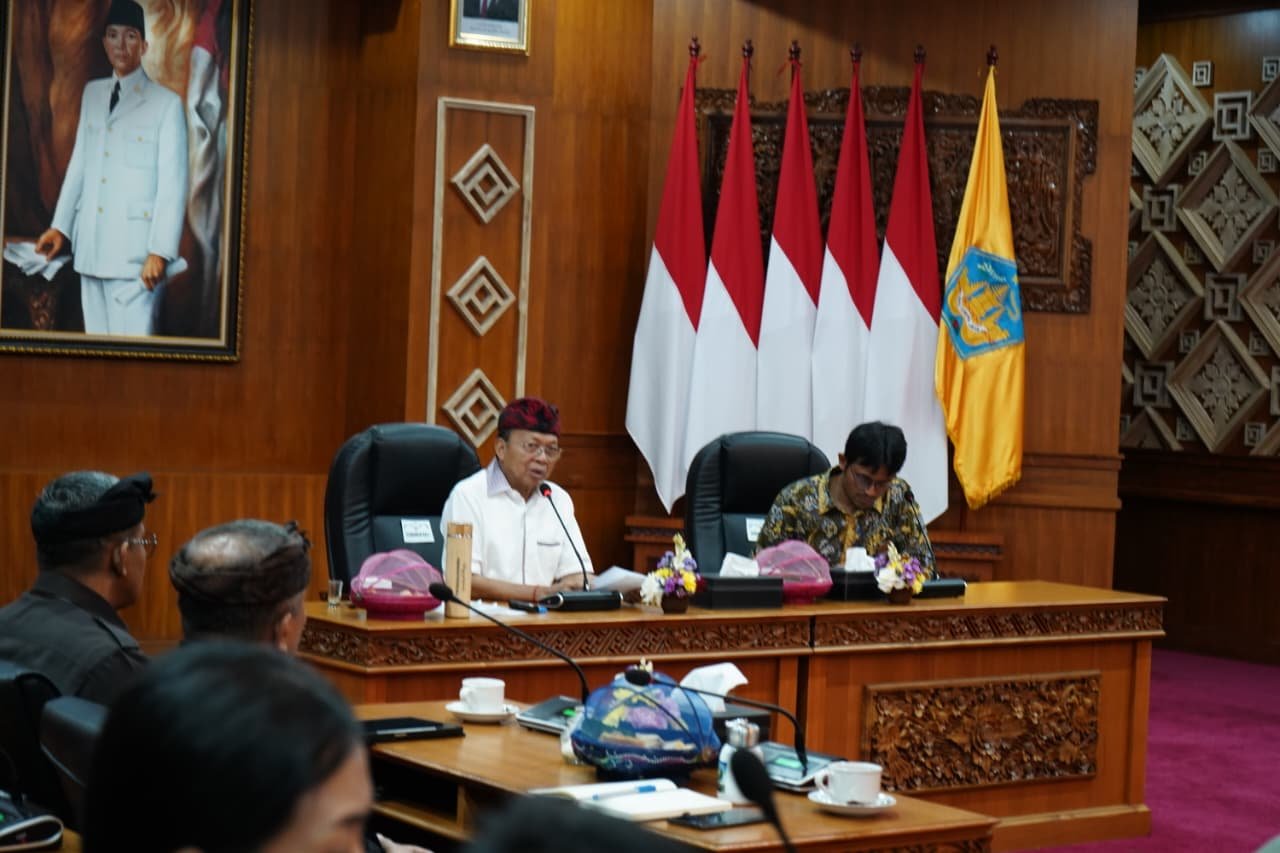
BALINEWSID.COM, DENPASAR – Bali Governor Wayan Koster has reaffirmed his commitment to making Bali energy independent by accelerating the development of renewable energy sources, including the utilization of marine renewable energy in the waters surrounding Nusa Penida.
Speaking during a Focus Group Discussion (FGD) on the Implementation of Marine Spatial Planning Based on Renewable Energy at Kertha Sabha Hall, Jaya Sabha, Denpasar, on Thursday (July 9), Koster said Bali must reduce its dependence on electricity supplies from outside the island.
As one of the world’s leading tourist destinations, he noted that Bali faces significant risks if it continues to rely on external energy sources while electricity demand keeps rising due to the rapid growth of tourism and industry.
“Bali must become energy independent by utilizing clean and renewable energy,” Koster said.
Bali currently requires between 1,300 and 1,400 megawatts (MW) of electricity, with around 400 MW still supplied through an undersea interconnection cable linked to the Paiton Coal-Fired Power Plant in East Java.
To achieve the vision of Energy-Independent Bali, Koster has implemented several initiatives under Bali Governor Regulation No. 45 of 2019 on Clean Energy. These include accelerating the installation of rooftop solar photovoltaic (PV) systems on government buildings, commercial facilities, hotels, and industrial complexes.
The provincial government is also promoting Waste-to-Energy Power Plants (PSEL) to address Bali’s urban waste problem while increasing the share of renewable energy in the island’s electricity mix.
In addition, the Bali Provincial Government is working with Indonesia’s Ministry of Marine Affairs and Fisheries on a study exploring the development of Marine Current Power Plants (PLTAL) in the Nusa Penida Strait. The research is being conducted by the Bandung Institute of Technology (ITB) under the coordination of Prof. Dwi Susanto of the University of Maryland.
“I fully support this idea because it is exactly what Bali needs. We have tremendous potential that should be utilized to improve the livelihoods of the Balinese people,” Koster said.
Prof. Dwi Susanto explained that Indonesia’s straits, particularly those surrounding Nusa Penida, possess strong marine current resources suitable for electricity generation. According to the study, the three straits around Nusa Penida have the potential to generate up to 376.8 MW of electricity—more than enough to make the island energy self-sufficient through modular development based on future demand.
Meanwhile, Kartika Listriana, Director General of Marine Spatial Planning at the Ministry of Marine Affairs and Fisheries, praised the Bali Provincial Government’s efforts to promote marine renewable energy. Speaking via video conference, she expressed hope that Bali’s initiative would become a model for the implementation of marine renewable energy projects across other regions of Indonesia.








Discussion (0)
No comments yet.