
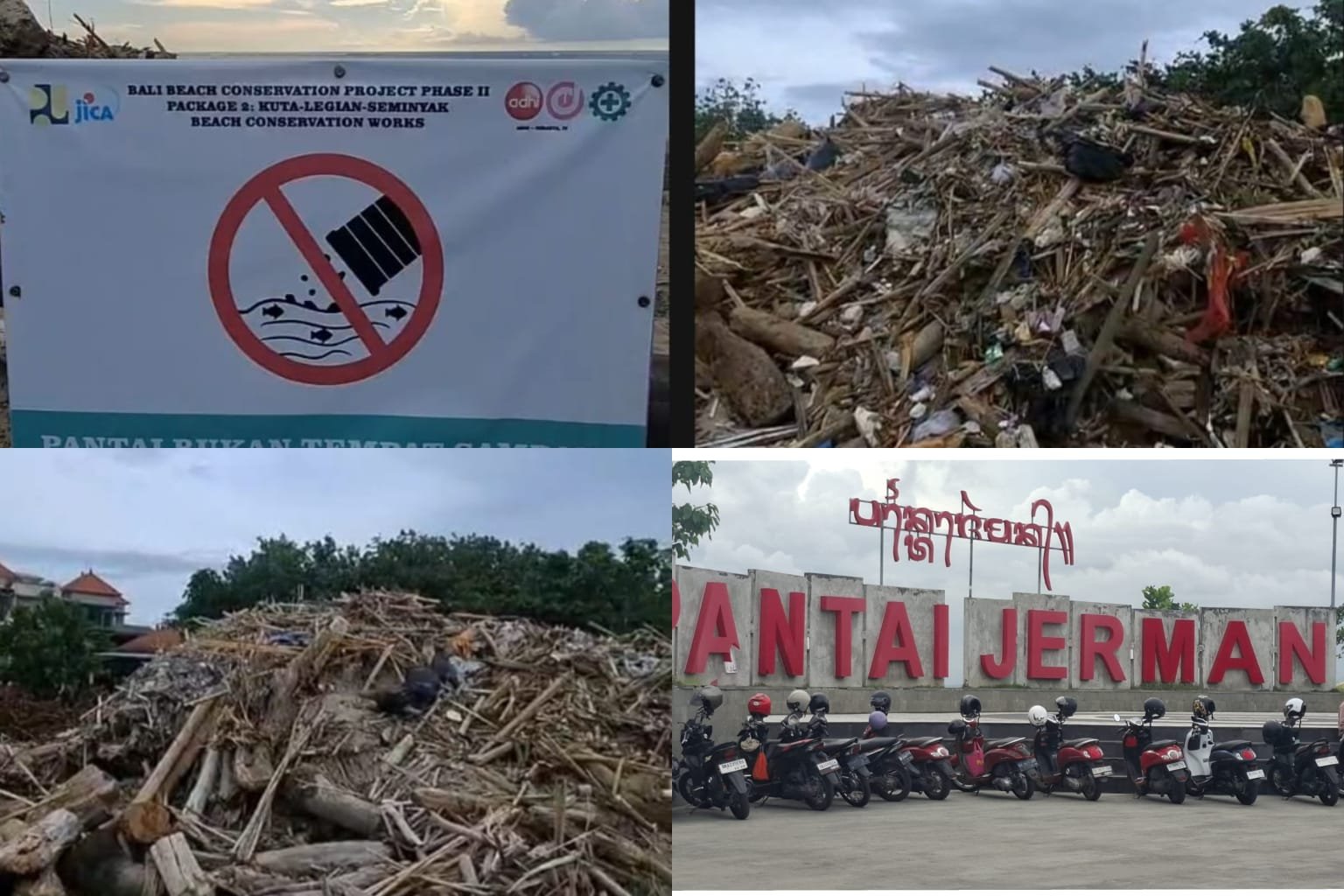
BALINEWSID.COM, BADUNG – The ongoing accumulation of waste along Jerman Beach in Kuta remains unresolved, raising serious concerns over its impact on Bali’s tourism image. Since 2025 through April 2026, large volumes of marine debris—dominated by organic waste and plastic—have continued to pile up along the shoreline, disrupting the area’s aesthetics and visitor comfort.
The issue has intensified during the west monsoon season, which routinely carries ocean waste to Bali’s coasts. As a result, Jerman Beach—once a popular destination for sunset views—now appears dirty and poorly maintained.
The situation has become more complex following the gradual closure policy of the Suwung Regional Landfill (TPA Suwung). Since April 1, 2026, the facility has only accepted residual waste and stopped receiving organic waste. While the policy is part of a broader transition toward source-based waste management, it has not been matched with adequate alternative processing systems on the ground.
This has led to waste accumulation in several areas, including Jerman Beach, prompting public concern over the readiness of local authorities to handle coastal waste issues effectively.
Local businesses are already feeling the impact. Made P, a vendor operating near the beach, reported a decline in tourist visits due to the deteriorating conditions.
“If this continues, tourists may stop coming. We, as small vendors, are directly affected,” he said on Sunday (April 5, 2026).
In addition to visual pollution, foul odors from the waste have begun to spread, especially during hot weather, further reducing the area’s appeal.
Chairperson of the Bali chapter of the Indonesian Online Journalists Association (IWO), Tri Widiyanti Prasetiyo, emphasized that waste management must be addressed comprehensively from upstream to downstream. She warned that restricting landfill intake without adequate supporting systems risks shifting the problem into public spaces, including tourist destinations.
“If not addressed immediately, this situation could damage Bali’s tourism image and worsen environmental impacts,” she stated.
As a long-term solution, the Bali Provincial Government is preparing to develop a Waste-to-Energy (PSEL) facility. The project will be built on a 6-hectare site owned by PT Pelindo, with a capacity to process up to 1,200 tons of waste per day from Denpasar and Badung.
Construction is scheduled to begin in June 2026, with completion targeted by the end of 2027. Initial operations are expected to start in 2028 under Zhejiang Weiming Environment Protection Co., Ltd.
Bali Governor Wayan Koster reaffirmed that the closure of TPA Suwung will proceed as planned, with a transition period lasting until August 31, 2026, before full closure. He added that the current waste issues are being handled by the Environmental and Forestry Agency.
Regarding the PSEL project, which was previously delayed in 2021, Koster clarified that it has not been canceled but postponed due to the absence of a third-party partner at the time.
Amid the ongoing challenges, Bali’s waste problem is increasingly seen as a “ticking time bomb.” There are also circulating reports that the Suwung landfill site has been earmarked for future commercial development.
Without swift and concrete action, the mounting waste at Jerman Beach risks becoming a serious threat to Bali’s global tourism reputation.








Discussion (0)
No comments yet.