
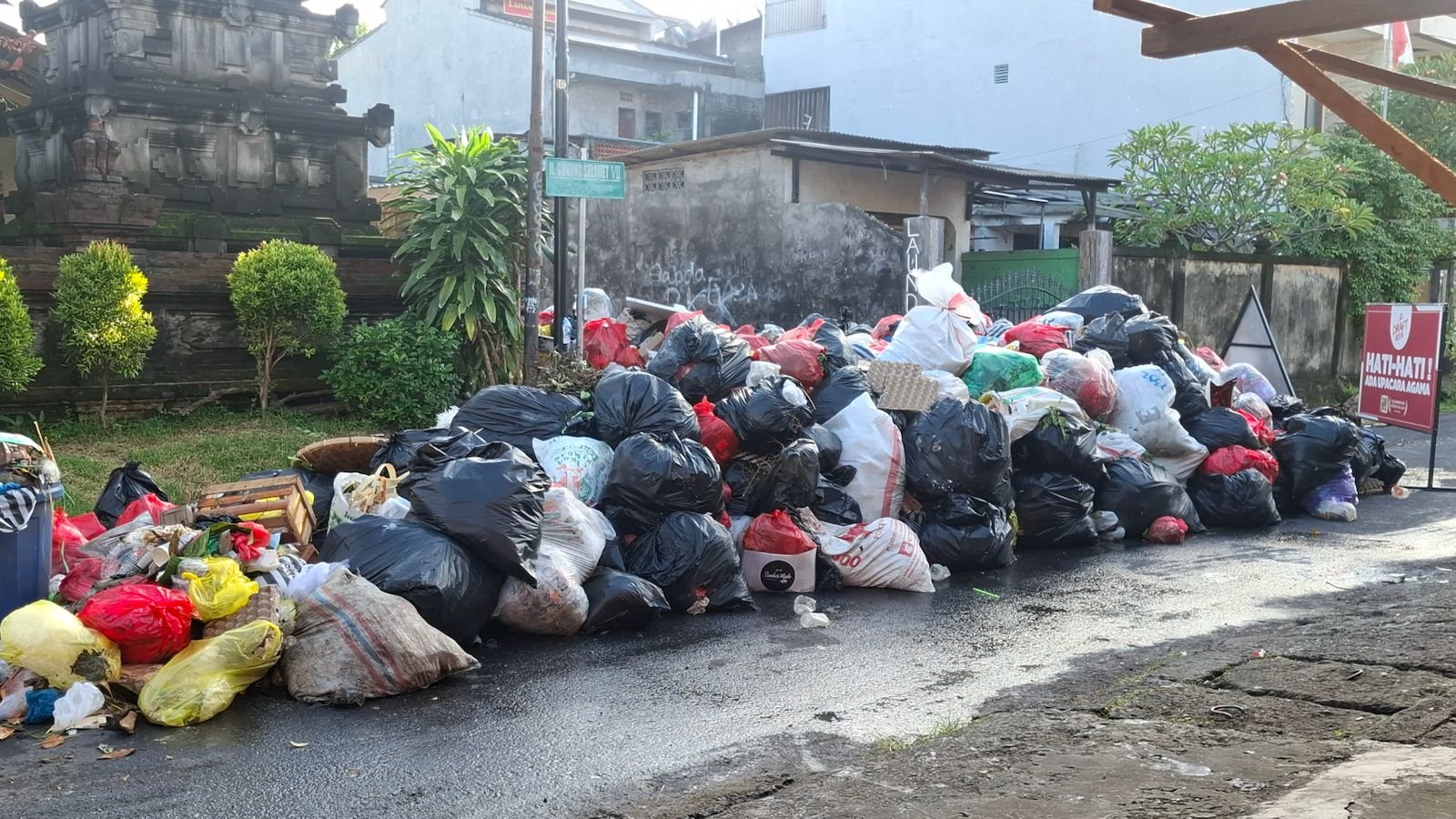
BALINEWSID.COM, DENPASAR – Waste management in Bali continues to face significant challenges as the closure of the Suwung Landfill (TPA Suwung) approaches, leaving many residents in Denpasar uncertain about where to dispose of their household waste.
With the government set to stop accepting organic waste at TPA Suwung, confusion has begun to spread among residents, particularly those who lack the space to process organic waste independently. The policy has sparked concern, with some residents describing the situation as overwhelming.
Although some households have started separating their waste, reports from the field indicate that sorted waste is often mixed again by collection workers during transport. This has raised questions over who is responsible for educating waste handlers who interact directly with the community.
Field findings by local media reveal that several waste collectors admitted they had never received proper guidance or socialization regarding the separation of organic and non-organic waste during collection.
Conditions across Denpasar vary widely. In areas such as Tegal Harum and Tegal Kertha, community-based waste management efforts have begun, including the construction of modern teba facilities and the distribution of composters to residents.
However, challenges remain. Traditional village leader (Kelian Adat) of Tegal Harum, Putu J, said his community is still struggling to manage organic waste.
“We hope the government will immediately facilitate the Waste-to-Energy (PSEL) project that has been promised, so this waste problem in Denpasar does not drag on,” he said.
He acknowledged that the Denpasar city government has provided support such as compost bins and composters, but noted that some residents are still reluctant to separate their waste.
In contrast, waste management in the Marlboro and Pura Demak areas of West Denpasar remains disorganized. Observations show a lack of facilities such as composters and modern teba, while several vacant plots of land have turned into illegal dumping sites, producing foul odors.
Issues also persist in waste transportation. A waste collector identified as Rendy said he had not received any directives regarding mandatory waste separation.
“For now, there is none,” he said when contacted. Mayor of Denpasar, I Gusti Ngurah Jaya Negara previously stated that organic waste could temporarily be sent to the Kertalangu Waste Processing Site (TPST). However, concerns remain about whether the facility can handle the city’s daily organic waste volume, which reaches around 1,100 tons.
“We have prepared TPST for organic waste. If residents have already separated it, we will collect it and bring it to TPST Kertalangu,” he said, adding that the facility is open to community-based waste management groups.
Meanwhile, Bali Governor Wayan Koster has confirmed that the closure of TPA Suwung will proceed as scheduled.
“TPA Suwung will definitely be fully closed. There will be no change in schedule,” he stressed.
The closure will be carried out in stages, beginning with the cessation of organic waste intake on March 31, 2026. Starting April 1, the landfill will only accept residual waste, with organic waste required to be managed at the source through community-based systems.
The government has set August 31, 2026, as the deadline for the complete closure of TPA Suwung.
As a long-term solution, the Bali provincial government is preparing the construction of a Waste-to-Energy (PSEL) facility on a 6-hectare site owned by PT Pelindo. The plant is expected to process around 1,200 tons of waste per day from Denpasar and Badung.
Construction is scheduled to begin in June 2026 and run through the end of 2027, with Zhejiang Weiming Environment Protection Co., Ltd. as the operator. The facility is targeted to begin operations in early 2028.


Discussion (0)
No comments yet.